- Follow On:
- [email protected]
- +918655715397
- Thane west, Maharashtra - 400604
New Delhi, September 16, 2026: The National Payments Corporation of India (NPCI) has introduced a revised Merchant Discount Rate (MDR) framework for select UPI Person-to-Merchant (P2M) transactions, with the new structure coming into effect from October 15, 2026.
Merchant Discount Rate (MDR) is a fee associated with processing certain digital payment transactions. It is paid within the merchant payment ecosystem and is distributed among relevant participants such as banks and payment service providers.
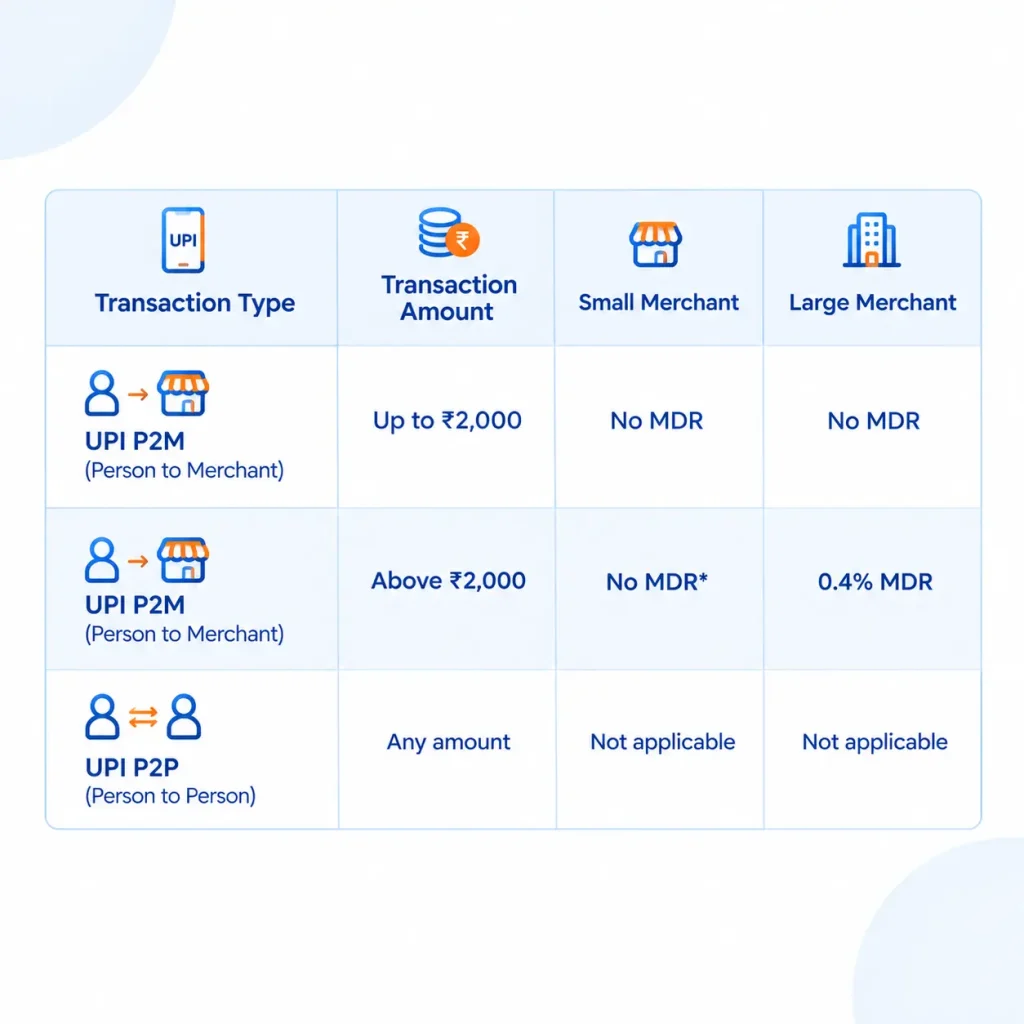
From October 15, 2026, the standard MDR for specified P2M UPI transactions above ₹2,000 will be 0.4%.
For transactions of ₹75,000 and above, the MDR will be capped at ₹300 per transaction. Therefore, the MDR does not continue increasing proportionately beyond the applicable cap.
UPI payments made to merchants up to ₹2,000 will continue to remain free of MDR.
This means everyday low-value purchases using UPI will generally remain outside the new MDR framework. According to the government, around 96% of merchant transactions will remain unaffected because they are either below the ₹2,000 threshold or covered by zero-MDR provisions for small merchants.
The revised framework does not introduce MDR for Person-to-Person (P2P) UPI transfers.
Individuals can continue to send or receive money through UPI without MDR, irrespective of the amount transferred. The government has also clarified that individuals will not face monthly quotas or additional platform charges under this framework.
NPCI has specifically provided protection for eligible small merchants under the Person-to-Person-Merchant (P2PM) framework.
Small merchants receiving up to ₹1 lakh per month through UPI QR codes directly into their accounts can continue to receive UPI payments without MDR. This includes eligible local vendors, neighbourhood shops and other small businesses.
Importantly, an individual payment above ₹2,000 does not automatically make an eligible P2PM merchant liable for MDR. The merchant’s classification is relevant.
Certain sectors will have a separate flat MDR structure instead of the standard 0.4% rate.
For specified categories such as railways, telecommunications, insurance, fuel and certain agricultural-input transactions, payments above ₹2,000 will attract a flat ₹5 MDR per transaction.
The separate structure is intended to provide greater cost certainty for sectors where payment margins can be relatively narrow.
The framework also provides a separate MDR rate for certain capital-market transactions.
Payments involving categories such as mutual funds, securities, stockbrokers and dealers will attract an MDR of 0.02%, capped at ₹300 per transaction.
The new framework is particularly relevant for businesses that receive a significant number of higher-value UPI payments.
Businesses should review their UPI payment arrangements before the new framework takes effect. Finance and accounting teams may need to consider the impact on payment reconciliation, transaction costs and accounting records.
No. The 0.4% MDR is a merchant-side payment ecosystem charge, not a general consumer UPI fee.
The government has clarified that banks should ensure merchants do not pass MDR charges on to customers. UPI application providers are also prohibited from imposing platform fees or hidden charges under the framework.
Therefore, consumers should distinguish between the MDR applicable within the merchant payment ecosystem and a direct charge for making a UPI payment.
The revised framework will take effect from October 15, 2026.
The implementation gives banks, payment service providers, UPI applications and businesses time to prepare their systems and processes for the revised MDR structure.
Businesses that regularly accept UPI payments should consider:
For finance teams, accurate reconciliation will become particularly important where UPI collections are large or involve multiple payment channels.
The new UPI MDR framework represents a change in the treatment of specified higher-value merchant transactions, but it does not introduce a general charge on individuals using UPI.
P2P transactions remain free, merchant payments up to ₹2,000 remain free, and eligible small merchants continue to receive zero-MDR treatment. The standard 0.4% MDR applies to specified P2M transactions above ₹2,000, with special rates and exemptions for certain categories.
For businesses, the key step is to understand their merchant category, UPI transaction profile and applicable MDR structure and prepare their payment reconciliation and accounting processes before October 15, 2026.
Subscribe to our newsletter and stay updated.