- Follow On:
- [email protected]
- +918655715397
- Thane west, Maharashtra - 400604

A major change to India’s provident fund framework is affecting employers, payroll teams and eligible employees in 2026.
The government has increased the statutory wage ceiling for mandatory EPFO coverage from ₹15,000 to ₹25,000 per month, effective 17 September 2026. The change is expected to bring more than 51 lakh additional employees into mandatory EPFO coverage, subject to the applicable eligibility conditions.
The revision has direct implications for PF contributions, payroll processing, employee take-home salary, employer costs and CTC calculations.
For businesses, however, it is important not to interpret this as a blanket rule saying that every employee’s PF contribution will automatically become ₹3,000 or that every employee’s salary will fall.
The actual impact depends on the employee’s applicable PF wage, existing EPF membership, contribution arrangement and the applicable statutory provisions.
The government says the revised ceiling is intended to expand social-security coverage for employees earning between ₹15,000 and ₹25,000 who were previously outside mandatory EPF coverage solely because their wages exceeded the old ceiling.
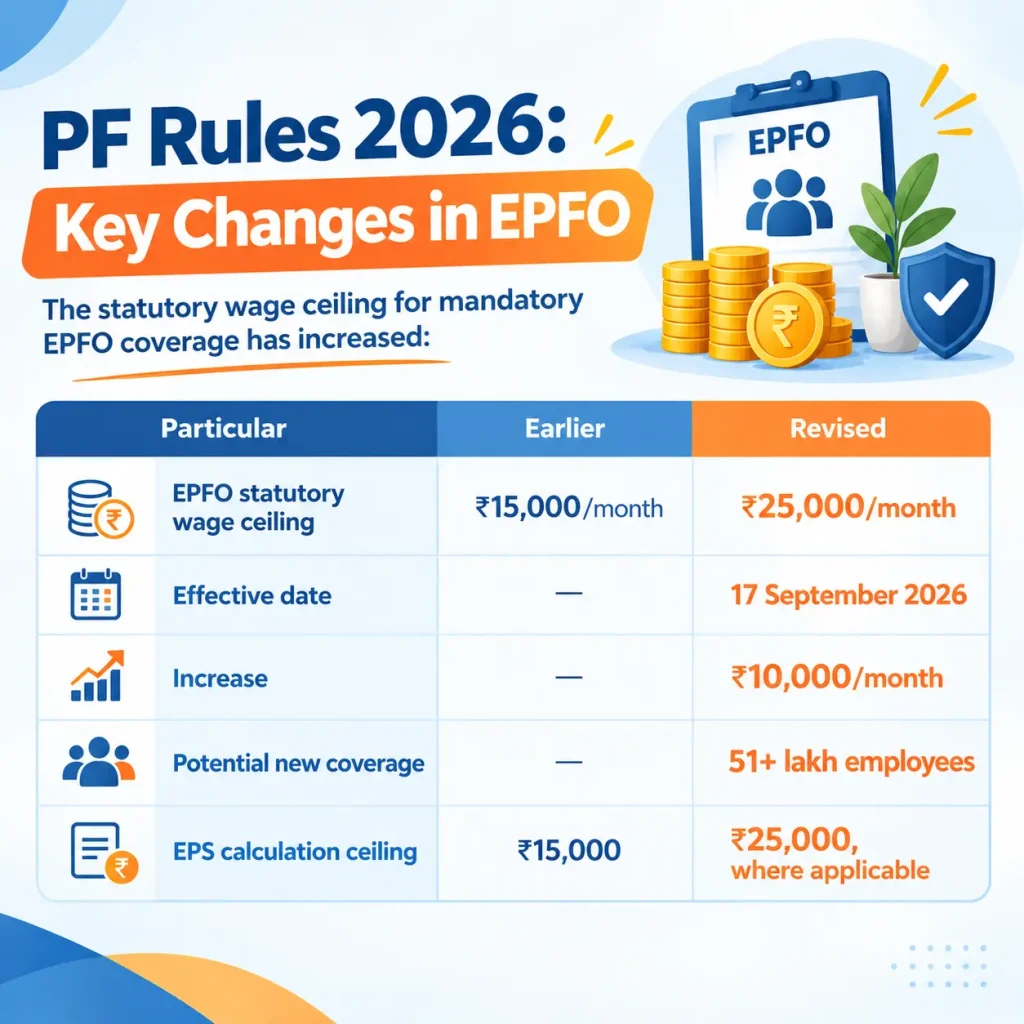
The most significant impact is on employees who fall into the ₹15,000–₹25,000 monthly wage band and were previously not enrolled in EPF because their wages were above the old ₹15,000 threshold.
Under the revised framework, eligible employees in this range can come under mandatory EPFO coverage, subject to the applicable conditions.
This means businesses should not simply look at an employee’s gross salary or CTC.
Payroll teams need to determine the applicable statutory wages for EPF purposes.
No.
This is one of the most important points businesses should understand.
The revised ₹25,000 figure is a statutory wage ceiling, not a compulsory flat PF contribution of ₹3,000 for every employee.
For employees whose PF contribution was previously restricted to the statutory ceiling, the revised ceiling is now ₹25,000 or the actual applicable salary/wages, whichever is lower, subject to the applicable scheme and statutory provisions.
Therefore, payroll teams should assess each employee individually rather than applying a blanket ₹25,000 calculation to the entire workforce.
The standard employee contribution is generally 12% of the applicable EPF wage.
For example, if the applicable PF wage is ₹20,000:
Employee PF contribution = 12% × ₹20,000 = ₹2,400
Previously, if the contribution had been restricted to ₹15,000:
12% × ₹15,000 = ₹1,800
So, where the revised ceiling applies to the employee’s contribution calculation, the employee’s PF deduction could increase.
This can reduce monthly take-home pay in situations where the employee’s own PF contribution increases.
However, this should not be presented as a universal salary cut because the actual payroll treatment depends on the employee’s circumstances and applicable contribution rules.
The employer also has a statutory contribution obligation.
Where contributions are calculated on the revised ceiling, the employer’s contribution can increase as well.
For example, if the applicable PF wage rises from ₹15,000 to ₹25,000:
12% of ₹15,000 = ₹1,800
versus
12% of ₹25,000 = ₹3,000
However, the employer’s contribution is not simply an additional amount that can automatically be deducted from an employee’s salary.
Recent Ministry guidance reported after the wage-ceiling revision has stressed that employers should not reduce employees’ wages or pass the additional statutory employer contribution to employees through CTC restructuring.
Employee PF contribution can affect take-home salary because it is a payroll deduction.
Employer PF contribution is an employer-side statutory cost and should not simply be shifted to the employee by reducing wages.
Businesses should therefore review their salary structures and employment terms carefully rather than automatically changing CTC components.
It can, but not for everyone.
This is where many online reports oversimplify the change.
Suppose an employee’s applicable PF wage was previously ₹15,000 and the employee contribution was ₹1,800 per month.
If the applicable wage for PF calculation becomes ₹20,000:
That additional employee contribution could reduce monthly take-home salary by ₹600, assuming other salary components remain unchanged.
However, the increase also means more money is being accumulated toward the employee’s retirement savings.
So the employee may see:
Lower current take-home → Higher PF accumulation
The exact result depends on the employee’s salary structure and applicable contribution rules.
Businesses should be particularly careful with the CTC impact.
CTC generally includes employer-side statutory contributions and other components. If the employer’s statutory PF contribution increases, the employer may face a higher employment cost where that contribution is borne in addition to existing salary components.
For example, a higher employer PF contribution can increase the employer’s cost for an eligible employee.
But businesses should not automatically reduce the employee’s fixed wages to offset the additional statutory employer contribution. Recent Ministry guidance has specifically addressed this concern.
The change is not limited to EPF.
The government has also revised the wage ceiling relevant to the Employees’ Pension Scheme (EPS).
The revised framework states that, where applicable, the maximum EPS contribution can be calculated at 8.33% of ₹25,000, instead of the earlier ₹15,000 ceiling, subject to the applicable statutory provisions and scheme rules.
This means payroll teams should correctly distinguish between:
Employee EPF contribution → Employer contribution → EPS allocation → EPF balance
Incorrect allocation can create reconciliation and compliance problems later.
The higher wage ceiling also expands the statutory social-security framework covering EPF, EPS and EDLI, subject to the applicable scheme provisions.
However, businesses should not assume that every EDLI benefit amount automatically increases simply because the wage ceiling has increased.
The contribution/wage ceiling and the maximum benefit payable are separate matters.
Therefore, HR and payroll teams should rely on the applicable EPFO provisions rather than calculating employee insurance benefits solely from the new ₹25,000 ceiling.
Although the revised ceiling became effective on 17 September 2026, October is an important implementation month because employers are now moving into regular payroll cycles under the revised framework.
EPFO itself is publishing FAQs concerning the revised ₹15,000-to-₹25,000 wage ceiling, including contribution calculations and transitional compliance requirements.
The September transition also creates an unusual payroll issue because the new ceiling became effective in the middle of the month.
Employers therefore need to ensure their September calculations and subsequent monthly payrolls are handled according to EPFO’s applicable instructions.
Create a payroll report identifying employees who:
Do not use gross CTC alone to determine eligibility.
Check whether your payroll system has been updated for the new ceiling.
Verify:
Employee master → PF wage → Employee contribution → Employer contribution → EPS → EDLI → ECR
An incorrect configuration can result in incorrect deductions and statutory filings.
Finance and HR teams should estimate the additional employer contribution for newly covered employees.
This will help businesses understand the impact on:
Businesses should review whether existing salary structures comply with the revised statutory framework.
Do not make unilateral CTC adjustments simply to recover an increased employer-side statutory contribution.
Employees may see changes in their PF deduction and may therefore notice a difference in take-home salary.
HR should explain:
Why the deduction changed → How PF is calculated → What goes toward retirement savings → Whether the employer contribution changed
Clear communication can prevent confusion and payroll complaints.
Businesses should verify:
The EPFO portal currently highlights FAQs specifically related to the revised wage ceiling.
Subscribe to our newsletter and stay updated.