- Follow On:
- [email protected]
- +918655715397
- Thane west, Maharashtra - 400604

As the July 31, 2026 deadline for filing Income Tax Returns (ITRs) for FY 2025–26 (AY 2026–27) approaches, many taxpayers are wondering whether the government will extend the due date due to increased portal traffic and last-minute filing activity. While discussions around a possible extension continue, there has been no official announcement from the Income Tax Department extending the deadline. Tax experts recommend treating July 31 as the final filing date and completing the return well in advance to avoid penalties, technical issues, and delays.
Despite speculation and requests from various stakeholders, the Income Tax Department has not announced any extension to the July 31 deadline for taxpayers required to file ITR-1 and ITR-2.
Tax professionals advise taxpayers not to rely on rumors of an extension. Filing early helps avoid portal congestion, technical glitches, and last-minute errors.
This year, different filing deadlines have been introduced for various taxpayer categories. Since Forms 3 and 4 have later due dates, experts believe portal traffic may be more manageable compared to previous years.
As filing activity increases closer to the deadline, taxpayers may experience slower portal performance or temporary technical issues. Filing early minimizes these risks.
Missing the due date may result in late filing fees, interest on outstanding taxes, and the loss of certain tax benefits, including the ability to carry forward eligible losses.
Timely ITR filing offers several advantages for both individuals and businesses.
Key benefits include:
Businesses should ensure tax filings are completed within the applicable due dates to avoid penalties and maintain regulatory compliance.
Timely return filing supports accurate financial reporting, tax planning, and cash flow management throughout the financial year.
Maintaining updated financial records, Form 16, AIS, Form 26AS, and supporting documents helps reduce filing errors and speeds up compliance.
Filing before the deadline minimizes the risk of portal issues, incorrect submissions, interest liabilities, and delayed refunds.
Organizations using digital accounting systems, ERP platforms, and automated tax compliance tools are better equipped to meet filing deadlines efficiently.
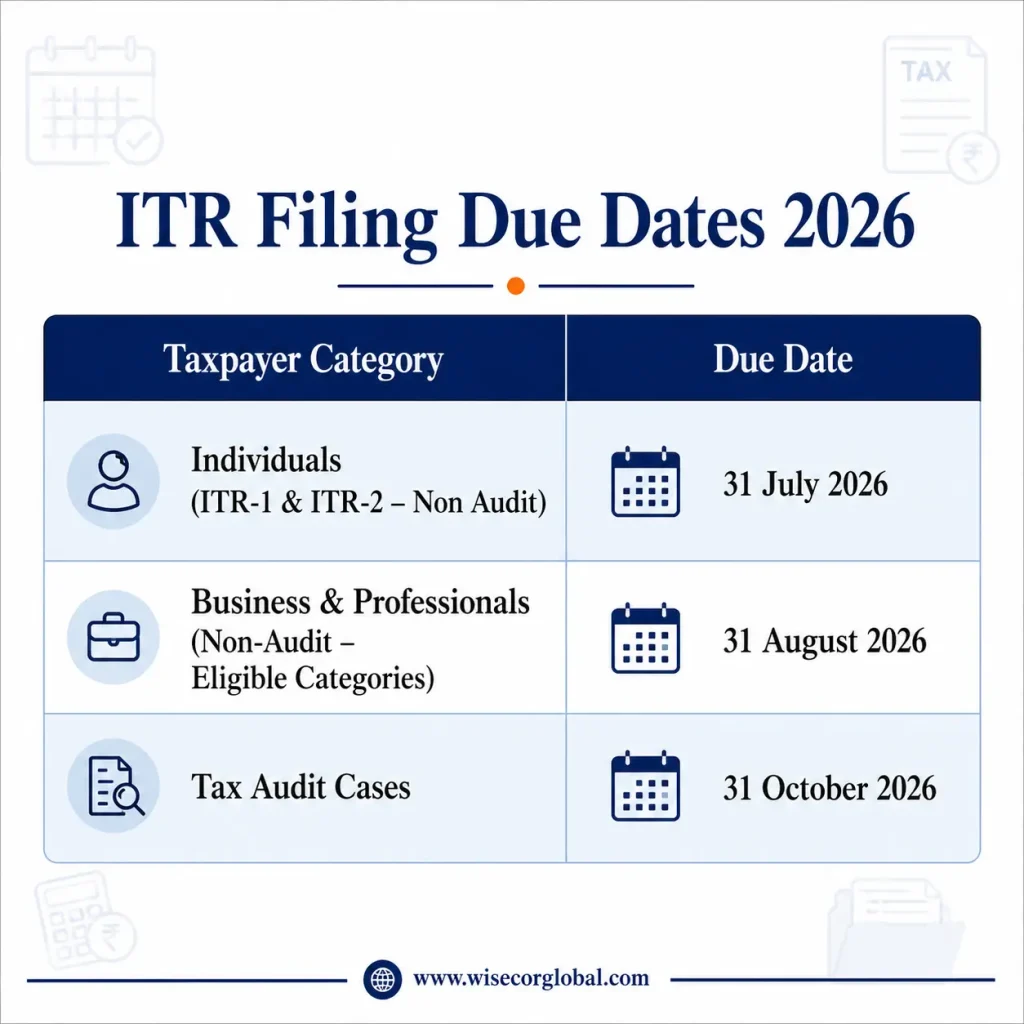
Always verify the applicable due date based on your filing category.
✔ Verify Form 16, AIS and Form 26AS
✔ Select the correct ITR form
✔ Check bank account details
✔ Verify deductions and exemptions
✔ Complete e-verification after filing
✔ Download the ITR acknowledgement
Taxpayers should remain aware of:
As India’s tax ecosystem becomes increasingly digital, timely and accurate tax compliance is more important than ever. Businesses should avoid waiting until the final days of the filing season and instead adopt a proactive approach to tax planning, financial documentation, and statutory compliance.
Organizations that leverage digital accounting, payroll, and compliance solutions can reduce filing risks while improving operational efficiency.
At Wisecor, we help businesses simplify tax compliance through:
✔ Tax Compliance Advisory
✔ Finance & Accounting Outsourcing
✔ Payroll Management Services
✔ GST & Regulatory Compliance
✔ Strategic Financial Consulting
Filing your Income Tax Return on time helps avoid penalties, improves financial discipline, and supports long-term business compliance.
Subscribe to our newsletter and stay updated.