- Follow On:
- [email protected]
- +918655715397
- Thane west, Maharashtra - 400604
The Reserve Bank of India (RBI), under Governor Sanjay Malhotra, announced the Monetary Policy Committee (MPC) decision on 5 August 2026, keeping the repo rate unchanged at 5.25% while maintaining a neutral policy stance. The decision reflects the RBI’s cautious approach amid global uncertainties, inflation risks, and India’s stable economic growth outlook.
For businesses, home loan borrowers, MSMEs, and investors, the latest policy provides clarity on borrowing costs and future monetary policy expectations.
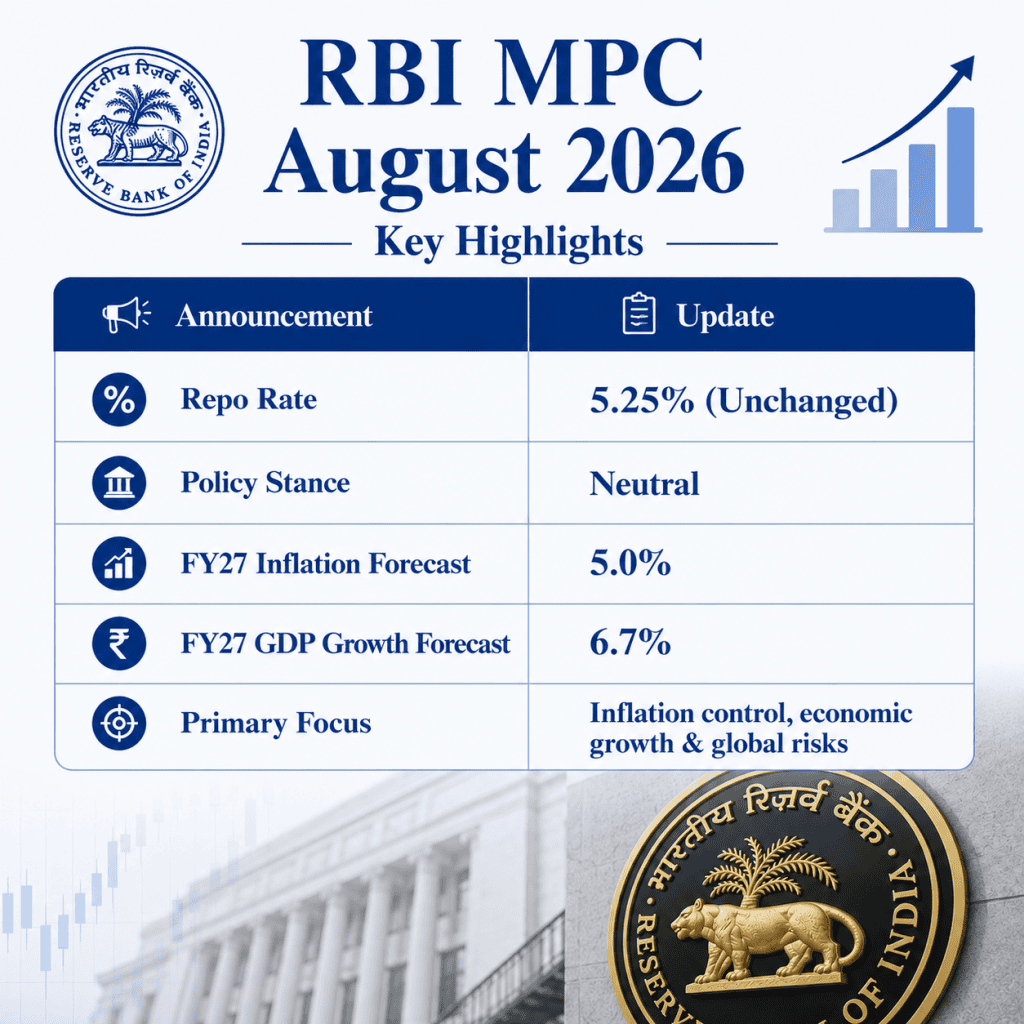
The RBI has kept the benchmark repo rate unchanged at 5.25%. This means banks can continue borrowing funds from the RBI at the same rate, helping maintain stability in lending and borrowing costs.
The MPC retained its neutral stance, allowing flexibility to respond to future economic developments rather than committing to immediate rate hikes or cuts.
The RBI revised its FY27 inflation forecast to 5.0%, indicating improving inflation expectations while continuing to monitor food prices, fuel costs, and global geopolitical developments.
India’s economic growth forecast for FY27 has been raised to 6.7%, supported by strong domestic demand, manufacturing activity, and services sector performance.
The RBI highlighted continued uncertainty due to geopolitical tensions, global trade conditions, and energy prices, emphasizing the need for careful monitoring before making future policy changes.
The latest RBI policy helps:
Companies planning expansion or working capital financing are unlikely to see immediate changes in lending rates.
Stable interest rates help organizations prepare budgets, investments, and cash flow forecasts with greater confidence.
Small and medium enterprises can continue accessing credit without sudden increases in financing costs.
A stable policy environment encourages businesses to continue capital expenditure and expansion plans.
Organizations can make long-term borrowing decisions with reduced uncertainty.
Businesses should continue monitoring:
Stable monetary policy provides businesses with greater confidence for financial planning, expansion, and investment decisions. Organizations should continue reviewing financing strategies, optimizing working capital, and monitoring interest rate movements to remain prepared for future policy changes.
Businesses should:
Professional financial planning helps organizations remain resilient during changing economic cycles.
Subscribe to our newsletter and stay updated.