- Follow On:
- [email protected]
- +918655715397
- Thane west, Maharashtra - 400604

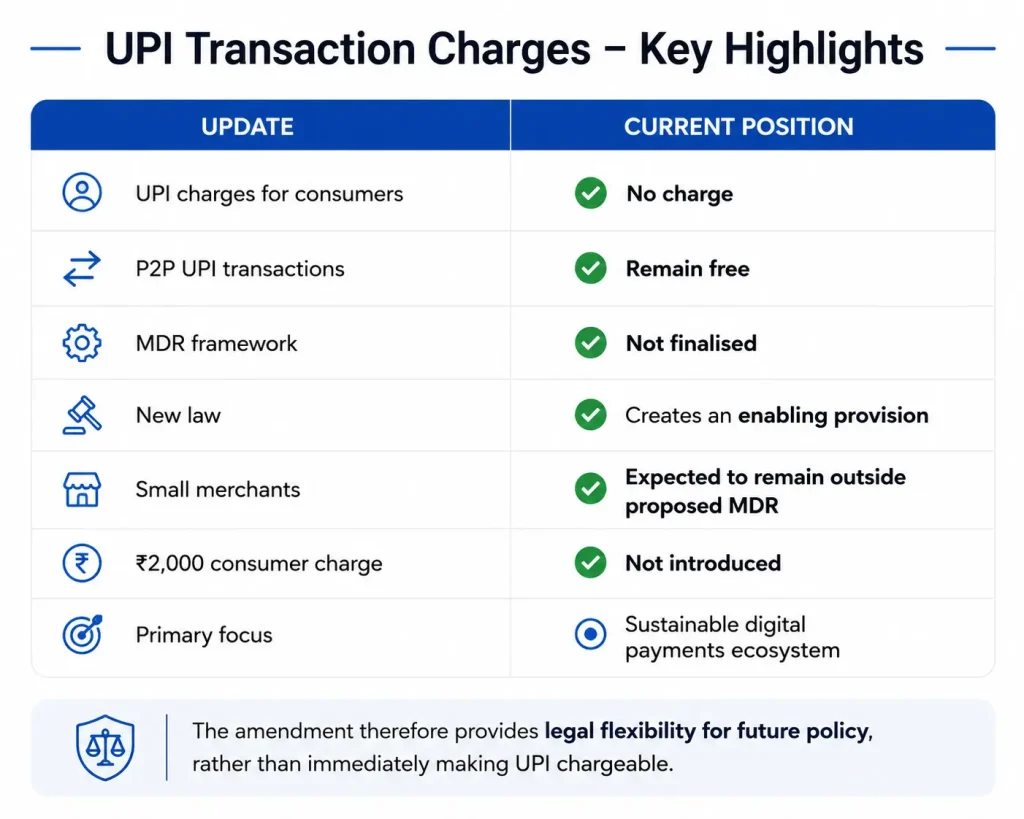
India’s Unified Payments Interface (UPI) remains free for consumers despite recent concerns about possible transaction charges. The Taxation and Other Laws (Amendment) Bill, 2026 has amended the legal framework around electronic payments, creating an enabling provision for a possible Merchant Discount Rate (MDR) in the future. However, the amendment itself does not impose a UPI transaction charge or tax on users. Finance Minister Nirmala Sitharaman has also clarified that no MDR framework has been finalised.
The development is important for consumers, merchants, banks, fintech companies and businesses that rely heavily on UPI for digital collections and payments
Finance Minister Nirmala Sitharaman has clarified that consumers will not be charged for making UPI payments. Person-to-person transactions will continue to remain free.
The new provision should therefore not be interpreted as an immediate introduction of UPI charges for customers.
The Taxation and Other Laws (Amendment) Bill, 2026 amends the Payment and Settlement Systems Act, 2007. The change creates a legal framework that could allow charges associated with certain electronic payment transactions to be specified in the future.
However, the government has not finalised an MDR framework.
Merchant Discount Rate (MDR) is a fee associated with processing digital payments. It is generally paid by the merchant to the acquiring bank, payment service provider or other participants involved in processing the transaction.
UPI currently operates without MDR for standard transactions, following the government’s zero-MDR policy.
The Finance Minister has said that small traders such as vegetable sellers, tea vendors and hawkers will not be covered under the proposed MDR framework. This is intended to protect small businesses that depend on low-cost digital payments.
There has been considerable discussion around UPI transactions above ₹2,000. However, the government has not introduced a ₹2,000-based charge for consumers.
The current development is about creating an enabling legal framework—not introducing an automatic charge on UPI payments above a particular amount.
UPI has become a critical part of India’s digital payment infrastructure. As of June 2026, around 55.49 crore users were onboarded on UPI. UPI processed 24,161.69 crore transactions worth ₹314.23 lakh crore during FY 2025-26, according to government data.
With transaction volumes continuing to expand, the sustainability of the UPI ecosystem has become an important policy discussion.
The key considerations include:
Businesses do not need to start charging customers for UPI payments because of the new amendment. The government has clearly stated that UPI users will not face transaction charges under the current framework.
While no MDR framework has been finalised, larger businesses should monitor future government and regulatory notifications that may determine whether MDR applies to specific categories of transactions.
If an MDR framework is introduced in the future, businesses may need to review their digital payment costs, payment-provider agreements and transaction economics.
Small merchants have received reassurance that they will not be covered by the proposed MDR framework. This could help preserve the affordability of UPI for small businesses.
Businesses using UPI extensively should keep their finance and compliance teams updated on notifications, MDR rules and payment-system changes before making changes to pricing or payment policies.
UPI continues to be an important collection and payment channel. Businesses should maintain proper reconciliation, transaction monitoring and payment documentation as digital volumes increase.
For regular UPI users:
The UPI ecosystem will need to balance several factors going forward:
A parliamentary committee has also highlighted the financial sustainability challenge: UPI’s operating cost was reported at around ₹20,700 crore, against a government allocation of ₹2,000 crore, prompting discussion around a more sustainable revenue model.
The latest UPI development highlights the growing importance of balancing digital-payment accessibility with ecosystem sustainability.
For businesses, the immediate takeaway is simple: there is no new UPI charge for customers today, but companies should continue monitoring regulatory developments around MDR.
Businesses with high digital-payment volumes should also review payment reconciliation, transaction reporting, cash-flow visibility and payment-processing costs as the regulatory framework evolves.
At Wisecor, we help businesses stay prepared for changing financial and regulatory requirements through:
Keeping financial processes updated with regulatory changes can help businesses reduce compliance risks and make better financial decisions.
Subscribe to our newsletter and stay updated.