- Follow On:
- [email protected]
- +918655715397
- Thane west, Maharashtra - 400604
In reality, payroll involves much more than transferring money to employees. Businesses must account for attendance, leave, salary components, deductions, tax, statutory contributions, records and reporting. That is where the difference between salary processing and payroll management becomes important.
Salary processing generally focuses on calculating and paying employee salaries for a particular payroll cycle. Payroll management takes a broader view. It covers the processes, controls, records, compliance activities and ongoing administration required to run payroll properly.
For businesses in India, this distinction matters because payroll can involve income-tax deductions, EPF, ESI and other applicable employment-related requirements. For example, the Income Tax Department states that employers deduct TDS from salary and issue Form 16 to employees, while EPFO provides employers with online facilities for monthly ECR filing and contribution payments.
So, salary processing vs payroll management is not simply a difference in terminology. The scope is different.
Salary processing is the activity of calculating an employee’s payable salary for a specific period and completing the salary payment cycle.
It starts with payroll inputs such as:
The payroll team then performs salary calculation, checks the results and prepares the final payroll.
A simple example makes this easier.
Suppose an employee has a fixed monthly salary but also has unpaid leave, variable pay and applicable deductions during the month. The salary processing team must incorporate those inputs before arriving at the amount payable.
That answers how does salary processing work: collect accurate inputs → calculate earnings and deductions → verify payroll → generate salary statements/payments → complete applicable reporting and records.
The exact calculation depends on the employee’s compensation structure and applicable rules.
Payroll management has a wider scope than one salary calculation cycle.
So, what does payroll management include? It can include the systems and processes used to manage employee payroll information, payroll inputs, calculations, deductions, statutory compliance, reporting, records and controls.
A well-managed payroll function may cover:
The scope can vary depending on the organisation, employee strength, locations and applicable laws.
For example, employers handling salary TDS have reporting responsibilities under the income-tax framework. The Income Tax Department’s current guidance also notes that salary TDS rules changed with the transition to the Income Tax Act, 2025 for salary payments from April 2026 onward.
In other words, payroll management is not simply “doing payroll every month.” It is about keeping the entire payroll function controlled and organised.
The difference between payroll processing and payroll management mainly comes down to scope.
Payroll processing is usually the execution of the payroll cycle. Payroll management covers the broader administration and control of that function.
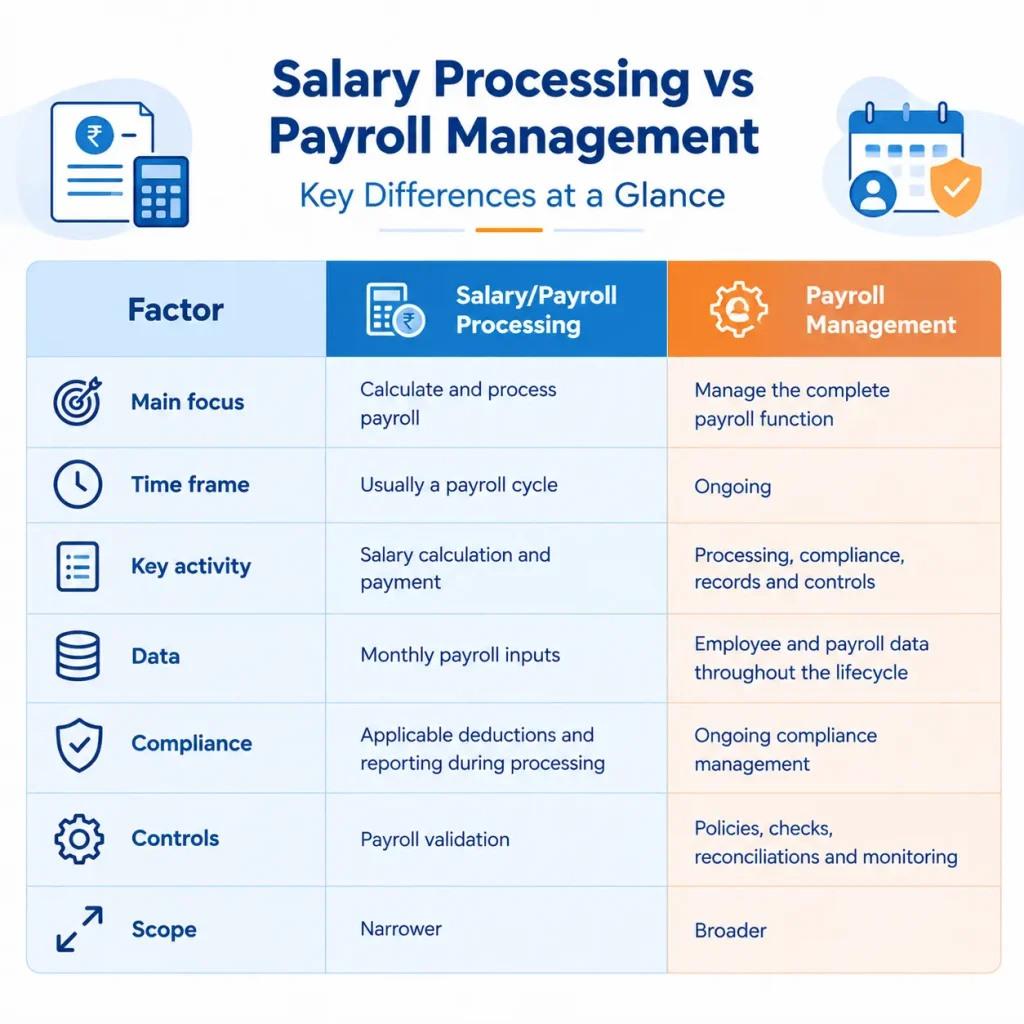
This is why the salary processing vs payroll management difference becomes more noticeable as a business grows.
A small business may handle most payroll activities within one process. A larger organisation may need separate responsibilities for payroll operations, HR inputs, finance checks, compliance and reporting.
The payroll management process in India typically begins before the salary calculation itself.
The business first maintains employee information and payroll inputs. HR, managers and employees may contribute information relating to attendance, leave, new hires, exits, salary changes and variable compensation.
The payroll team then validates those inputs and performs the monthly payroll calculation.
Depending on applicability, payroll may also involve deductions and contributions connected with tax and social-security requirements.
For example, EPFO provides an online ECR system for employers to submit monthly payroll-related contribution information and make payments.
ESIC also requires employers covered by the scheme to handle employee-wise wage and contribution information through its online system.
This means the payroll management process in India needs both accurate payroll data and appropriate compliance controls.
Important: Payroll requirements can differ based on employee category, establishment, location and applicable legislation. Businesses should verify current requirements rather than relying on a generic payroll checklist.
The exact workflow differs between organisations, but a practical payroll cycle generally follows this sequence:
1. Collect payroll inputs
Gather attendance, leave, new-joiner, exit, salary revision and variable-pay information.
2. Validate the data
Check unusual changes, missing information and employee master-data errors before calculation.
3. Perform salary calculation
Calculate earnings, applicable deductions and net salary.
4. Apply applicable compliance requirements
Calculate and process applicable tax and statutory contributions.
5. Review and reconcile
Compare payroll outputs with relevant records and investigate unusual differences.
6. Approve payroll
Authorised personnel review the payroll before payment.
7. Process salary payments
Release employee payments through the organisation’s approved payment process.
8. Complete records and reporting
Maintain payroll records and complete applicable statutory or tax reporting.
This approach creates an important distinction: salary processing is one part of payroll management, not the whole function.
The salary calculation and payroll management difference becomes clear when we look at the level of responsibility.
Salary calculation answers:
“How much should this employee receive for this payroll period?”
Payroll management asks broader questions:
“Is the employee data correct?”
“Were the payroll inputs approved?”
“Were applicable deductions handled correctly?”
“Were statutory obligations completed?”
“Can we reconcile the payroll?”
“Are payroll records accurate and secure?”
Salary calculation is therefore a specific payroll activity, while payroll management is an ongoing business process.
That distinction can prevent a common misunderstanding: buying or using payroll software does not automatically mean the business has effective payroll management. Technology can automate calculations, but businesses still need appropriate inputs, review procedures, controls and compliance oversight.
The answer to how does salary processing work is straightforward in principle but more complicated in practice.
Payroll errors often begin with incorrect or incomplete inputs rather than the mathematical calculation itself.
Some common salary processing mistakes include:
The risk increases when teams depend heavily on spreadsheets, email approvals and manual data transfers.
This does not mean manual payroll is always wrong. It means the business needs clear controls around every manual step.
The problems with manual payroll processing usually appear when employee numbers, locations or salary structures increase.
A process that works comfortably for a small team can become difficult to control when payroll inputs multiply.
Common challenges include:
For growing organisations, these issues can turn payroll day into a monthly detective exercise.
The better approach is not simply “automate everything.” Businesses should first map the payroll workflow, identify repetitive or error-prone steps, establish approval controls and then decide where technology or specialist support can add value.
Businesses asking how to reduce payroll processing errors should focus on process controls rather than relying only on software.
A practical approach includes:
Standardise payroll inputs: Use defined formats and deadlines for HR, attendance and variable-pay information.
Create approval controls: Salary changes, incentives and exceptional payments should go through appropriate approval.
Reconcile before payment: Review payroll totals and investigate unusual movements before releasing salaries.
Maintain employee records: Keep employee master data current and restrict unnecessary changes.
Separate responsibilities: Where practical, avoid giving one person complete control over input, processing, approval and payment.
Review compliance requirements regularly: Tax and employment-related requirements can change, so payroll processes should not rely on outdated assumptions.
For example, the Income Tax Department currently provides specific guidance for employer salary TDS, including quarterly reporting and Form 16 requirements.
The payroll management challenges for growing businesses usually increase with complexity rather than simply employee numbers.
A company may add multiple locations, different salary structures, variable compensation, new HR policies or additional compliance requirements. Each change creates more payroll inputs to control.
Growing businesses should therefore ask:
At this stage, businesses may consider technology, process redesign or payroll processing services to improve consistency.
Outsourcing does not remove management responsibility. The business still needs clear ownership, approvals, data access controls and oversight.
The answer is: most businesses need both, but they serve different purposes.
Salary processing handles the actual payroll cycle. Payroll management provides the broader framework around that cycle, including employee data, controls, compliance, records, reporting and ongoing administration.
For a small business with straightforward payroll, these activities may sit with the same person or team.
As the organisation grows, separating responsibilities and introducing stronger processes can become increasingly useful. Businesses may also evaluate payroll processing services or broader payroll outsourcing when internal teams spend too much time on repetitive payroll administration or struggle with compliance complexity.
The objective should not be to outsource simply because outsourcing is available. The objective should be accurate, timely, controlled and compliant payroll.
After all, employees may forgive a boring payslip. They are much less forgiving when the number on it is wrong.
No. Salary processing focuses mainly on calculating and processing employee salaries for a payroll cycle. Payroll management covers the broader administration, controls, records, reporting and compliance activities surrounding payroll.
Payroll management can include employee payroll data, salary processing, deductions, applicable tax and statutory requirements, reconciliations, reporting, records and payroll controls.
Payroll processing is generally the execution of the payroll cycle, while payroll management covers the wider ongoing management of the payroll function.
Businesses can reduce errors by standardising payroll inputs, maintaining accurate employee records, introducing approval controls, reconciling payroll before payment and regularly reviewing applicable compliance requirements.
It can be considered when payroll becomes time-consuming, complex or difficult to manage internally. Businesses should assess factors such as employee strength, locations, payroll complexity, internal expertise, data security and compliance requirements before choosing an outsourcing model.
Payroll management can include applicable payroll compliance activities. The exact requirements depend on the business, employees, locations and laws that apply.
Not completely. Software can automate calculations, workflows and records, but businesses still need accurate inputs, appropriate controls, approvals, reviews and compliance oversight.
A business may consider payroll processing services when payroll consumes significant internal time, manual errors become difficult to control, payroll complexity increases or the business needs additional operational support.
Understanding salary processing vs payroll management helps businesses identify what their payroll function actually needs.
Salary processing answers the immediate question of how much employees should be paid. Payroll management goes further by managing the information, processes, controls, compliance and records that support accurate payroll.
For growing businesses, the difference matters. A reliable payroll function is not just about getting salary calculations right. It is about building a process that remains accurate, controlled and manageable as the organisation changes.
Subscribe to our newsletter and stay updated.