AP vs AR Outsourcing: Which Finance Process Should You Outsource First?
AP vs AR Outsourcing — Which Should You Choose?
Managing accounts payable and accounts receivable efficiently is essential for maintaining healthy cash flow and accurate financial reporting. However, as businesses grow, these processes can become increasingly time-consuming for internal finance teams.
This is where AP vs AR outsourcing becomes an important business decision. You can outsource both functions, but the right starting point depends on your biggest operational challenge.
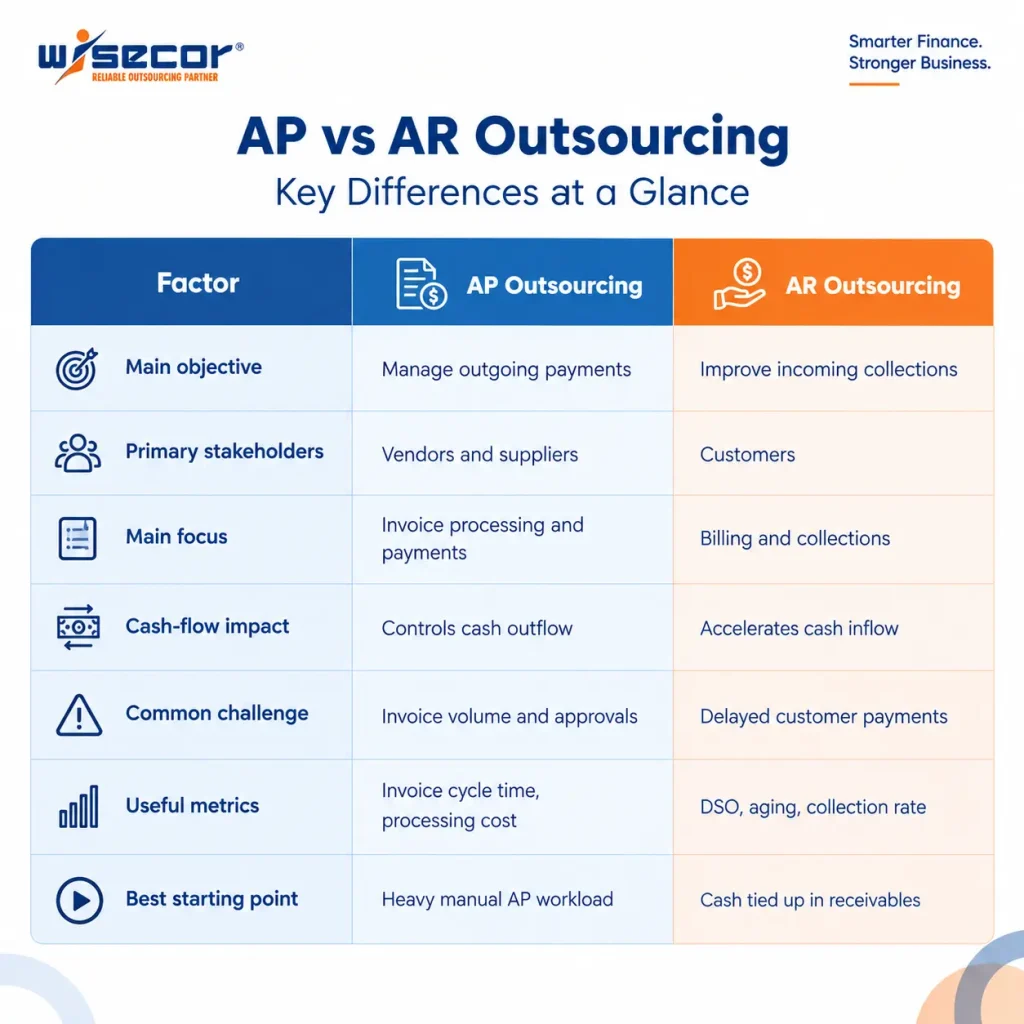
Accounts Payable (AP) focuses on money your business needs to pay, while Accounts Receivable (AR) focuses on money your business needs to collect. Although both are part of finance operations, they affect the business differently.
If your finance team spends too much time processing invoices and managing vendor payments, AP outsourcing may provide the quickest improvement. If overdue customer invoices are affecting cash flow, AR outsourcing may deserve priority.
What Is AP Outsourcing?
AP outsourcing involves transferring some or all accounts payable activities to an external finance and accounting service provider.
The outsourced team can support businesses with activities such as:
- Invoice processing and verification
- Purchase order matching
- Vendor statement reconciliation
- Payment preparation
- Payment-status tracking
- Duplicate invoice identification
- AP reporting and documentation
The objective is not simply to process invoices faster. A well-managed AP process should also improve accuracy, visibility, and control over outgoing payments.
For example, if your internal finance team receives hundreds of invoices every month, manually checking, recording, and routing each invoice can consume significant employee time. Outsourcing repetitive AP activities can allow the internal team to focus on higher-value financial responsibilities.
What Is AR Outsourcing?
AR outsourcing involves delegating selected accounts receivable activities to an external finance team.
The process can include:
- Customer invoicing
- Receivables tracking
- Payment follow-ups
- Customer account reconciliation
- Aging analysis
- Dispute coordination
- Collection reporting
- Cash application support
The major difference between AP vs. AR outsourcing is the direction of cash flow.
AP → Managing money going out
AR → Managing money coming in
For businesses experiencing delayed customer payments, an efficient AR process can help improve receivables visibility and support better working capital management.
AP vs AR Outsourcing: Which Process Has the Bigger Impact?
There is no universal answer to which process should be outsourced first. The better approach is to identify the process creating the greatest cost, workload, risk, or cash-flow pressure.
Consider AP outsourcing first if your business has:
- High invoice volumes
- Manual invoice processing
- Frequent payment errors
- Vendor reconciliation issues
- Delayed invoice approvals
- A finance team spending excessive time on routine AP work
AR outsourcing may be the better starting point if you experience:
- Increasing overdue receivables
- Slow customer payments
- Poor visibility into aging invoices
- Frequent billing errors
- Delayed customer reconciliations
- High collection workload
This makes AP vs AR outsourcing a business-priority decision rather than simply an accounting decision.
When Should You Outsource Accounts Payable First?
Businesses often consider AP outsourcing when their finance team is spending too much time on repetitive transaction processing.
For example, a growing company may have a small finance team handling hundreds or thousands of supplier invoices. As transaction volumes increase, manual processing can result in approval delays, duplicate entries and limited visibility over upcoming payments.
AP outsourcing can help create a more structured workflow from invoice receipt through approval, recording, and payment preparation.
It can be particularly useful when the business wants to:
Reduce repetitive finance workload → Standardize AP processes → Improve invoice visibility → Strengthen payment controls.
However, outsourcing AP should not mean handing over control of payments without appropriate safeguards. Approval authority, segregation of duties, access controls, and payment authorization should remain clearly defined.
When Should You Outsource Accounts Receivable First?
AR outsourcing may be a higher priority when your business is profitable on paper, but customers are taking too long to pay.
Consider a company that generates strong sales but has a large amount of outstanding receivables. Its income statement may look healthy, but cash remains tied up with customers.
An outsourced AR team can support activities such as invoice tracking, aging analysis, reconciliation, and structured payment follow-ups.
Businesses should pay particular attention to indicators such as:
- Rising overdue invoices
- Increasing Days Sales Outstanding (DSO)
- Growing receivables aging
- Frequent invoice disputes
- Delayed cash application
- Lack of consistent collection follow-up
In such situations, improving AR may have a more immediate impact on working capital than outsourcing AP.
Should You Outsource AP and AR Together?
For some businesses, outsourcing both functions can create a more integrated finance operation.
However, businesses do not necessarily need to outsource everything at once. A phased approach can be more practical.
Step 1: Identify the process causing the greatest problem.
Step 2: Document the current workflow and responsibilities.
Step 3: Select the AP or AR activities suitable for outsourcing.
Step 4: Establish KPIs and approval controls.
Step 5: Measure performance before expanding the outsourcing scope.
This approach allows management to test the model, measure results, and gradually build a more scalable finance function.
How Do You Decide Whether to Outsource AP or AR First?
The best starting point depends on the problem your finance team is trying to solve. Instead of choosing based only on transaction volume, evaluate workload, cost, risk, and cash-flow impact.
Choose AP outsourcing first when your biggest challenge is:
- High invoice-processing workload
- Delayed approvals and vendor reconciliations
- Manual data entry
- Frequent invoice errors or duplicates
- Finance employees spending too much time on routine AP tasks.
Choose AR outsourcing first when your biggest challenge is:
- Overdue customer payments
- Rising receivables
- Poor collection follow-up
- Billing and reconciliation issues
- Increasing Days Sales Outstanding (DSO)
A simple way to decide is to ask: “Where is the bigger financial or operational leak today?”
What KPIs Should You Track After AP or AR Outsourcing?
Outsourcing should be measured through clear performance indicators rather than simply the number of tasks completed.
For AP, businesses can monitor:
- Invoice processing time
- Invoice exception rate
- Payment accuracy
- Duplicate invoice rate
- Cost per invoice
For AR, useful metrics include:
- Days Sales Outstanding (DSO)
- Collection rate
- Overdue receivables
- Aging of outstanding invoices
- Cash application accuracy
Tracking these metrics helps management determine whether AP vs AR outsourcing is actually improving finance performance.
Frequently Asked Questions
1. What is the difference between AP and AR outsourcing?
AP outsourcing manages vendor invoices and payments, while AR outsourcing focuses on customer billing, collections, and receivables. AP manages outgoing cash; AR helps improve incoming cash.
2. Which is better to outsource first, AP or AR?
It depends on the business. Choose AP outsourcing for heavy invoice-processing workloads and AR outsourcing when delayed customer payments or high receivables are the bigger concern.
3. Is AP outsourcing suitable for small businesses?
Yes. Small businesses can outsource repetitive AP activities to reduce finance workload, improve invoice processing, and access specialized accounting support without expanding their internal team.
4. Can AR outsourcing improve cash flow?
It can help improve receivables management through consistent invoicing, reconciliation, aging analysis, and payment follow-ups. Better AR processes can support faster and more predictable collections.
5. What are the benefits of AP outsourcing?
Key benefits include lower administrative workload, standardized processes, improved invoice visibility, better reconciliation, and stronger payment controls.
6. What are the benefits of AR outsourcing?
AR outsourcing can improve collection follow-up, receivables visibility, customer reconciliation, aging management, and cash-flow monitoring.
7. Can businesses outsource AP and AR together?
Yes. Businesses can outsource both functions when they want an integrated finance operation. A phased approach can also be used, starting with the process creating the greatest business impact.
8. How do I choose an AP and AR outsourcing provider?
Look for a provider with relevant finance expertise, defined processes, strong data controls, clear reporting, and measurable KPIs. The provider should also understand your accounting systems and business requirements.
AP vs AR Outsourcing: Which One Should Your Business Choose?
There is no one-size-fits-all answer to AP vs AR outsourcing. The right decision depends on where your business currently faces the greatest pressure.
If your finance team is overwhelmed by invoices, vendor reconciliations, and payment-related activities, AP outsourcing may be the logical first step.
If cash is getting tied up in unpaid customer invoices, inconsistent collections and receivables management, AR outsourcing may deliver greater value.
For businesses with challenges on both sides, outsourcing AP and AR together can create a more structured finance function while allowing internal teams to focus on analysis, planning and strategic decision-making.
Build a More Efficient Finance Function
Outsourcing does not have to mean giving up control. With clearly defined responsibilities, approval workflows, KPIs and reporting, businesses can outsource routine finance processes while maintaining appropriate oversight.
Wisecor supports businesses with finance and accounting outsourcing, accounts payable, accounts receivable, reconciliation, reporting and other finance operations. The right outsourcing model can help reduce repetitive workload, strengthen processes, and create a more scalable finance function.
Evaluate your AP and AR processes, identify the biggest bottleneck, and outsource the function that can create the most measurable business impact first.