- Follow On:
- [email protected]
- +918655715397
- Thane west, Maharashtra - 400604
A Global Capability Center (GCC) is a team that a foreign company sets up in India to run its own technology, engineering, analytics, finance, and operations work. The parent company owns the work, controls the processes, and keeps its intellectual property. A GCC is an extension of the global business, not a vendor you hire for one project.
India hosts more of these centers than any other country. A 2026 industry report counts 2,117 GCCs operating 3,728 units across India in FY2026. Together they employ about 2.36 million professionals and generated an estimated $98.4 billion in revenue.
This guide explains what a GCC is, how the GCC model works, how the main setup options differ, what functions GCCs handle, and why global companies choose India. It also compares GCCs with outsourcing and subsidiaries, so you can decide which model fits your business.
A GCC in India is a company-owned or company-controlled center that delivers work for the parent organization. It has its own office, its own employees, and its own management structure in India. It reports to headquarters and serves the global business.
The term “Global Capability Center” is the modern name. Earlier, many people called these units “captive centers” or “offshore development centers.” The name changed because the work changed. What began as back-office support now includes product engineering, AI, and research.
Think of a GCC as the India arm of your global team, with the same standards, security rules, and goals as the rest of the company.
Companies usually choose from three GCC model options in India. Each balances control, speed, and risk differently.
Captive model. The company builds and runs the center on its own. It registers the legal entity, leases office space, hires staff, and manages compliance. This model gives full control, but it takes more time and effort to start. It suits deep capability building and long-term innovation.
Build-Operate-Transfer (BOT) model. A partner such as Wisecor, our GCC partner, builds and runs the center for an agreed period. Once the team, processes, and infrastructure are stable, ownership transfers to the company. Legal advisors who review GCC deals note that a third-party provider sets up the unit under a BOT agreement, and the foreign company often needs the provider’s help for a time after the transfer to make the handover smooth.
Hybrid model. The company runs core work in-house and uses a partner for support areas such as recruitment, payroll, or compliance. This suits companies that want control over key work but don’t want to handle every administrative task themselves.
No model is best for every company. A large enterprise with a clear long-term plan may prefer a captive center. A company testing India for the first time may start with BOT to reduce early risk.
A typical GCC has four layers. Understanding them helps you plan the setup.
Legal entity. The center needs a registered presence in India. Depending on the model, this can be a subsidiary, a branch, or an entity run by a partner during the BOT phase. Legal and tax advisors should confirm the right structure for your case.
Leadership and governance. Most GCCs have a country head or site leader in India who reports to a global function head. Governance covers decision rights, reporting lines, and how the India team connects with headquarters.
Teams and functions. Teams are organized around the work, such as engineering, data, finance operations, or cybersecurity. Each team has clear goals and a named owner at the global level.
Infrastructure and compliance. The center needs office space, IT systems, secure networks, data protection controls, and processes for Indian labor and tax rules. A strong GCC structure keeps these pieces aligned from day one.
A well-designed structure makes the center easier to scale. A weak one creates confusion over who decides what, and that slows delivery.
GCCs have moved far beyond basic support. A 2026 industry report finds that complex problem-solving makes up 38.1% of GCC work portfolios. The same report notes that cutting-edge R&D roughly doubled between 2015 and 2026.
Common GCC functions include:
Nearly half of the GCCs set up since FY2021 started with AI as a core focus. That shift is one reason GCCs are now judged on capability, not just cost.
The benefits of a GCC go beyond lower costs, although cost still matters. Here are the most common advantages, along with the evidence behind them.
Access to a large talent pool. India’s engineering and analytics workforce is among the largest in the world. A GCC lets a company hire specialists in areas where local talent is hard to find. The 2.36 million professionals working in India’s GCCs show the depth of the market.
Cost efficiency with control. A GCC can lower operating costs compared with running the same work in high-cost markets. Unlike outsourcing, the parent company keeps direct control over processes, quality, and data. That control is a major reason companies choose this model over vendors.
Capability beyond cost. Many GCCs now lead product and AI work. A 2025 survey of GCC leaders found that 92% say their centers contribute far beyond cost arbitrage. Survey results reflect opinions, so treat this as one data point rather than a universal rule.
Hiring stability in some cities. Attrition varies by location. The same 2025 survey reported attrition of 8% to 12% in Tier 2 cities, compared with 16% to 22% in Tier 1 metros. Companies that want stable teams often look beyond the largest cities.
Scale and flexibility. A GCC can grow as the business grows. The average size of ER&D GCCs rose from about 400 employees in FY2019 to about 500 in FY2024, according to a national industry study. That growth shows how companies expand their India teams over time.
Vendor-reported results. Service providers often publish case studies. One published BOT case study reported an 83% cost reduction and a 65% improvement in work quality over three years. These results come from the provider, so they show what is possible rather than what every company will achieve.
A balanced view matters here. Some analysts question whether all GCCs deliver the productivity and high-value work their owners expect. A June 2026 commentary argues that many centers still fall short on productivity and innovation. A GCC works best when it has a clear purpose, the right talent, and strong governance.
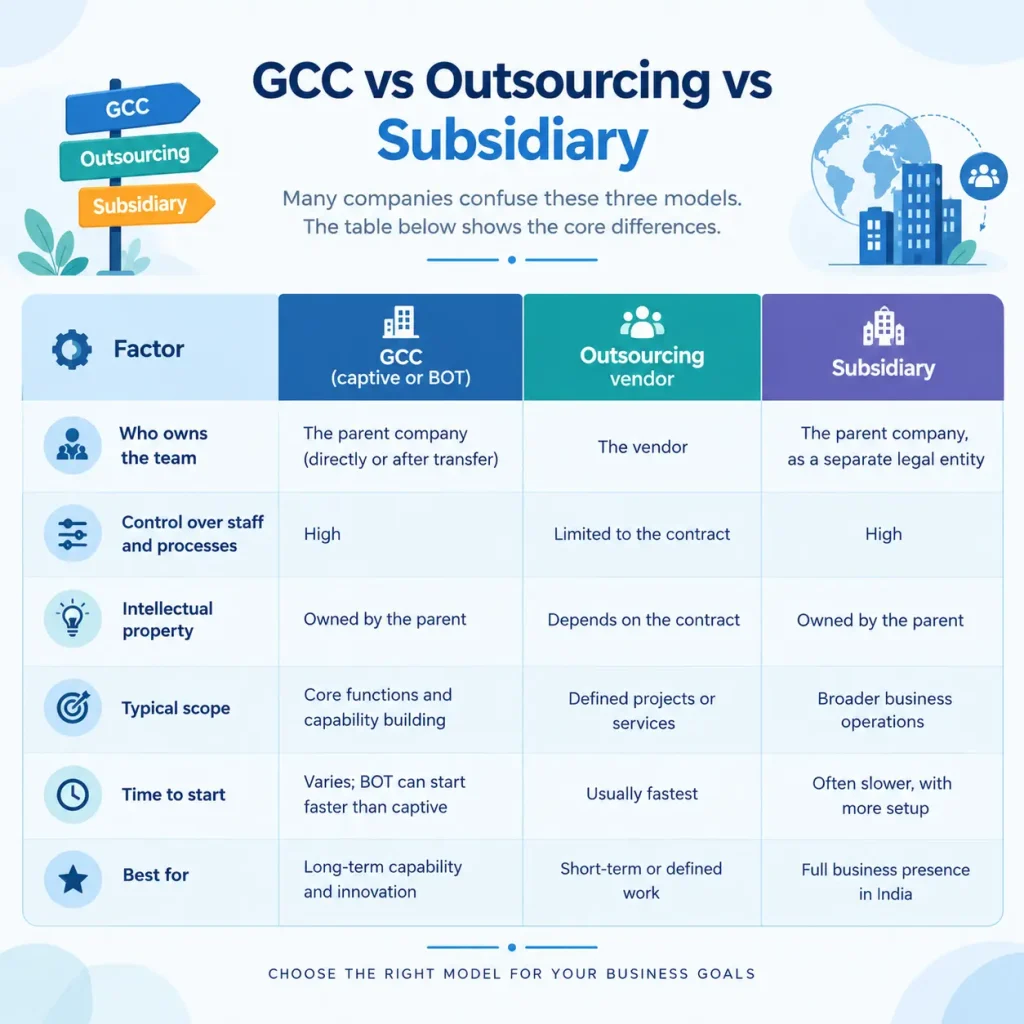
An outsourcing company delivers a service for a fee under a contract. The vendor owns the team, sets the processes, and decides how work gets done. You pay for the output.
A GCC keeps the work inside your organization. Even in a BOT model, the goal is to transfer the center to you. You control the strategy, the roadmap, and the people who deliver it. Outsourcing suits defined projects, while a GCC suits work you want to build into your core.
Companies set up GCCs for a mix of reasons: access to talent, cost control, scale, and the ability to build new capabilities. The reasons often change over time. Many centers begin as cost-saving units and later take on strategic work. The shift toward AI-focused centers shows this trend clearly.
Sector also plays a role. Technology, banking and financial services, healthcare, and retail companies all run GCCs in India. Bengaluru, Hyderabad, and Chennai account for most GCC leasing demand, which shows where the market is concentrated.
A GCC works through a few repeatable steps:
Each stage needs clear ownership. Companies that struggle usually skip the first step and start hiring before they know what the center will do.
Timelines depend on the model, the city, and the number of roles. A small captive center can start within months, while a large center with specialized hiring takes longer. A BOT model often gets teams working sooner, because the partner handles much of the groundwork. Plan for legal setup, leasing, recruitment, IT infrastructure, and compliance from the start.
Yes, if the company has a clear, repeatable function and a long-term plan. Mid-market GCCs have become a distinct segment in the industry. Many mid-sized companies start with one function, such as finance operations or software testing, and expand once the model proves itself.
Wisecor works as a GCC service provider in India, supporting foreign companies from planning through daily operations. Our services cover setup planning, compliance, hiring, and operational support. We help clients choose between captive, BOT, and hybrid models based on their goals. If you’re researching the model, our team can help you compare options for your business. Explore our GCC service page to see how we work
A GCC may not suit a company with a small, one-off project or no plans to manage a team long term. Companies that lack a clear function to move, or that can’t commit to governance and oversight, often do better with a shorter-term vendor arrangement.
Most centers start with a small leadership group, such as a site leader, a finance or HR lead, and technical specialists for the core function. Hiring order depends on the work being moved, so define the first team before you start recruiting.
A GCC needs to meet Indian requirements for company registration, employment, taxation, and data protection. Legal and tax advisors should review the structure before setup, since rules can change and differ by model.
Yes, when the center has strong access controls, secure networks, and clear data protection policies. The parent company should define who can access what, and the contract should state who owns the IP.
Yes, if the company has a clear, repeatable function and a long-term plan. Many mid-sized companies start with one function, such as finance operations or software testing, and expand once the model proves itself.
Cost savings are common but not guaranteed. The result depends on the function, the talent market, the setup model, and how well the center is managed. Companies should compare total costs, including setup, compliance, and management, before deciding.
A GCC gives a foreign company a dedicated team in India that works as part of its global business. It can be built on your own, through a BOT partner, or in a hybrid model, and each option balances control, speed, and risk differently. GCCs now handle far more than support work, including engineering, data, AI, and cybersecurity.
The right model depends on your goals, your timeline, and how much control you want from day one. Start with a clear scope, plan the structure and governance early, and measure results against agreed goals. If you’re exploring a GCC in India, talk to our team about which model fits your business.
Wisecor is a GCC service provider in India, supporting foreign companies with setup planning, compliance, hiring, and operations. Learn more about our GCC services.