- Follow On:
- [email protected]
- +918655715397
- Thane west, Maharashtra - 400604
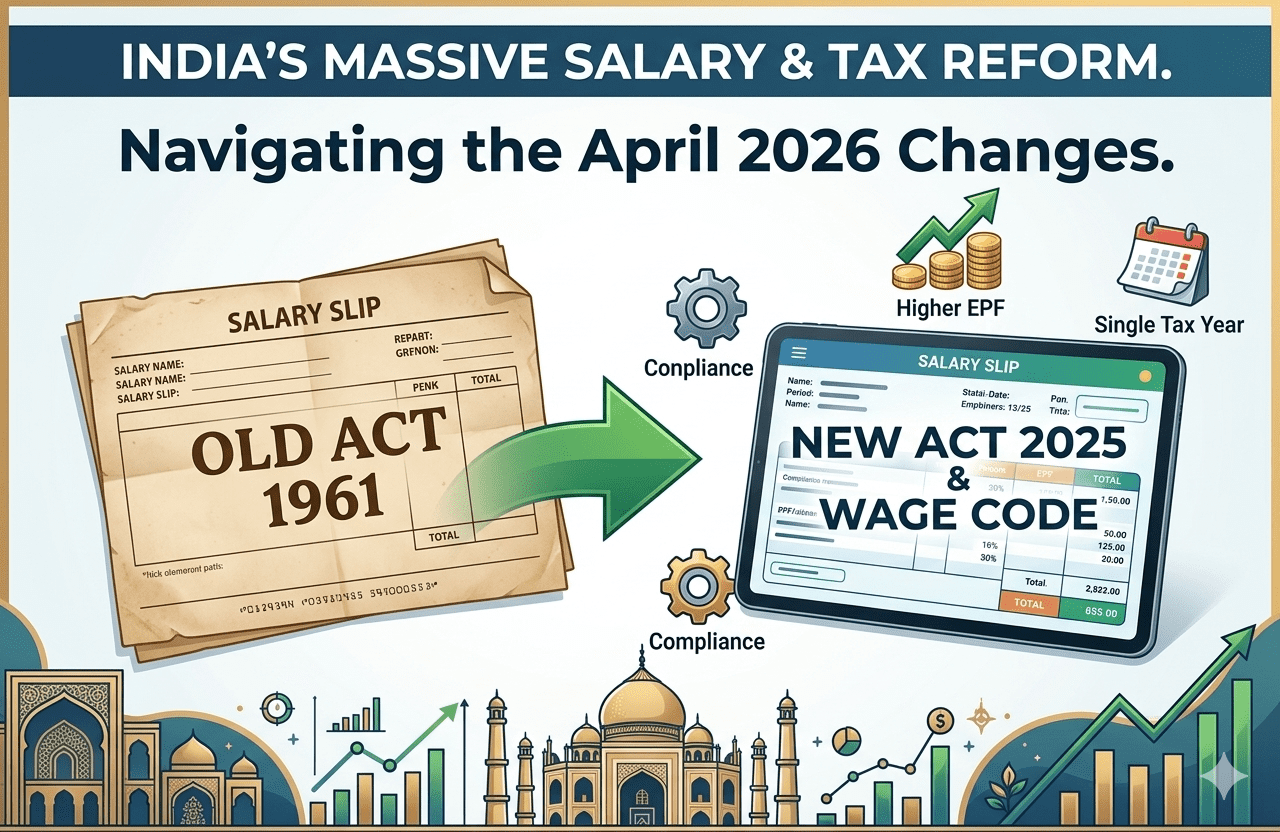
Starting April 1, 2026, India is witnessing its most significant salary and tax reform in decades. With the implementation of the new Income Tax Act 2025 and the Code on Wages 2019, every salaried employee in India will see changes in their salary structure, tax deductions, and take-home pay.
If you’ve noticed changes in your April salary slip or received notifications from your HR department about salary restructuring, you’re not alone. These reforms are mandatory, nationwide, and will impact millions of employees across private and public sectors.
In this comprehensive guide, we break down everything you need to know about the salary changes from April 2026, how they affect your monthly paycheck, and what you should do to prepare.
April 1, 2026 marks a major financial reset for India. Three key reforms are being implemented simultaneously:
After 65 years, India is replacing the Income Tax Act 1961 with a completely new law. The Income Tax Act 2025 aims to simplify tax compliance while maintaining the same tax slabs and rates. The new law reduces:
– Sections from 800+ to 536
– Chapters from 47 to 23
– Complexity in language and terminology
While tax rates remain unchanged, the way salary components are valued and taxed has been redefined.
The Code on Wages 2019, which was passed years ago, is finally being implemented from April 2026. The most significant change: basic salary must now constitute at least 50% of your total Cost to Company (CTC)
This is a departure from the previous practice where companies kept basic salary artificially low (often 25-40% of CTC) to minimize EPF and gratuity contributions.
Several labour reforms are being rolled out, including:
– Faster Full and Final settlement (2 working days instead of 30-90 days)
– Standardized wage definitions
– Enhanced employee benefits and protections
The Code on Wages 2019 introduced a uniform definition of “wages” across all Indian companies. According to this law, basic salary, Dearness Allowance (DA), and retaining allowance must together form at least 50% of an employee’s total CTC.
Previously, companies had the flexibility to structure salaries with low basic pay and high allowances. This helped them reduce statutory contributions to EPF (Employee Provident Fund) and gratuity calculations, which are based on basic salary.
Here’s a practical example of how salary restructuring works:
Before April 2026:
– Total CTC: ₹10,00,000 per annum
– Basic Salary: ₹3,00,000 (30%)
– HRA: ₹2,00,000
– Special Allowance: ₹3,00,000
– Other Allowances: ₹2,00,000
After April 2026:
– Total CTC: ₹10,00,000 per annum
– Basic Salary: ₹5,00,000 (50% minimum)
– HRA: ₹2,50,000
– Special Allowance: ₹1,50,000
– Other Allowances: ₹1,00,000
Notice that the total CTC remains the same, but the distribution changes significantly.
The increase in basic salary has three major effects:
EPF contribution is calculated as 12% of basic salary (subject to a ceiling). With a higher basic salary, your EPF deduction increases.
Example:
– Old structure: 12% of ₹3,00,000 = ₹36,000 per year
– New structure: 12% of ₹5,00,000 = ₹60,000 per year (capped based on EPF rules)
Because more money goes into EPF and gratuity provisions, your monthly take-home salary may decrease slightly (typically 5-10% for most employees).
The long-term benefit: your EPF corpus grows faster, and your gratuity payout at retirement or job change will be significantly higher.
The Income Tax Act 2025 does not change tax slabs or rates, but it introduces several compliance and reporting changes:

One of the most confusing aspects of Indian taxation was the dual system of Financial Year (when you earn) and Assessment Year (when you file returns). This has been eliminated.
From April 2026 onwards, we have a single concept: Tax Year 2026-27.
– Income earned: April 2026 to March 2027
– Returns filed: In the same Tax Year 2026-27
This makes tax filing simpler and more intuitive.
TDS (Tax Deducted at Source) on salary is now calculated differently:
Key Changes:
– Salary paid up to March 31, 2026: Old Income Tax Act 1961
– Salary paid from April 1, 2026 onwards: New Income Tax Act 2025
Employers must recalculate projected income, deductions, and applicable tax regime for the new tax year.
Employees must submit new investment declarations referencing the new section numbers. For example:
– Old: Section 80C deduction
– New: Schedule XV read with Section 123
One of the biggest changes in the new Income Tax Rules 2026 is the strict valuation of perquisites (perks provided by employers).
If your employer provides you with a car, the taxable value has been revised:
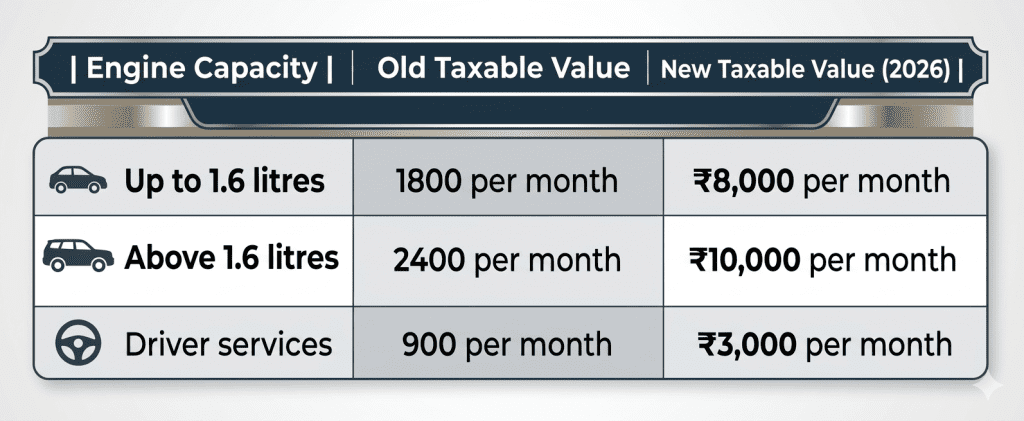
This applies to both personal and official use. If you use the car for business purposes more than 50%, you may claim partial exemption.
The taxable value of employer-provided accommodation depends on the city population:
– Cities with population above 40 lakh: 10% of salary
– Cities with population between 15-40 lakh: 7.5% of salary
– Other areas: Lower rates apply
If the employee pays rent, that amount is deducted from the taxable value.
Food and Beverages:
– Tax-free up to ₹200 per meal during office hours
– Includes breakfast, lunch, tea, coffee, and snacks
Gifts and Vouchers:
– Tax-free up to ₹15,000 per financial year
– If value exceeds ₹15,000, the entire amount becomes taxable
Children’s Education Allowance:
Under the old tax regime:
– Increased from ₹100 to ₹3,000 per month per child
– Hostel allowance increased from ₹300 to ₹9,000 per month
Loan Benefits and Taxability
Interest-free or concessional loans provided by employers are now treated as taxable perks. The taxable benefit is calculated using the SBI lending rate.
Exemptions:
– Medical loans for specified treatments
– Loans for certain approved purposes
With the mandatory increase in basic salary to 50% of CTC, EPF contributions automatically increase. Here’s what this means:
Employee Contribution: 12% of basic salary
Employer Contribution: 12% of basic salary (of which 3.67% goes to EPF and 8.33% to EPS)
Impact Example:
If your basic salary increases from ₹30,000 to ₹50,000 per month:
– Old EPF deduction: ₹3,600 per month
– New EPF deduction: ₹6,000 per month
While this reduces your take-home salary, it significantly boosts your retirement savings.
Gratuity is calculated as: (Last drawn salary × 15 days × Years of service) / 26
Since “last drawn salary” is based on basic salary, a 50% basic salary rule means:
– Higher gratuity accumulation
– Better financial security at retirement or job change
This is one of the most employee-friendly reforms.
Old System:
– Employees waited 30-90 days to receive pending salary, leave encashment, and other dues after resignation
New Rule (From April 2026):
– Companies must clear all wage-related dues within 2 working days of the employee’s last working day
What’s Covered:
– Pending salary
– Leave encashment
– Any other wage-related payments
What’s Not Covered:
– EPF transfers (follows EPFO timelines)
– Gratuity payouts (follows existing process)
Enforcement:
Employees can approach state Labour Departments to seek redress and claim interest on delayed payments.
House Rent Allowance (HRA) claims are now subject to stricter compliance:
New Requirements:
This is designed to reduce fake HRA claims and improve tax compliance.
Action Steps:
This decision is now more critical than ever.
Old Tax Regime:
– Higher tax rates
– But allows deductions: HRA, Section 80C, home loan interest, etc.
– Better for employees with high deductions
New Tax Regime:
– Lower tax rates
– No deductions allowed (except standard deduction)
– Better for employees with simple salary structures
– Income up to ₹12 lakh is tax-free (with rebate under Section 87A)
Recommendation:
Use online tax calculators to compare both regimes based on your updated salary structure and deductions.
If you’re claiming deductions under the old tax regime, update your investment declarations:
– Reference new section numbers from Income Tax Act 2025
– Provide proper documentation
– Submit to your employer before the deadline
If your company hasn’t yet communicated the changes clearly, or if you’re confused about the impact:
– Schedule a meeting with your HR department
– Ask for a detailed salary restructuring breakdown
– Consider consulting a tax advisor or payroll expert
At Wisecor, we understand that April 2026’s salary and tax reforms can be overwhelming for both employees and employers. Our comprehensive HR, payroll, and compliance services are designed to help businesses transition smoothly while ensuring 100% compliance.
Our Services Include:
– Complete salary structure redesign aligned with Code on Wages
– EPF and gratuity calculation adjustments
– Compliance audit and implementation support
– Income Tax Act 2025 compliance setup
– TDS calculation and filing under new rules
– Form 130 generation and employee tax support
– Full and Final settlement process redesign
– Updated leave encashment policies
– Labour code compliance documentation
– Automated salary processing with new rules
– Real-time compliance monitoring
– Employee self-service portals for tax declarations
– Employee webinars on tax changes
– HR team training on new regulations
– Customized compliance workshops
– Expertise: 15+ years in payroll and compliance management
– Technology: Advanced automation tools for seamless transitions
– Compliance Guarantee: 100% adherence to new regulations
– Dedicated Support: Expert advisors for all your queries
Get Started Today:
If you’re an employer struggling with payroll restructuring or an employee Struggling with payroll compliance? on the new changes, contact Wisecor for a free consultation.
No, your total Cost to Company (CTC) will remain the same. However, the distribution of salary components will change to comply with the 50% basic salary requirement.
Your take-home salary may reduce slightly because of higher EPF contributions. Since basic salary is now 50% of CTC, your EPF deduction (12% of basic) increases, reducing net pay. However, this builds your retirement corpus faster.
Yes, the Code on Wages 2019 applies to all establishments across India. All employers must restructure salaries to ensure basic pay is at least 50% of CTC.
This depends on your deductions:
– If you have high deductions (HRA, home loan, 80C investments): Choose old regime
– If you have minimal deductions and simple salary: Choose new regime (benefit from ₹12 lakh tax-free income)
Use online calculators with your updated salary structure to decide.
Under the new rules, employers must clear all wage-related dues within 2 working days of your last working day. EPF and gratuity follow their respective timelines.
No, tax slabs and rates remain the same. The new law simplifies language, reduces sections, and improves compliance processes.
Subscribe to our newsletter and stay updated.