- Follow On:
- [email protected]
- +918655715397
- Thane west, Maharashtra - 400604
A major change to India’s Employees’ Provident Fund (EPF) framework is creating new responsibilities for employers and payroll teams. Effective 17 September 2026, the statutory wage ceiling for mandatory EPF coverage increased from ₹15,000 to ₹25,000 per month. The revision expands access to social security for eligible employees who were previously excluded solely because their wages exceeded the earlier limit.
For businesses, the PF wage ceiling increase to ₹25,000 affects employee eligibility, contribution calculations, payroll costs, and statutory reporting. Employees may also notice changes in their monthly take-home salary and retirement savings.
The previous ceiling had remained unchanged since 2014. According to the government, the revision is expected to bring more than 51 lakh additional employees within mandatory EPFO coverage, subject to the applicable conditions.
This guide explains what the revised PF ceiling means, who may be affected, how contributions are calculated, and what employers should review to maintain payroll compliance.
Previously, the statutory wage ceiling for mandatory EPF coverage was ₹15,000 per month. Following the revision notified on 17 September 2026, the ceiling increased to ₹25,000 per month under the applicable provisions of the Code on Social Security, 2020.
The change primarily affects two groups: eligible employees who may newly come under mandatory EPF coverage and existing members whose contributions were previously restricted to the old wage ceiling.
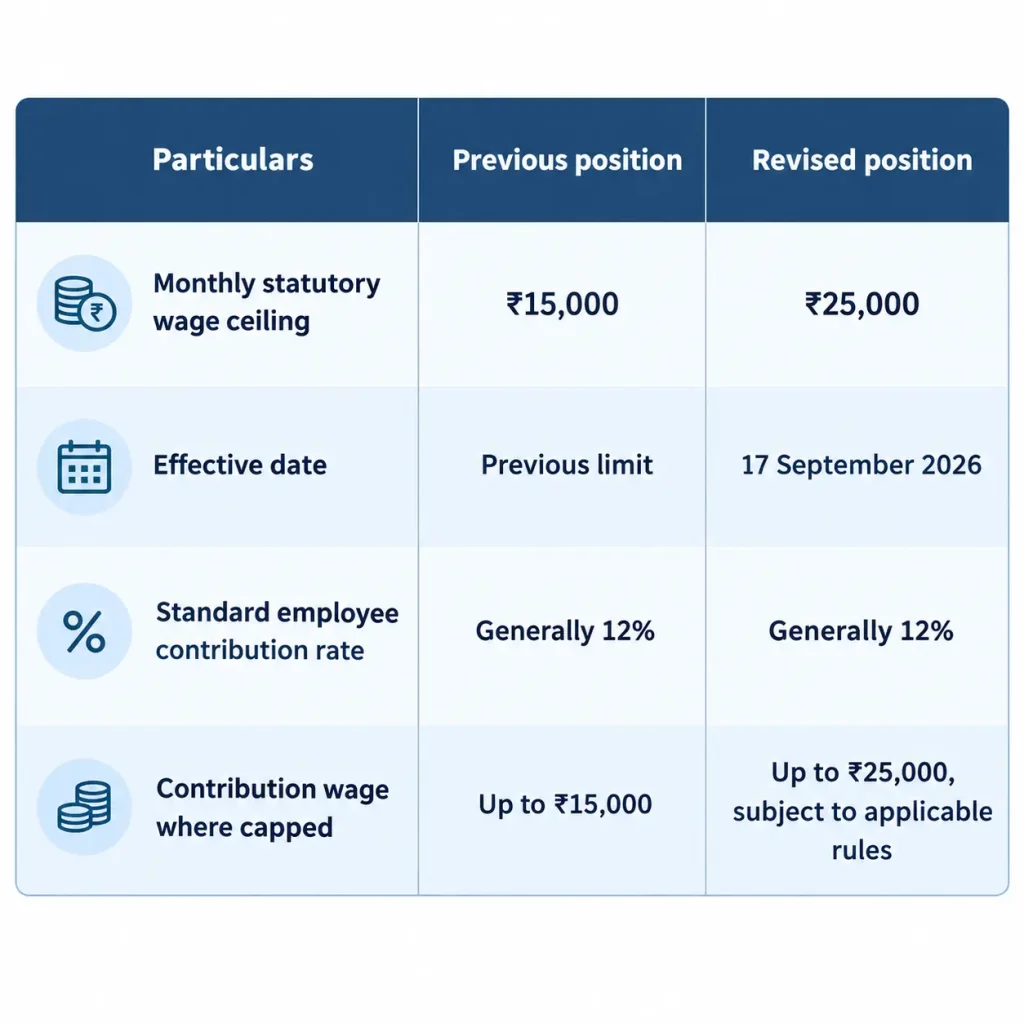
The important distinction is that the wage ceiling has changed, not the standard 12% contribution rate. The revised ceiling is not a fixed PF payment, nor does it automatically mean that every employee’s contribution must be calculated on their entire gross salary or cost-to-company (CTC).
The earlier wage ceiling had remained unchanged for approximately 12 years, even as salary levels and employment patterns evolved. This meant that some workers could remain outside mandatory EPF coverage when they entered employment above the previous threshold.
The revised ceiling aims to extend social security to a wider section of the workforce and help eligible employees build retirement savings through the applicable provident fund framework.
The expected benefits include:
However, eligibility for EPF, EPS, and EDLI depends on the relevant scheme rules. These benefits should not be assumed to apply identically to every employee.
The impact of the PF wage ceiling raised to ₹25,000 depends on an employee’s applicable PF wages, membership history, and the establishment’s coverage.
Employees who were previously excluded solely because their wages exceeded ₹15,000 may now fall within mandatory coverage, provided all other eligibility conditions are met.
For example, an employee earning ₹20,000 per month who was previously excluded for that reason may now qualify for mandatory coverage.
Employees who are already EPF members generally continue their membership. Where contributions were previously capped at ₹15,000, the contribution base may increase under the revised provisions.
A new employee who has never been an EPF member is generally not brought into mandatory coverage solely because of the wage level if their applicable PF wages exceed ₹25,000. Existing membership and other applicable rules must still be considered.
The ceiling applies to wages relevant for EPF purposes, not automatically to gross salary or CTC. Employers must first determine the correct PF wage under the applicable provisions.
This distinction is critical when evaluating employee eligibility and updating payroll systems.
The standard employee contribution is generally 12% of applicable PF wages. The employer’s contribution is also generally 12%, with the employer’s share allocated between EPF and EPS where applicable.
Consider an employee whose applicable PF wages are ₹20,000 and whose contributions were previously 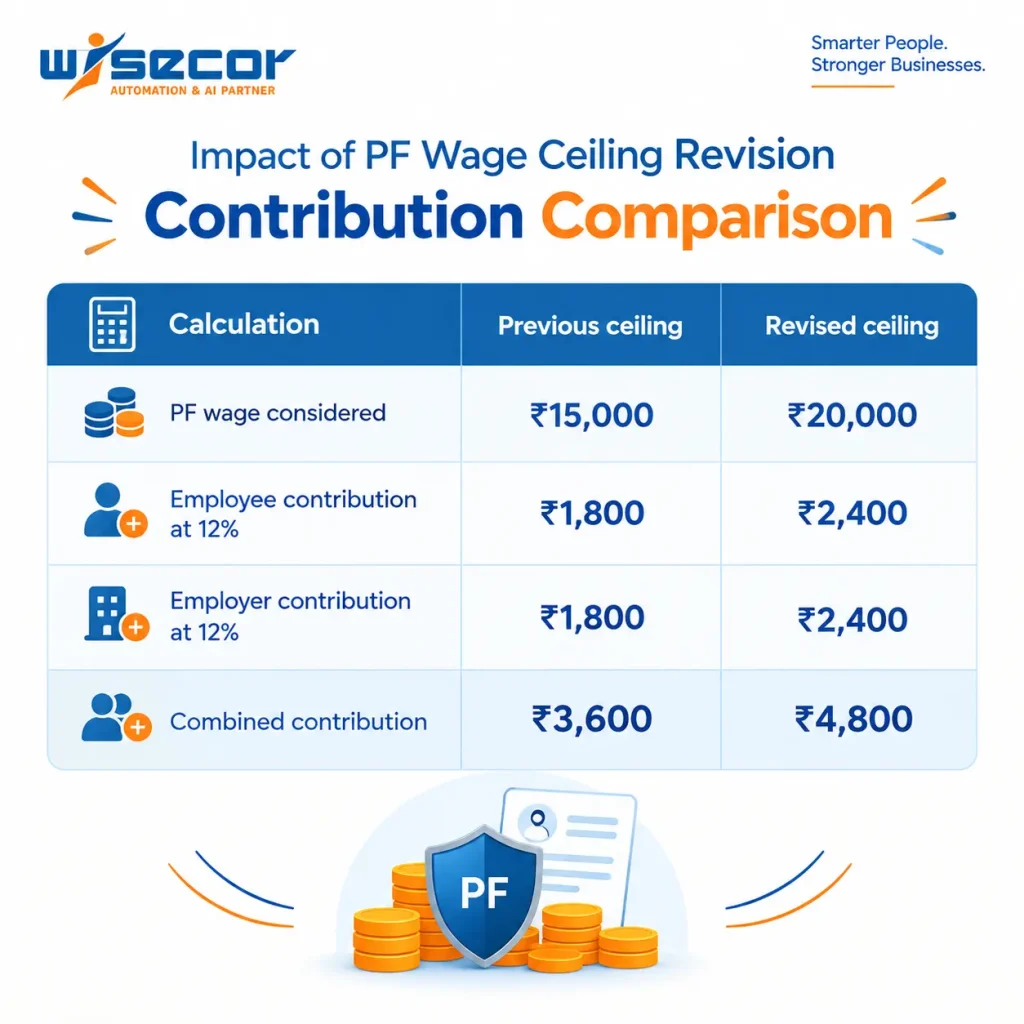
In this illustrative example, the employee contribution increases by ₹600 per month, and the employer’s total contribution increases by ₹600. The combined monthly contribution increases by ₹1,200.
The actual calculation depends on applicable PF wages, membership status, and the relevant contribution rules. The employer’s contribution also requires the appropriate EPF/EPS allocation.
Payroll teams should verify these details before applying the change to individual employees.
The revision also has implications for the Employees’ Pension Scheme (EPS) and Employees’ Deposit Linked Insurance Scheme (EDLI), subject to their respective provisions.
Eligible employees entering EPF coverage within the revised ₹15,000–₹25,000 wage band may qualify for EPS coverage under the applicable scheme rules.
The employer’s contribution is generally divided between EPF and EPS where applicable. Therefore, HR teams should verify pension eligibility and the correct allocation before updating payroll.
EDLI provides eligible EPF members with employment-linked insurance protection. Keka reports that the maximum assurance benefit remains ₹7 lakh after the wage-ceiling revision.
Employers should avoid assuming that every employee receives identical benefits. Coverage and eligibility must be checked against the applicable scheme provisions.
The increase from ₹15,000 to ₹25,000 requires employers to review employee eligibility, payroll settings, contribution calculations, and statutory reporting.
The revised ceiling took effect on 17 September 2026. September was therefore a transition month, while October 2026 is the first full monthly payroll cycle following the change.
When contributions were previously restricted to ₹15,000, increasing the applicable contribution base can raise employer costs for affected employees.
Consider a company with 30 employees whose applicable PF wages are ₹20,000 per month and whose contributions were previously capped at ₹15,000.
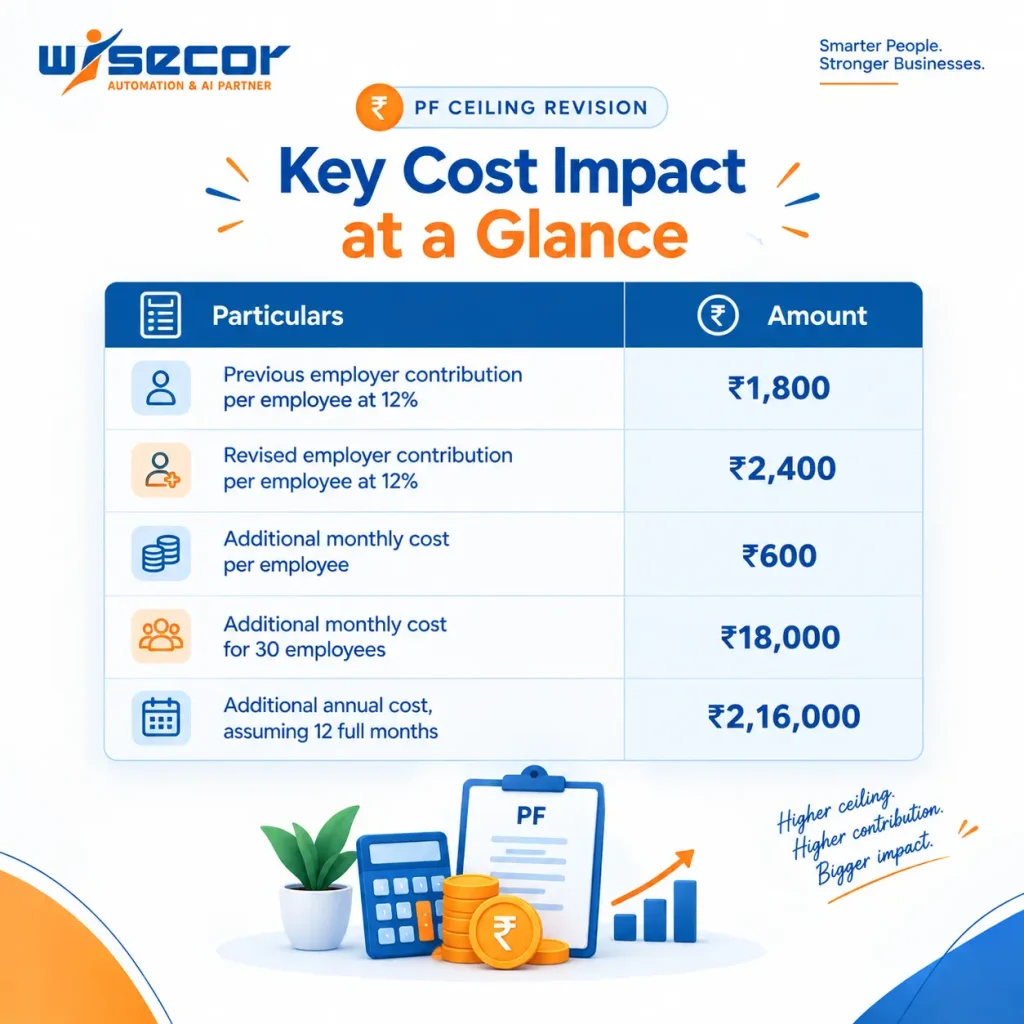
These figures are illustrative and assume that the contribution base increases for all 30 employees for a full year. Actual costs will depend on eligibility, effective dates, applicable PF wages, and contribution arrangements.
For employers managing hundreds of employees, the total impact can be material. Reviewing the salary structure and budgeting for the new contribution requirements is therefore important.
The revised wage ceiling took effect on 17 September 2026, following the government’s announcement and notification.
No. The standard employee and employer contribution rates remain generally 12%. The revision changes the wage ceiling relevant to mandatory coverage and applicable contribution calculations.
No. Eligibility also depends on establishment coverage, membership history, and the applicable EPF scheme provisions. The wage ceiling is not the only eligibility test.
No. The ₹25,000 ceiling applies to wages relevant for EPF purposes under the applicable rules. Employers should not automatically use gross salary or total CTC as the contribution base.
Some employees may experience lower take-home pay if they become newly covered or their contribution base increases. The actual deduction depends on the employee’s situation and applicable contribution rules.
It can expand EPS eligibility for certain employees, including eligible new members in the relevant wage band. Employers should verify the applicable EPS conditions and membership records rather than assuming that EPF and EPS eligibility are identical.
Employers should review employee eligibility, PF-relevant wages, contribution settings, EPS allocation, payroll calculations, ECR filings, and communication to employees.
Yes. The revised ceiling is not a universal prohibition on EPF membership or higher-wage contributions. Existing membership and applicable contribution arrangements must be considered.
The increase in the EPF wage ceiling from ₹15,000 to ₹25,000 is a significant change for India’s payroll and social security framework. It expands mandatory EPF coverage for eligible workers and may increase contributions for employees whose contribution base was previously restricted.
For employers, the priority is to verify employee eligibility, calculate the correct PF-relevant wages, update payroll systems, review EPS treatment, and maintain accurate statutory records. Employees should understand how any revised contribution affects their take-home salary and retirement savings.
Businesses with large or distributed workforces may benefit from professional payroll outsourcing and compliance support to review employee records, validate contribution calculations, and manage statutory reporting more consistently.
The goal is not simply to update a payroll setting. It is to ensure that every eligible employee is handled correctly under the applicable rules and that the company remains compliant as the revised ceiling takes effect.
Review your payroll processes, identify potentially affected employees, and check whether your contribution calculations and statutory records reflect the revised requirements.
For businesses seeking support, Wisecor’s Payroll outsourcing services can help strengthen payroll-related compliance processes.
Subscribe to our newsletter and stay updated.