- Follow On:
- [email protected]
- +918655715397
- Thane west, Maharashtra - 400604
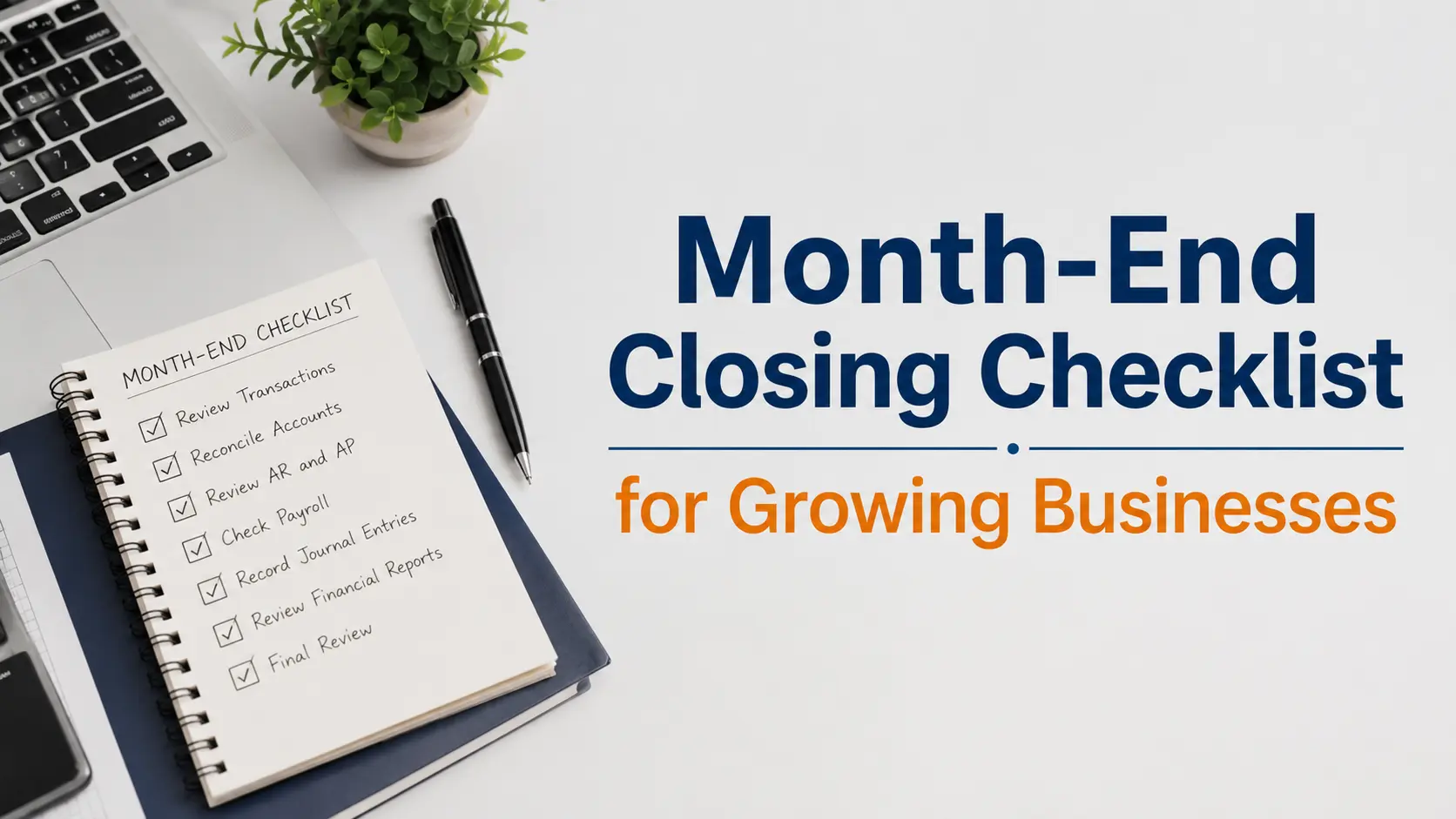
Managing finances accurately is essential for every growing business, and one of the most important accounting activities is the month-end closing checklist for growing businesses. Whether you’re a startup, SME, or expanding enterprise, completing a structured month-end close ensures that your financial records are accurate, compliant, and ready for decision-making.
The month-end financial close checklist is a step-by-step process used by finance teams to review transactions, reconcile accounts, prepare financial reports, and identify any discrepancies before beginning a new accounting period. Businesses that follow a consistent month-end accounting checklist for SMEs can improve reporting accuracy, reduce errors, and make faster business decisions.
According to industry research, companies with standardized month-end closing procedures complete their financial reporting significantly faster while improving audit readiness and operational efficiency. As finance functions become more technology-driven, many organizations are adopting automation and finance outsourcing to streamline their monthly close process.
Month-end closing is the accounting process of reviewing, reconciling, and finalizing all financial transactions at the end of each month. It ensures that every income, expense, asset, and liability is properly recorded before financial reports are prepared.
A standard accounting month-end closing process typically includes reviewing accounting records, reconciling accounts, posting journal entries, and generating financial statements.
Without a structured closing process, businesses may experience reporting errors, inaccurate financial statements, delayed decision-making, and compliance issues.
A well-planned monthly close is much more than an accounting routine. It provides business leaders with accurate financial information that supports better planning and strategic decision-making.
Some key benefits include:
For growing businesses, accurate monthly reporting helps management identify financial trends before they become major issues.
Preparation plays a major role in improving accounting close efficiency. Rather than waiting until the last day of the month, finance teams should organize financial records throughout the accounting period.
Good preparation includes:
Businesses that maintain updated records throughout the month usually complete the closing process much faster.
Many business owners ask, “How does month-end closing work?” The process can be broken into a series of manageable accounting tasks.
The first step is ensuring every financial transaction has been entered into the accounting system.
This includes:
Missing transactions often result in inaccurate financial reports.
Bank reconciliation is one of the most critical month-end accounting tasks.
Finance teams compare internal accounting records with bank statements to identify:
Accurate reconciliation helps ensure cash balances are correct before preparing financial statements.
Businesses should carefully review both customer receivables and supplier payables.
This includes:
Maintaining updated receivable and payable records improves cash flow management and reduces reporting errors.
After reviewing transactions, accountants record required journal entries for items such as:
These entries ensure financial statements accurately reflect business activities for the month.
Every organization should develop a standardized month-end closing checklist explained to ensure consistency across accounting periods.
A complete checklist generally includes:
✔ Record all financial transactions
✔ Reconcile bank accounts
✔ Review accounts payable
✔ Review accounts receivable
✔ Verify payroll entries
✔ Update inventory records
✔ Record depreciation and accruals
✔ Review fixed assets
✔ Prepare journal entries
✔ Generate financial statements
✔ Review cash flow reports
✔ Perform final management review
Using a standardized checklist helps finance teams avoid missing important accounting tasks while improving reporting quality.
One of the final stages of the month-end financial reporting process involves reviewing important financial reports before closing the books.
Key reports include:
These reports help management evaluate business performance and identify unusual financial trends before moving into the next accounting cycle.
Even businesses with experienced finance teams can encounter errors during the month-end closing process for finance teams. These mistakes often lead to inaccurate financial reports, delayed decision-making, and additional work in the following month.
Understanding the common month-end closing mistakes can help businesses build a more efficient and reliable financial close process.
Waiting until the end of the month to record invoices, expenses, or receipts creates unnecessary pressure on the finance team. Regular bookkeeping throughout the month makes the closing process faster and more accurate.
Bank accounts, customer balances, and supplier accounts should always be reconciled before closing the books. Ignoring reconciliations can result in duplicate entries, missing transactions, or incorrect financial statements.
Incomplete invoices, receipts, payroll records, or expense documentation can delay financial reporting and increase audit risks. Maintaining organized records throughout the month simplifies the review process.
Finance teams often depend on information from HR, procurement, operations, and sales. Delayed communication can postpone approvals, journal entries, and financial reporting.
Closing the books without reviewing reports may allow errors to remain undetected. A final review of financial statements helps identify unusual balances and improves reporting accuracy.
Growing businesses often ask, “How to speed up month-end closing?” The answer lies in creating standardized processes and reducing manual work.
Here are some finance month-end closing best practices that help improve efficiency.
Instead of collecting accounting data at month-end, businesses should update transactions daily. This reduces the workload during the final closing period.
A consistent month-end reporting checklist for businesses ensures every important task is completed in the correct order. It also improves accountability within the finance team.
Automation can simplify bank reconciliations, invoice processing, journal entries, and report generation, allowing finance professionals to focus on analysis instead of manual data entry.
Rather than waiting until the last day, businesses should establish internal timelines for invoice approvals, expense submissions, and reconciliation activities.
Reviewing financial performance every week makes month-end adjustments easier and minimizes last-minute surprises.
Technology has transformed the monthly financial close process for companies by reducing manual effort and improving reporting accuracy.
Modern accounting software can automate several activities, including:
Automation reduces human errors, speeds up financial reporting, and provides real-time visibility into business performance. As a result, finance teams can complete the month-end close more efficiently while focusing on strategic analysis.
As businesses expand, the accounting workload increases. More transactions, multiple bank accounts, growing payrolls, and complex compliance requirements can make internal month-end closing challenging.
This is where Finance and Accounts Outsourcing becomes valuable.
An experienced outsourcing partner can help businesses:
For startups and SMEs, outsourcing offers access to professional accounting expertise without the cost of maintaining a large in-house finance department.
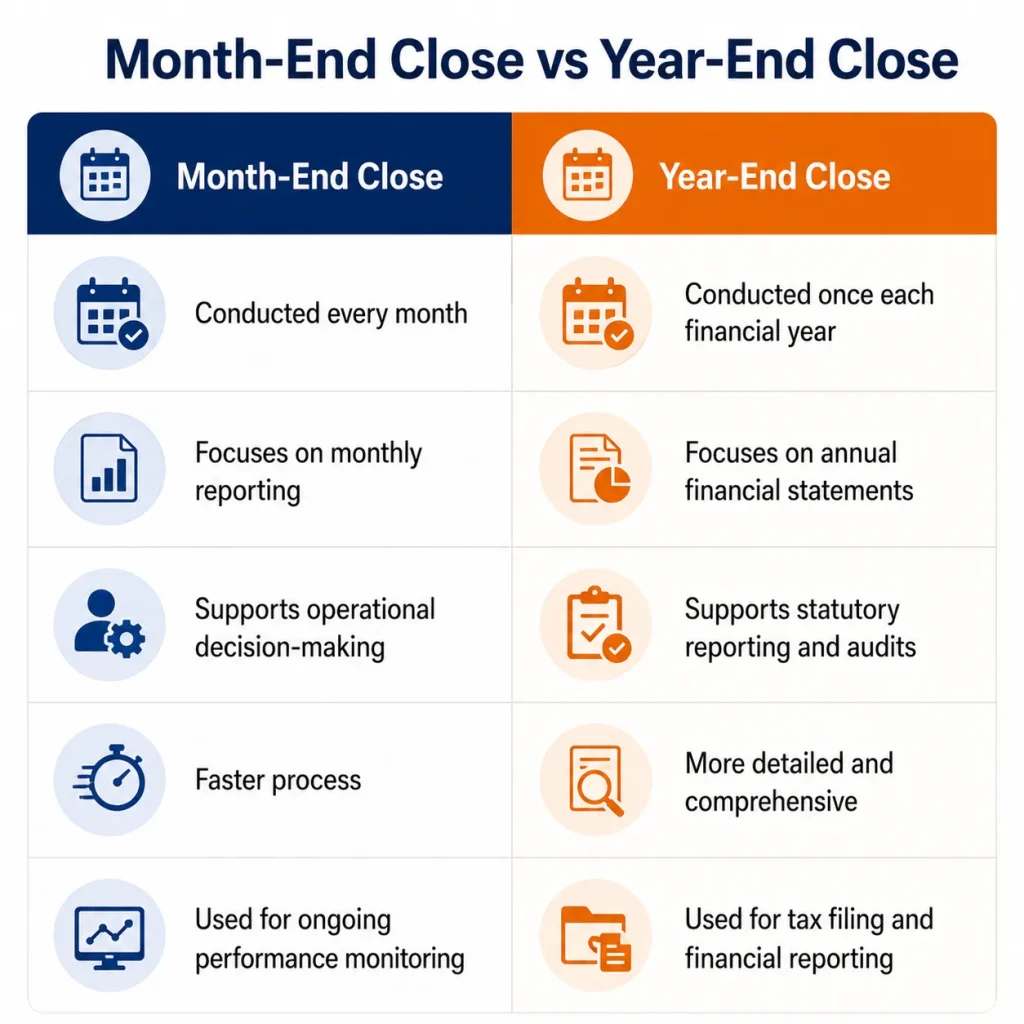
Many business owners confuse month-end closing with year-end closing. Although both involve reviewing financial records, their purpose and scope differ.
Both processes are important, but a disciplined monthly close makes year-end reporting significantly easier.
A growing manufacturing company was taking nearly two weeks to complete its monthly financial close because transactions were recorded manually and reconciliations were delayed.
After implementing standardized month-end accounting procedures, automating bank reconciliations, and outsourcing selected accounting functions, the finance team reduced the closing cycle to just five business days. Management gained faster access to financial reports, improved cash flow visibility, and made more informed operational decisions.
A month-end closing checklist is a structured list of accounting tasks completed at the end of each month to ensure financial records are accurate and financial statements are ready for reporting.
It helps maintain accurate financial records, improves cash flow visibility, supports better business decisions, and prepares organizations for audits and compliance requirements.
The duration varies depending on the size and complexity of the business. Many growing businesses aim to complete the process within a few business days using standardized procedures and automation.
A complete close typically includes recording transactions, reconciling accounts, reviewing receivables and payables, posting journal entries, generating financial reports, and conducting a final review.
Common mistakes include delayed transaction recording, incomplete reconciliations, missing documents, poor communication between departments, and skipping the final financial review.
Businesses can improve efficiency by maintaining updated records, using standardized checklists, automating routine accounting tasks, setting internal deadlines, and reviewing reports regularly.
Automation reduces manual work, improves accuracy, speeds up reconciliations, generates reports faster, and provides better visibility into financial performance.
Businesses should consider outsourcing when accounting workloads increase, financial reporting becomes delayed, compliance requirements become more complex, or internal teams need additional expertise.
A well-structured month-end closing checklist for growing businesses is essential for maintaining accurate financial records and making informed business decisions. By following a consistent month-end accounting checklist for SMEs, businesses can reduce errors, improve reporting accuracy, strengthen cash flow management, and prepare for audits with greater confidence.
As organizations grow, adopting finance month-end closing best practices, leveraging automation, and outsourcing selected accounting functions can significantly improve the efficiency of the month-end financial reporting process. Businesses that complete their monthly close accurately and on time gain better financial visibility, enabling leaders to make faster, data-driven decisions and support sustainable long-term growth.
Subscribe to our newsletter and stay updated.