- Follow On:
- [email protected]
- +918655715397
- Thane west, Maharashtra - 400604
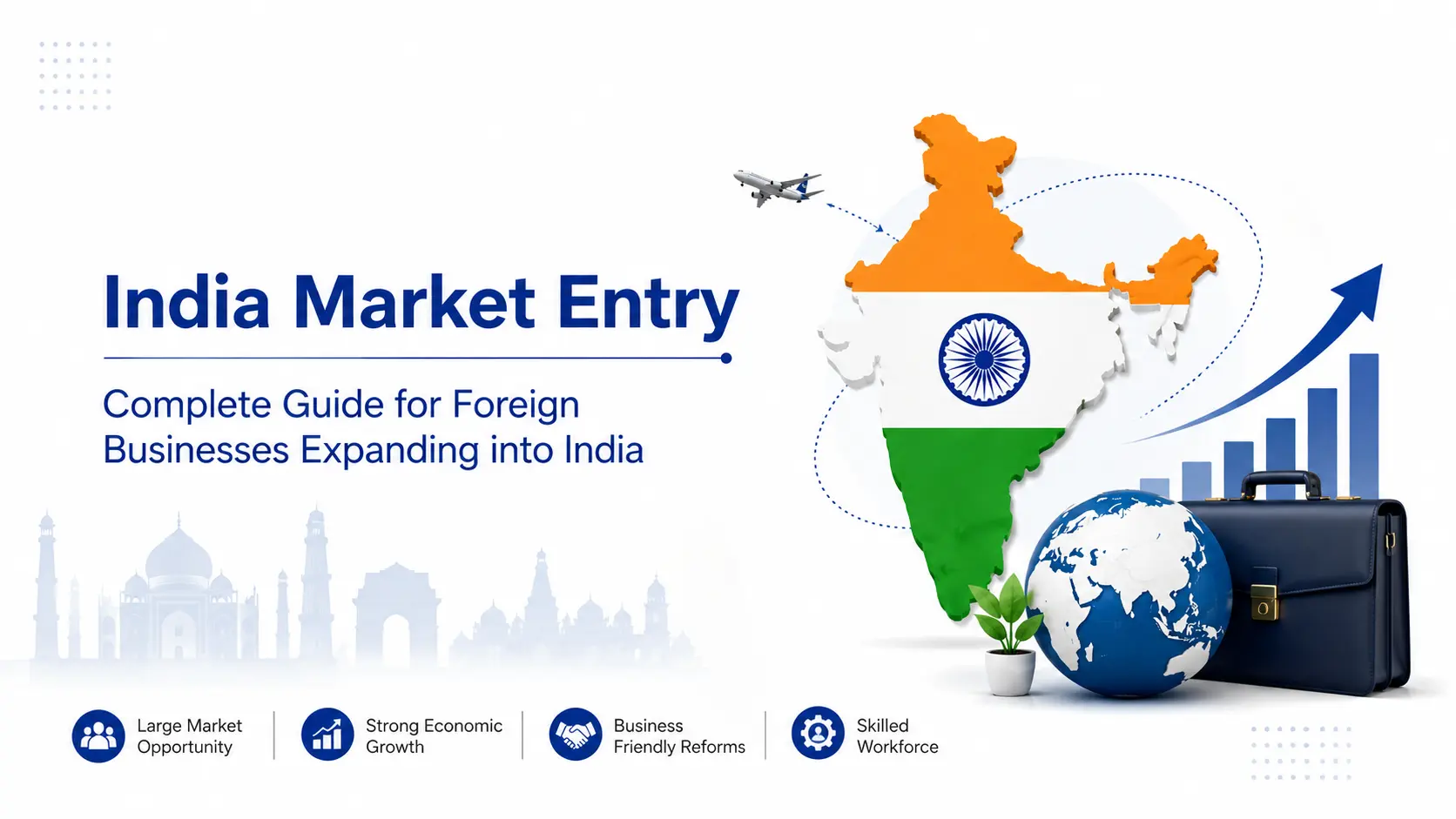
India has become one of the world’s fastest-growing economies and a key destination for global business expansion. With a large consumer market, growing middle class, strong digital adoption, and investor-friendly reforms, the country offers significant opportunities for foreign businesses.
Whether you are a startup or a multinational company, understanding India market entry is essential for successful expansion. Businesses must evaluate market potential, regulations, investment options, talent availability, and operational requirements before entering the market.
India continues to attract substantial foreign investment across industries such as technology, manufacturing, healthcare, retail, and financial services. This guide covers the key aspects of entering the Indian market, including opportunities, entry strategies, business structures, compliance requirements, and expansion planning.
India market entry refers to the process through which foreign companies establish commercial operations, partnerships, investments, or business entities within India. It involves developing a strategic approach to enter the market while complying with local regulations and aligning operations with customer needs.
Market entry can take several forms depending on business goals, investment capacity, and industry requirements. Some organizations begin with distribution partnerships, while others establish wholly owned subsidiaries or operational centers.
Successful market entry requires businesses to understand:
A structured approach reduces risks and improves the likelihood of long-term success.
India has become one of the most attractive destinations for global expansion due to its unique combination of market size, economic growth, and business-friendly reforms.
Several factors continue to drive international investment.
India’s expanding population and rising income levels create substantial demand across industries. Businesses entering India gain access to millions of potential customers across both urban and emerging markets.
India consistently ranks among the world’s fastest-growing major economies. Long-term economic growth creates favorable conditions for investment and business expansion.
Rapid adoption of digital technologies has transformed sectors such as e-commerce, fintech, healthcare, education, and logistics. This digital growth creates opportunities for both technology-driven and traditional businesses.
India offers access to one of the world’s largest pools of skilled professionals in technology, finance, engineering, operations, and customer support.
Programs supporting business development, infrastructure growth, manufacturing, and investment have significantly improved the country’s business environment.
These advantages continue to attract businesses seeking sustainable international growth opportunities.
Foreign companies entering India often gain advantages that support both short-term expansion and long-term growth.
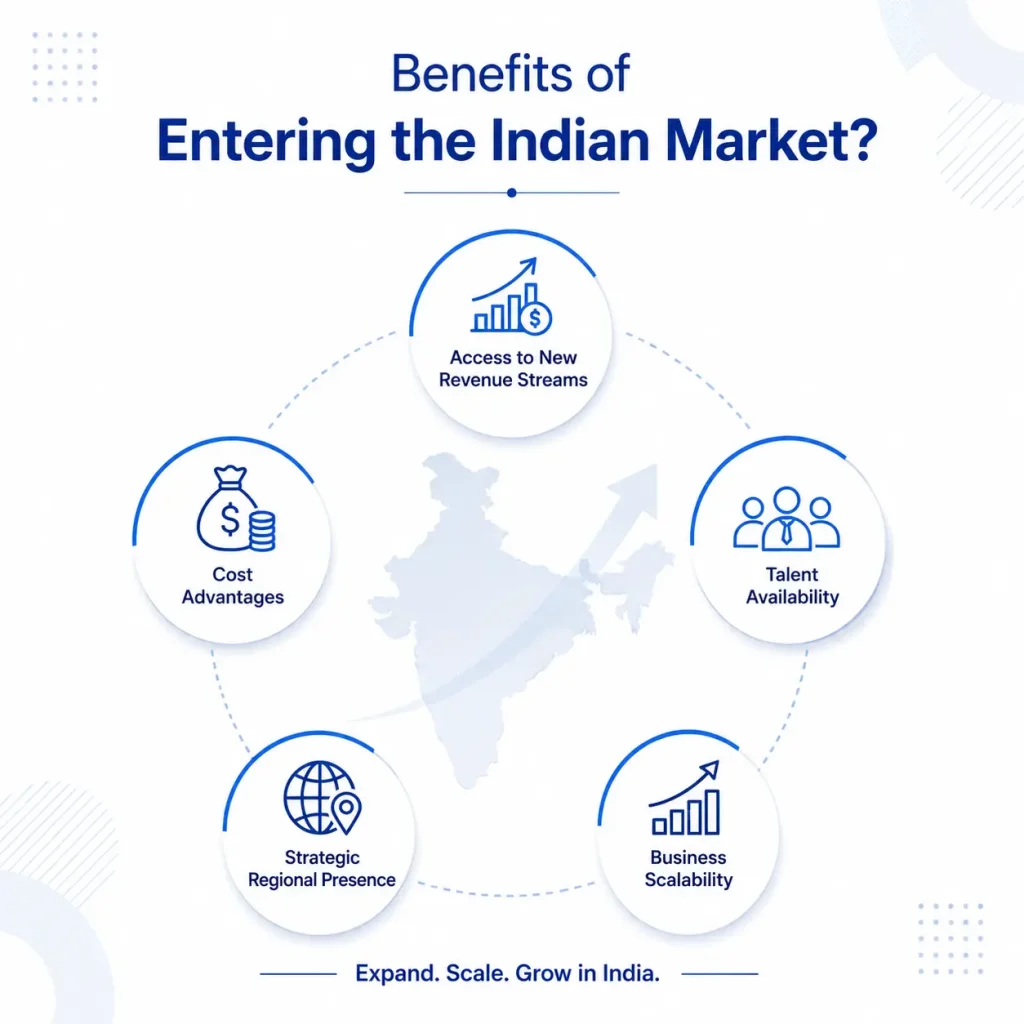
India’s large and growing market helps businesses reach new customers and generate additional revenue. It also reduces dependence on a single market for growth.
Companies can benefit from competitive operating costs across talent, infrastructure, and business support services. This helps improve profitability and operational efficiency.
India offers access to a vast pool of skilled professionals across technology, finance, engineering, and operations. This supports innovation and business expansion.
India serves as a gateway to broader Asian and global markets. Establishing operations here can strengthen regional and international business growth.
The diverse and expanding market allows businesses to scale operations gradually as demand grows. Companies can test and refine their offerings before expanding further.
These advantages make India a preferred destination for international expansion initiatives.
India offers opportunities across multiple industries, making it attractive for businesses with different expansion objectives.
High-growth sectors include:
India continues to be a global leader in software development, digital transformation, artificial intelligence, and technology services.
Government initiatives promoting domestic production have created opportunities for manufacturing investments across various industries.
Digital payments, fintech innovation, insurance, and financial technology continue to attract global investment.
Growing healthcare demand creates opportunities for medical technology, healthcare services, pharmaceuticals, and healthcare infrastructure.
Rising consumer spending and digital adoption continue to drive growth in retail and online commerce.
Accounting, consulting, HR, payroll, legal support, and outsourcing services remain important growth sectors.
Understanding industry-specific opportunities helps businesses develop a more focused expansion strategy.
Entering a new market requires careful planning and execution. A well-defined expansion roadmap helps businesses minimize risks and improve operational readiness.
The process usually begins with market research and strategic assessment.
Businesses should evaluate:
After completing market research, organizations can determine the most suitable entry strategy, operational structure, and resource requirements.
A phased expansion approach often allows businesses to enter the market efficiently while maintaining flexibility as operations grow.
One of the most important decisions foreign businesses must make is selecting the right market entry model. The ideal approach depends on factors such as investment goals, operational requirements, risk tolerance, and long-term growth plans.
India offers several entry options that allow businesses to establish a presence based on their expansion strategy.
Many businesses initially enter India through local distributors or channel partners. This model requires lower investment and allows companies to test market demand before establishing full-scale operations.
For example, a foreign manufacturing company may partner with an Indian distributor to sell products without setting up a local office immediately.
A joint venture involves partnering with an Indian company to share resources, expertise, and operational responsibilities.
This model can be beneficial for businesses entering highly regulated industries or sectors requiring strong local market knowledge.
A wholly owned subsidiary allows foreign companies to establish independent operations in India while maintaining full ownership and control.
Many multinational companies prefer this approach because it provides greater operational flexibility and stronger brand control.
A branch office enables foreign companies to conduct specific business activities in India while remaining part of the parent organization.
This structure is often used for consulting, professional services, and international business operations.
Many international organizations now establish Global Capability Centers (GCCs) in India to manage finance, HR, technology, customer support, analytics, and back-office operations.
India has become one of the world’s leading destinations for GCCs due to its skilled workforce and operational efficiency.
Selecting the right structure is a critical step in building a successful India expansion strategy.
After selecting an entry model, businesses must complete the registration and operational setup process.
The process typically involves several stages.
Companies first determine whether they want to establish:
The selected structure impacts taxation, compliance obligations, ownership rights, and operational flexibility.
The registration process includes obtaining approvals, company incorporation documents, and statutory registrations required to conduct business legally.
Businesses must obtain relevant tax registrations based on operational requirements, including GST registration and other applicable tax obligations.
A local business bank account is typically required for conducting financial transactions and managing business operations.
Organizations then establish office infrastructure, recruit employees, implement payroll systems, and create operational processes.
Professional business setup support often helps foreign companies accelerate the registration and implementation process while ensuring compliance.
Regulatory compliance is one of the most important aspects of doing business in India.
While India has significantly improved its business environment, companies must still comply with various legal and regulatory requirements.
Important areas include:
Businesses must maintain statutory filings, corporate records, and annual compliance obligations.
Organizations must comply with applicable taxation requirements, including GST, corporate taxes, payroll taxes, and reporting obligations.
Businesses hiring employees in India must follow labor laws, employment regulations, employee benefits requirements, and payroll compliance standards.
Companies handling customer or employee information should ensure compliance with applicable data protection requirements.
Certain sectors, such as healthcare, financial services, education, and telecommunications, may require additional approvals or licensing.
Developing a compliance framework early helps businesses avoid legal challenges and operational disruptions.
Although India offers tremendous growth potential, foreign companies may encounter challenges during market entry.
Understanding these challenges in advance allows businesses to prepare effective solutions.
Compliance requirements in India can vary depending on the industry, business structure, and location of operations. Businesses must stay updated with changing regulations to avoid legal and operational risks.
Consumer expectations, communication styles, and workplace practices can differ significantly from global markets. Understanding local culture helps businesses build stronger customer relationships and improve market acceptance.
India has a highly competitive business environment with both domestic and international players. Companies need a strong value proposition and market strategy to stand out from competitors.
While India offers a large workforce, finding experienced professionals in specialized fields can be highly competitive. Businesses must develop effective hiring and retention strategies to attract top talent.
India’s diverse regions have different languages, customer preferences, and purchasing behaviors. Businesses often need localized strategies to effectively serve multiple markets across the country.
Depending on the industry and location, companies may face logistical, supply chain, and operational challenges. Proper planning and local partnerships can help overcome these complexities and improve business efficiency.
A structured market entry strategy helps organizations minimize risk while maximizing growth opportunities.
Successful businesses typically focus on:
Working with experienced market entry consultants, compliance experts, and operational partners can significantly improve expansion outcomes.
Understanding how businesses successfully enter India can provide valuable insights for organizations planning expansion.
A global software company enters India by establishing a wholly owned subsidiary in a major technology hub. The company recruits local talent, builds development teams, and supports global operations while serving Indian customers.
A foreign manufacturing company partners with local distributors to test market demand before investing in production facilities. This phased approach helps reduce risk while building market presence.
An international consulting firm establishes operations in India to serve both local clients and global customers. Access to skilled professionals and lower operational costs improves service delivery and scalability.
These examples demonstrate that successful expansion depends on choosing the right market entry strategy based on business objectives and industry requirements.
Global Capability Centers have become one of the most popular expansion models for international companies entering India.
A GCC serves as a strategic operational center supporting business functions such as:
India offers access to a vast pool of skilled professionals across finance, IT, HR, engineering, and business operations. This enables companies to build capable teams quickly while supporting global business functions efficiently.
A GCC helps centralize key business processes, improving workflow consistency and service quality. This allows organizations to operate more efficiently while maintaining better control over operations.
Businesses can significantly reduce operational and workforce costs by leveraging India’s competitive talent market. These savings can be reinvested into growth, innovation, and expansion initiatives.
GCCs provide the flexibility to expand teams and business functions as organizational needs evolve. Companies can scale operations efficiently without the challenges of establishing multiple international offices.
A successful expansion strategy should balance growth opportunities with risk management and operational readiness.
Key considerations include:
Understand customer behavior, industry trends, competition, and demand patterns before making investment decisions.
Select the most appropriate market entry model based on ownership preferences, compliance requirements, and growth objectives.
Ensure compliance with tax, employment, corporate governance, and industry-specific regulations.
Develop a workforce plan that supports operational requirements and future expansion.
Prepare realistic budgets covering registration, infrastructure, recruitment, compliance, and operational costs.
Working with experienced advisors can help businesses navigate legal, financial, and operational complexities more effectively.
Organizations that approach expansion strategically are often better positioned for long-term success.
India market entry refers to the process through which foreign businesses establish operations, investments, partnerships, or commercial activities within India.
India offers a large consumer market, strong economic growth, a skilled workforce, digital transformation opportunities, and a favorable investment environment.
Common models include wholly owned subsidiaries, joint ventures, branch offices, liaison offices, distribution partnerships, and Global Capability Centers (GCCs).
Yes. In many sectors, foreign companies can establish wholly owned subsidiaries subject to applicable regulations and investment guidelines.
FDI refers to investments made by foreign entities into Indian businesses or operations, contributing to economic growth and business development.
Common challenges include regulatory compliance, market competition, regional diversity, talent acquisition, and adapting to local business practices.
The timeline varies depending on the business structure, industry, approvals, and documentation requirements. Professional support can help accelerate the process.
Technology, manufacturing, healthcare, financial services, retail, e-commerce, renewable energy, and professional services continue to attract strong investment.
A GCC is an operational center established in India to support global business functions such as finance, HR, IT, analytics, and customer support.
Market entry consultants help businesses navigate registration, compliance, taxation, workforce planning, operational setup, and expansion strategy.
India has emerged as one of the world’s most attractive destinations for international business expansion. Its growing economy, large consumer base, skilled workforce, digital transformation, and supportive investment environment create significant opportunities for foreign companies across industries.
However, successful market entry requires more than identifying opportunities. Businesses must carefully evaluate market conditions, choose the right entry model, understand regulatory requirements, and build a scalable operational framework.
As global businesses continue seeking new growth markets in 2026 and beyond, India remains a strategic destination for companies looking to expand operations, access talent, optimize costs, and strengthen their global presence.
Subscribe to our newsletter and stay updated.