- Follow On:
- [email protected]
- +918655715397
- Thane west, Maharashtra - 400604
Manufacturing businesses today operate in an environment where speed, productivity, and workforce availability directly influence profitability. As production targets increase and labor shortages become more common, companies are searching for practical ways to manage their workforce more effectively. One solution gaining significant attention is manpower outsourcing for manufacturing companies.
Recruiting, training, and managing a large workforce internally can place considerable pressure on HR teams and production managers. Delays in hiring, employee turnover, compliance obligations, and rising labor costs can affect overall business performance. To address these challenges, many manufacturers are adopting workforce outsourcing models that provide access to qualified workers while reducing administrative responsibilities.
Industry studies suggest that companies using outsourced workforce solutions often experience faster hiring cycles, improved workforce flexibility, and better operational efficiency. For manufacturing organizations looking to remain competitive, manpower outsourcing has evolved from a staffing option into a strategic business decision.
Many business leaders ask, what is manpower outsourcing in manufacturing?
In simple terms, it involves partnering with a specialized workforce provider that recruits, deploys, and manages workers on behalf of a manufacturing company. Instead of handling every aspect of recruitment and labor administration internally, businesses leverage external expertise to fulfill workforce requirements.
Outsourcing partners typically support:
This approach enables manufacturers to dedicate more attention to production quality, operational planning, and business growth while workforce specialists handle staffing requirements.
Workforce-related challenges continue to increase across the manufacturing sector. Many organizations struggle to find the right talent at the right time while maintaining operational efficiency.
Several factors are driving the shift toward outsourcing:
Manufacturing demand can fluctuate significantly throughout the year. Businesses often need additional workers quickly during peak production periods.
Recruiting qualified workers within short timelines can be difficult, particularly for specialized manufacturing roles.
Managing recruitment, onboarding, attendance, payroll coordination, and workforce documentation requires considerable time and resources.
Manufacturers increasingly require workforce models that can adapt to changing production schedules and market conditions.
These factors explain why manufacturing companies outsource manpower as part of their workforce strategy.
Effective staffing directly impacts production efficiency. Delays in recruitment or labor shortages can disrupt operations and reduce output.
Staffing providers maintain extensive candidate databases and can often deploy workers significantly faster than traditional hiring processes.
Manufacturing companies no longer need to spend excessive time sourcing candidates, screening applications, and coordinating hiring activities.
Access to outsourced workforce networks helps organizations respond quickly to sudden increases in production demand.
Reliable staffing support reduces disruptions caused by employee shortages and unexpected workforce gaps.
For manufacturers operating in highly competitive industries, these advantages can contribute significantly to operational success.
A productive workforce is essential for maintaining production schedules and meeting customer expectations.One reason companies invest in outsourcing is because it helps improve workforce performance through better staffing quality and workforce planning.
Experienced staffing providers understand the requirements of manufacturing roles and can identify workers with relevant experience and capabilities.
When positions remain vacant, production lines often slow down. Outsourcing helps ensure adequate workforce availability.
Outsourcing providers assist manufacturers in maintaining optimal staffing levels, reducing both overstaffing and understaffing situations.
Consider a manufacturing company that experiences a sudden increase in customer orders. Recruiting dozens of workers internally may take weeks. An outsourcing provider can often supply qualified personnel much faster, helping the company maintain productivity and delivery commitments.
The value of outsourcing extends beyond simply filling positions.
Recruitment involves advertising, screening, interviewing, onboarding, and administrative expenses. Outsourcing helps reduce many of these costs.
Finding experienced workers remains one of the biggest challenges for manufacturers. Workforce providers often maintain large talent pools that include technicians, machine operators, supervisors, and production specialists.
Manufacturers can scale staffing levels according to production needs without committing to permanent workforce expansion.
Effective workforce planning helps manufacturers maintain productivity while controlling labor expenses. Outsourcing partners support workforce scheduling, deployment, and resource allocation.
By reducing the burden of workforce administration, manufacturers can concentrate on quality improvement, production optimization, customer satisfaction, and business growth.
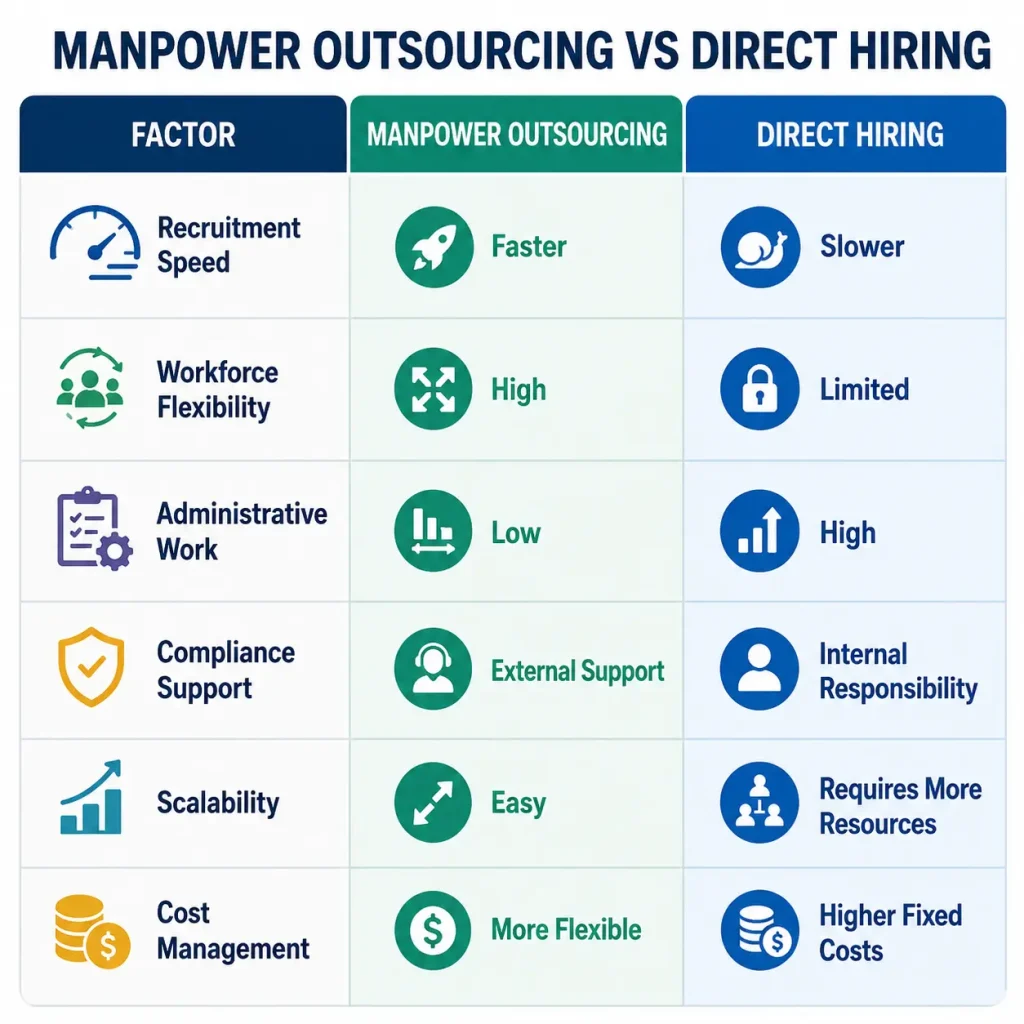
Manufacturing companies often compare manpower outsourcing vs direct hiring when planning workforce strategies. Both approaches have advantages, but the right choice depends on business goals, production requirements, and workforce flexibility needs.
Not every manufacturing business requires outsourced staffing immediately. However, certain situations indicate that workforce outsourcing may be the right solution.
As production expands, workforce requirements increase. Outsourcing helps companies scale staffing levels without overloading internal HR teams.
Difficulty finding qualified workers can affect productivity and customer commitments. Staffing partners help bridge workforce gaps quickly.
Manufacturers experiencing seasonal demand fluctuations often benefit from flexible workforce solutions rather than permanent hiring.
Opening new plants or adding production lines typically requires immediate workforce support. Outsourcing providers can accelerate staffing requirements during expansion.
When workforce management consumes excessive time and resources, outsourcing can help improve operational focus.
Manufacturing businesses face several workforce-related challenges that impact daily operations.
Frequent workforce changes can disrupt production schedules and increase recruitment costs. Outsourcing providers help maintain workforce continuity by supplying replacement workers when needed.
Traditional recruitment processes often take weeks or months. Outsourcing reduces hiring timelines and ensures workforce availability.
Manufacturers must balance labor availability with production requirements. Workforce outsourcing provides greater flexibility in managing staffing levels.
Labor regulations continue to evolve, creating additional administrative responsibilities. Experienced staffing providers help support compliance and documentation requirements.
Recruitment, onboarding, training, and workforce administration can become expensive. Outsourcing helps manufacturers optimize labor-related expenses while maintaining productivity.
An automotive parts manufacturer experienced a surge in orders following a new contract win. Instead of conducting large-scale recruitment internally, the company partnered with a staffing provider to quickly increase workforce capacity and maintain production targets.
A consumer goods company required additional workers during peak seasonal demand. Contract staffing enabled the business to increase workforce levels temporarily without permanent hiring commitments.
A rapidly growing electronics manufacturer struggled to recruit technical operators. Through industrial staffing support, the company gained access to qualified professionals and reduced production delays.
These examples demonstrate how workforce outsourcing helps businesses remain agile and responsive in changing market conditions.
How Does Manpower Outsourcing Support Long-Term Business Growth?
The benefits of outsourcing extend beyond short-term staffing needs. Many manufacturers use workforce outsourcing as part of a broader growth strategy.
Management teams can spend less time handling recruitment challenges and more time improving manufacturing performance and customer satisfaction.
Companies can expand operations more efficiently by increasing workforce capacity when required.
Access to qualified personnel helps maintain production quality and operational consistency.
Outsourcing providers help businesses manage labor-related challenges more effectively while maintaining workforce continuity.
Manufacturers with flexible workforce models can respond faster to market opportunities and changing customer demands.
Manpower outsourcing is the process of hiring an external workforce provider to recruit, deploy, and manage workers for manufacturing operations.
Companies outsource manpower to improve workforce flexibility, reduce recruitment challenges, access skilled workers, and support production growth.
Outsourcing ensures manufacturers have access to the right workers at the right time, reducing labor shortages and production delays.
In many cases, outsourcing can reduce recruitment, administration, and workforce management costs while improving operational efficiency.
Automotive, engineering, electronics, pharmaceuticals, textiles, food processing, and consumer goods manufacturers often benefit from workforce outsourcing solutions.
Contract staffing provides workforce flexibility, allowing businesses to increase or decrease staffing levels based on production requirements.
Yes. Workforce providers often maintain talent networks that help manufacturers access experienced and specialized workers more quickly.
Companies should evaluate industry experience, workforce quality, compliance expertise, scalability, and service reliability before selecting a provider.
As manufacturing businesses face increasing pressure to improve efficiency, control costs, and maintain workforce stability, manpower outsourcing has become a practical and strategic solution. It helps organizations address labor shortages, improve workforce flexibility, and optimize workforce management without adding significant administrative burden.
From supporting seasonal demand and production expansion to improving access to skilled labor, workforce outsourcing offers manufacturers the agility needed to compete in today’s fast-changing market. Businesses that implement the right staffing strategy are often better positioned to enhance productivity, reduce operational challenges, and support long-term growth.
By partnering with an experienced workforce solutions provider, manufacturers can focus on what matters most—delivering quality products, meeting customer expectations, and achieving sustainable business success.
Subscribe to our newsletter and stay updated.