Human Resource Management (HRM): Types, Functions, Roles & 2026 Trends
Human Resource Management (HRM) is no longer limited to hiring employees, processing payroll, and maintaining personnel records. Modern HR plays a strategic role in workforce planning, employee development, performance management, compliance, technology adoption, and organizational transformation.
As businesses adopt AI, automation, hybrid work models, and skills-based workforce planning, HR teams are increasingly responsible for understanding what skills organizations need, how work should evolve, and how employees can adapt to changing roles.
In 2026, AI is becoming an increasingly important part of HR operations, particularly in recruitment, HR technology, learning and development, and employee experience. This makes it important for businesses to understand the different types of HRM, its core functions, modern HR technologies, and strategies for building a future-ready workforce.
What Is Human Resource Management (HRM)?
Human Resource Management is the structured process of planning, acquiring, developing, managing, engaging, and retaining employees so that workforce capabilities support business objectives.
HRM covers the complete employee lifecycle, from workforce planning and recruitment to onboarding, development, performance management, retention, and exit.
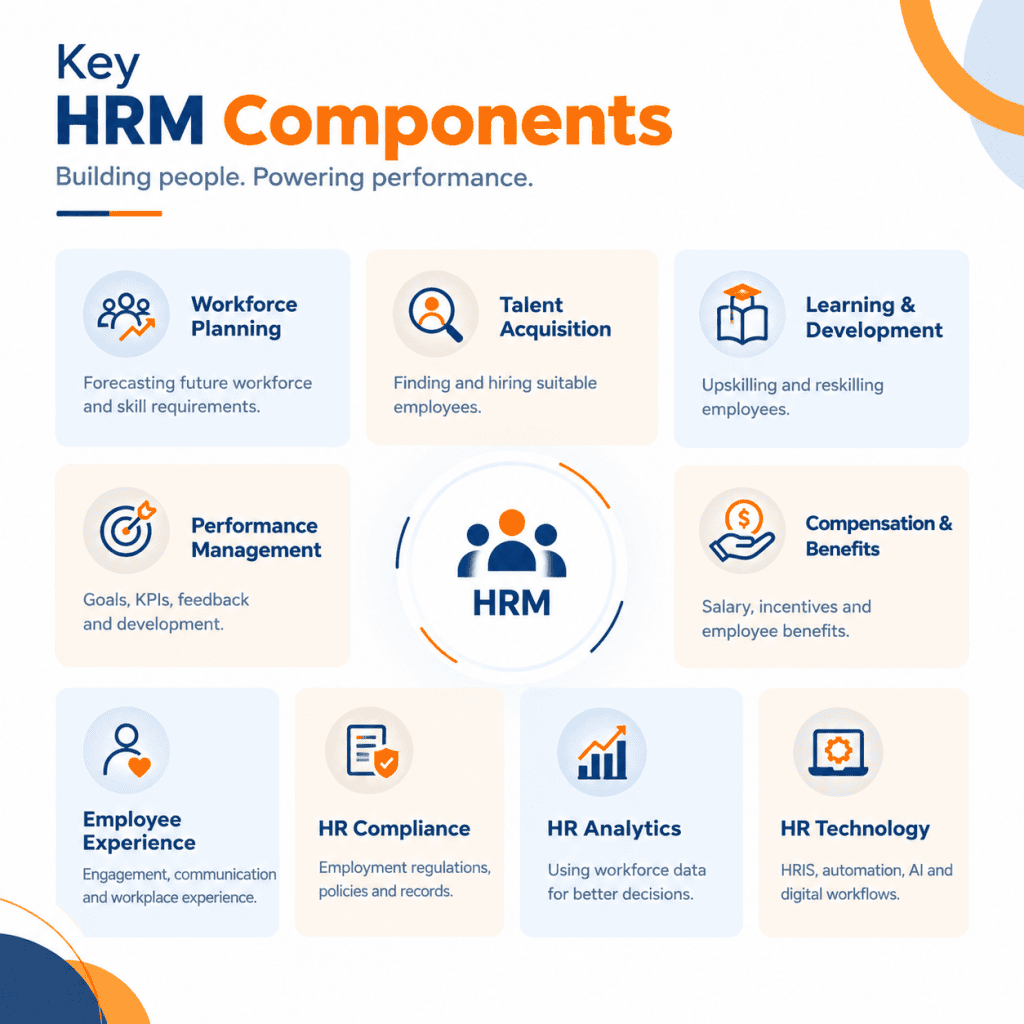
Key components of HRM include:
Why Is HRM Important for Modern Businesses?
It can help businesses:
- Hire the right talent
- Reduce employee turnover
- Improve productivity
- Identify skill gaps
- Develop future leaders
- Strengthen employee engagement
- Improve workforce planning
- Reduce administrative workload
- Maintain HR and employment compliance
- Make data-driven workforce decisions
When Is HRM Applied in an Organization?
HRM operates throughout the employee lifecycle and becomes particularly important during periods of business growth, workforce change and organizational transformation.
HRM is continuous and applies throughout the employee lifecycle from onboarding to retirement. It becomes especially crucial during:
| Business Situation |
HRM Role |
| Business expansion |
Workforce planning and recruitment |
| Skills shortage |
Upskilling, reskilling and targeted hiring |
| New technology adoption |
Training and change management |
| Restructuring |
Role redesign and workforce transition |
| Mergers & acquisitions |
Workforce integration and culture alignment |
| Rapid growth |
HR process standardization and automation |
| Employee turnover |
Retention and engagement strategies |
| Regulatory changes |
Policy and compliance updates |
How Does HRM Work in Practice?
1. Workforce Planning
Identifying current and future workforce requirements based on business objectives, growth plans and skill requirements.
2. Talent Acquisition
Attracting, assessing and hiring employees with the skills required by the organization.
3. Employee Onboarding
Introducing new employees to their roles, teams, systems, policies and organizational culture.
4. Learning & Development
Providing training, mentoring, upskilling and reskilling opportunities.
5. Performance Management
Setting goals, monitoring performance, providing feedback and identifying development opportunities.
6. Retention & Career Development
Using career opportunities, employee experience, recognition and development programs to retain valuable talent.
What HR Technology Is Used in 2026?
- HRIS / HRMS
- Applicant Tracking Systems
- Payroll automation
- Attendance management
- Learning Management Systems
- Performance management platforms
- Employee engagement platforms
- People analytics
- AI assistants and copilots
- Workforce planning platforms
- Skills intelligence platforms
What Are the Main Types of Human Resource Management?
Human Resource Management (HRM) is a vital function in every organization, as it focuses on managing the workforce the most important asset for achieving business success. Effective HRM ensures that employees are not only skilled and competent but also motivated, engaged, and aligned with the organization’s goals. To achieve these objectives, HRM is often classified into different types, each tailored to address specific organizational needs, operational challenges, and strategic priorities.
Understanding the different types of HRM is essential because organizations face diverse challenges, depending on their size, industry, culture, and business goals. By recognizing the distinctions between these classifications, companies can implement the most appropriate HR strategies, ensuring efficient management of human capital and sustainable growth. For example, a startup may prioritize operational HRM to establish basic HR functions like recruitment and payroll, while a multinational corporation may focus heavily on strategic HRM to align global workforce planning with long-term business objectives. Similarly, administrative HRM is critical in highly regulated industries, where compliance, record-keeping, and employee benefits management must be meticulously maintained to avoid legal and operational risks.
Types of Human Resource Management
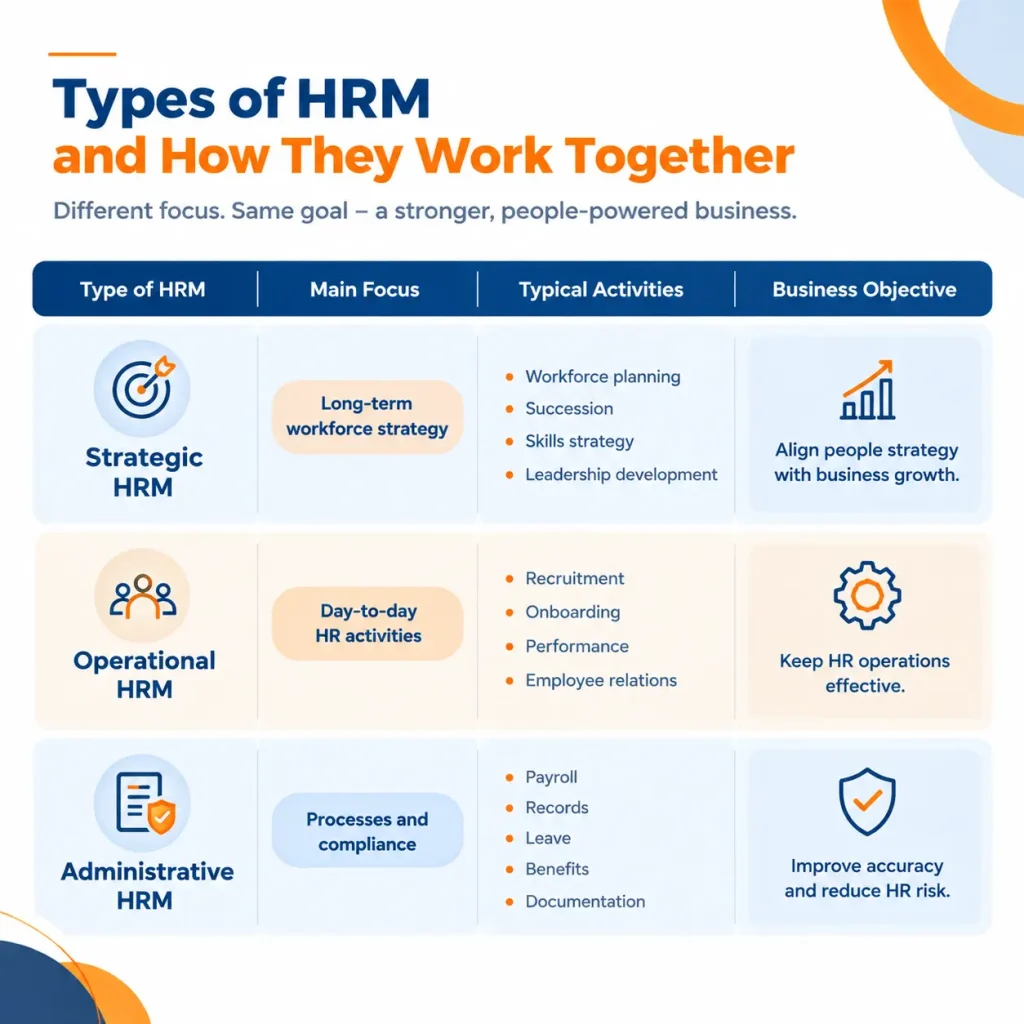
Human Resource Management (HRM) can be broadly classified into three main types: Strategic HRM, Operational HRM, and Administrative HRM. Each type plays a distinct role in managing the workforce effectively, and understanding these distinctions helps organizations implement tailored HR practices that align with their goals, improve productivity, and enhance employee satisfaction.

a) Strategic HRM
Strategic Human Resource Management connects workforce capabilities with an organization’s long-term business objectives.
It focuses on:
- Workforce planning
- Talent strategy
- Leadership development
- Succession planning
- Skills-gap analysis
- Organizational design
- Employee retention
- Workforce transformation
In 2026, strategic HR increasingly involves skills-based workforce planning and preparing employees for changing roles influenced by AI and automation.
b) Operational HRM
Operational HRM manages the everyday activities required to support employees and managers.
It includes:
- Recruitment
- Onboarding
- Attendance management
- Employee communication
- Performance reviews
- Employee relations
- Training coordination
- Leave management
- HR reporting
Operational HR bridges the gap between HR strategy and employees’ day-to-day experience.
c) Administrative HRM
Administrative HRM focuses on accurate, efficient and compliant HR processes.
It includes:
- Payroll administration
- Employee records
- Benefits administration
- Leave and attendance records
- HR documentation
- Policy administration
- Employment compliance
- HR reporting
Automation can reduce repetitive administrative work while appropriate controls and human oversight remain necessary.
What Are the Key Areas of HRM?
-
1. Workforce Planning & Development
Prepares the organization for future workforce and skill requirements.
2. Talent Acquisition
Attracts and selects employees who meet business and role requirements.
3. Learning & Development
Builds employee capabilities through training, upskilling and reskilling.
4. Performance Management
Aligns employee goals with business objectives and provides ongoing feedback.
5. Employee Experience
Improves engagement, communication, career development and workplace experience.
6. HR Analytics
Uses workforce data to support better HR and business decisions.
7. HR Compliance
Maintains policies, documentation and compliance with applicable employment requirements.
8. HR Operations & Automation
Uses technology to streamline repetitive HR processes and improve efficiency.
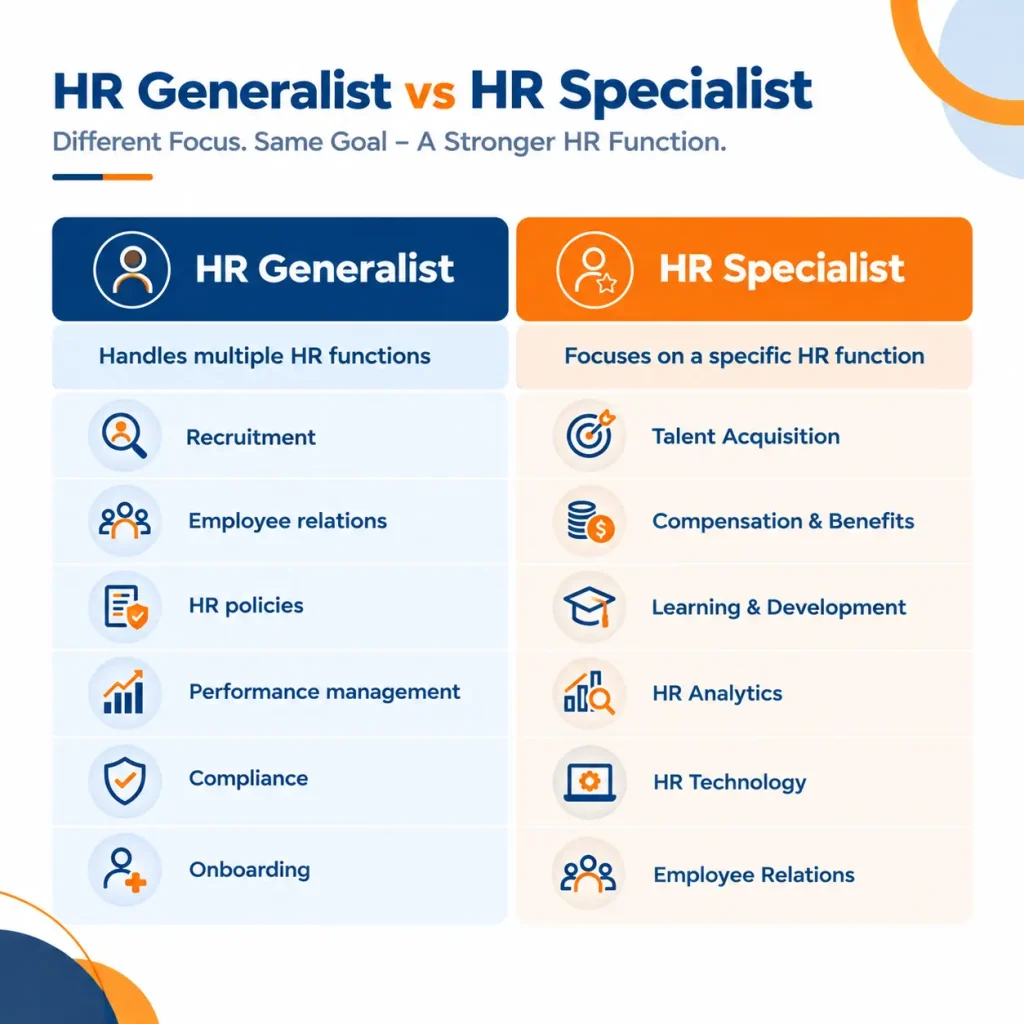
HR Generalists vs HR Specialists
HR professionals can broadly be categorized as generalists or specialists. Generalists manage multiple HR functions, while specialists focus on specific areas of HR expertise.
Emerging HR Roles in 2026
AI & HR Technology Specialists
Support organizations in adopting and managing AI-enabled HR systems.
People Analytics Professionals
Use workforce data to generate actionable business insights.
Skills & Workforce Planning Specialists
Identify future skills, workforce gaps and reskilling requirements.
Employee Experience Professionals
Design better employee journeys and workplace experiences.
Change Management Professionals
Help organizations adapt to technology, restructuring and transformation.
AI Governance & Responsible AI Roles
Help organizations address transparency, privacy, bias, security and human oversight when using AI in HR.
What Are the Major HR Trends in 2026?
1. AI-Augmented HR
AI is increasingly supporting recruitment, learning, HR technology, analytics and employee experience.
2. Skills-Based Workforce Planning
Organizations are focusing more on skills and capabilities rather than only traditional job titles.
3. Human-AI Collaboration
Employees are increasingly working alongside AI while retaining responsibility for judgment and decisions.
4. Continuous Upskilling
Organizations are investing in ongoing learning as job responsibilities change.
5. Data-Driven HR
HR analytics is becoming more important for workforce and business decisions.
6. Employee Experience
Organizations are focusing on career development, flexibility, communication and engagement.
7. HR Automation
Routine HR activities can increasingly be automated to reduce administrative workload.
8. Responsible AI & HR Governance
Organizations need appropriate controls for privacy, security, transparency, bias and human oversight.
Best Practices for Effective HRM in 2026
- Align HR with business strategy
- Build a skills-based workforce strategy
- Automate routine HR processes
- Invest in upskilling and reskilling
- Use HR analytics
- Improve employee experience
- Establish responsible AI policies
- Review HR processes regularly
What are the HR Transformation Strategies for Future Readiness?
To succeed in a rapidly changing business world, HR departments need to adopt new strategies. Key transformation strategies can include:
- Digital Transformation and HR Technology: Using modern HR tools, like AI-driven recruitment, HR analytics, and cloud-based systems, makes HR processes faster and more efficient.
- Agile HR Practices: Agile HR focuses on being flexible, working together, and adapting quickly to changes. This approach helps companies respond to new business needs and employee expectations.
- Employee Experience and Well-being: Supporting employees’ well-being, work-life balance, and mental health leads to happier, more productive teams.
- Leadership Development and Succession Planning: Training future leaders through mentorship and development programs ensures the company has strong leaders for long-term success.
- Sustainability and Corporate Social Responsibility (CSR): Including CSR and sustainability in HR practices improves the company’s brand image and keeps employees engaged.
Conclusion
Human Resource Management has evolved far beyond traditional recruitment and employee administration. Modern HRM combines people, processes, technology, analytics and business strategy to build productive and adaptable workforces.
The three core types Strategic HRM, Operational HRM and Administrative HRM remain important, but their execution is changing rapidly.
In 2026, organizations are placing greater emphasis on AI-enabled HR, skills-based workforce planning, people analytics, continuous upskilling, employee experience and responsible technology adoption.
The goal is not simply to adopt more HR technology. It is to create an HR function that can understand what skills the organization needs, how work should evolve and how employees can succeed in a changing workplace.
Frequently Asked Questions About Human Resource Management
What is Human Resource Management?
Human Resource Management is the process of managing an organization’s workforce through recruitment, development, performance management, compensation, employee engagement and compliance.
What are the three main types of HRM?
The three commonly used classifications are Strategic HRM, Operational HRM and Administrative HRM.
What are the main functions of HRM?
Major HRM functions include workforce planning, recruitment, onboarding, training, performance management, compensation, employee engagement, compliance and HR analytics.
How is AI changing HR in 2026?
AI is increasingly being used for recruitment, HR technology, learning and development, employee experience and workforce analytics. Human oversight remains important for responsible and effective AI adoption.
What is the difference between an HR Generalist and HR Specialist?
An HR Generalist manages multiple HR functions, while an HR Specialist focuses on a particular area such as recruitment, payroll, compensation, learning or HR analytics.
What is Strategic HRM?
Strategic HRM aligns workforce capabilities, talent strategies and organizational development with an organization’s long-term business objectives.
What is Operational HRM?
Operational HRM manages day-to-day HR activities such as recruitment, onboarding, performance management and employee relations.
What is Administrative HRM?
Administrative HRM focuses on HR records, payroll, benefits, leave administration, documentation and compliance-related processes.
Why is HR analytics important?
HR analytics helps organizations use workforce data to understand trends such as employee turnover, hiring efficiency, productivity, engagement and workforce costs.
Is HR outsourcing suitable for small businesses?
Yes. Small and mid-sized businesses can outsource selected HR activities such as recruitment, payroll, HR administration and compliance when they need additional expertise or operational support.