- Follow On:
- [email protected]
- +918655715397
- Thane west, Maharashtra - 400604
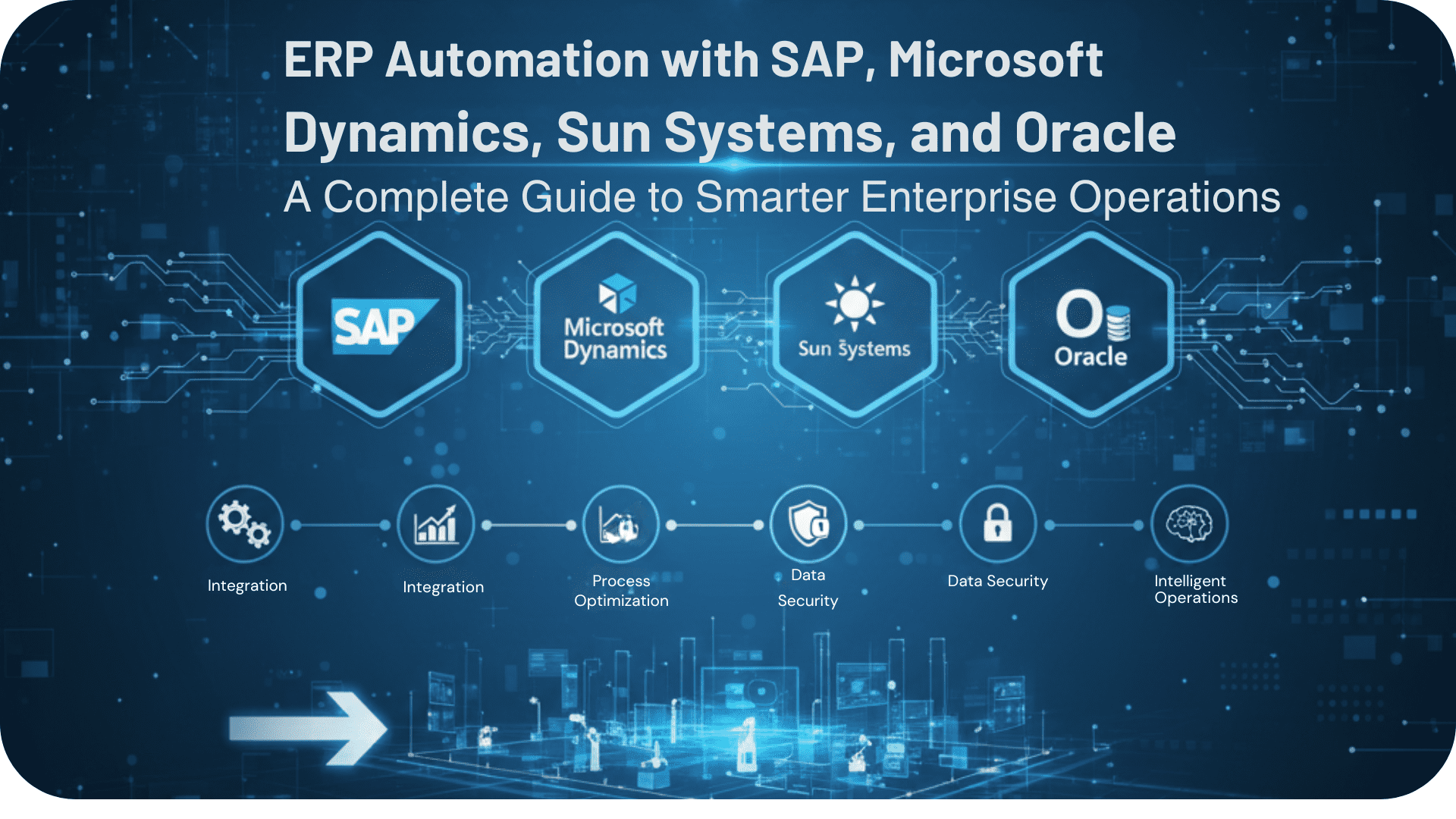
In today’s fast-moving digital economy, businesses rely on complete accuracy, speed, and real-time decision-making. This shift has made ERP automation a priority for organizations across finance, manufacturing, logistics, hospitality, healthcare, and more. Whether a company uses SAP ERP, Microsoft Dynamics 365, Sun Systems, or Oracle, the goal remains the same streamlining business processes to reduce manual effort, minimize operational errors, and increase efficiency.
Enterprise Resource Planning systems were traditionally built to centralize data. But manual inputs, repetitive workflows, and disconnected processes still slowed down productivity. This is where ERP automation reshapes the landscape. By integrating automation tools such as SAP automation, Microsoft Dynamics ERP automation, Sun Systems automation, and Oracle workflow automation organizations can eliminate bottlenecks and operate with greater precision.
ERP automation refers to integrating automated workflows, rule-based engines, AI-driven logic, and robotic process automation (RPA) into enterprise systems. Instead of employees manually entering data or updating records, automated bots and ERP-native features perform the work.
In simple terms:
ERP automation = faster processes + fewer errors + real-time analytics + improved decision-making.
From invoice posting in SAP S/4HANA to CRM updates in Microsoft Dynamics CRM, to ledger automation in Sun Systems, and HR workflows in Oracle HCM Cloud, automation ensures consistency and operational excellence.
Businesses today face increased complexity—multiple departments, global operations, remote teams, and evolving customer expectations. ERP automation solves these challenges by:
Modern organizations also rely on cloud-based ERP tools like Microsoft Dynamics 365, SAP S/4HANA, and Oracle Fusion Cloud that support advanced workflow automation, RPA integrations, and intelligent analytics.
In this landscape, companies are no longer asking “Should we automate?” but rather “How fast can we automate our ERP?”
SAP is one of the world’s most powerful ERP systems, designed to manage end-to-end enterprise operations. With SAP S/4HANA and SAP ERP, organizations can automate:
Tools such as SAP Intelligent Robotic Process Automation, SAP Workflow Management, and SAP Process Automation enhance business processes by reducing manual touchpoints.
For example:
A manufacturing company can automate its entire procurement cycle—from vendor onboarding to goods receipt—using SAP workflow automation and integrated RPA bots.
This ensures:
✔ Zero duplication
✔ Real-time updates
✔ Accurate data flow between modules (MM, FI, PP, SD)
SAP’s automation capabilities allow businesses to shift from transactional work to strategic decision-making.
Oracle has long been a pioneer in enterprise automation. Today, Oracle Fusion ERP, Oracle Cloud Financials, and Oracle HCM Cloud help large organizations automate complex processes across finance, HR, procurement, and supply chain.
Oracle automation is built on AI, predictive analytics, and cloud architecture—making it ideal for enterprises with robust governance requirements.
Where Oracle Automation Creates the Most Impact
Oracle’s integration with RPA platforms and its own intelligent tools make it possible to handle high-volume transactions effortlessly.
Automated Payroll Processing
Oracle HCM Cloud pulls attendance → validates rules → triggers payroll → exports compliance-ready reports.
Smart Procurement Automation
Oracle Cloud compares vendor quotes → applies policies → creates purchase orders → sends approvals automatically.
Financial Close Automation
Data consolidation, reconciliation, and reporting are completed with minimal human input.
Oracle’s automation suite is particularly beneficial for enterprises with thousands of employees or complex supply chains.
Modern businesses operate in environments where speed, data accuracy, and real-time decision-making are no longer optional—they are essential. ERP automation ensures that business operations run smoothly with minimal human intervention, allowing organizations to stay competitive and scalable.
Whether a company uses SAP S/4HANA, Microsoft Dynamics 365, Sun Systems, or Oracle ERP, automation creates a system where processes work seamlessly across departments.
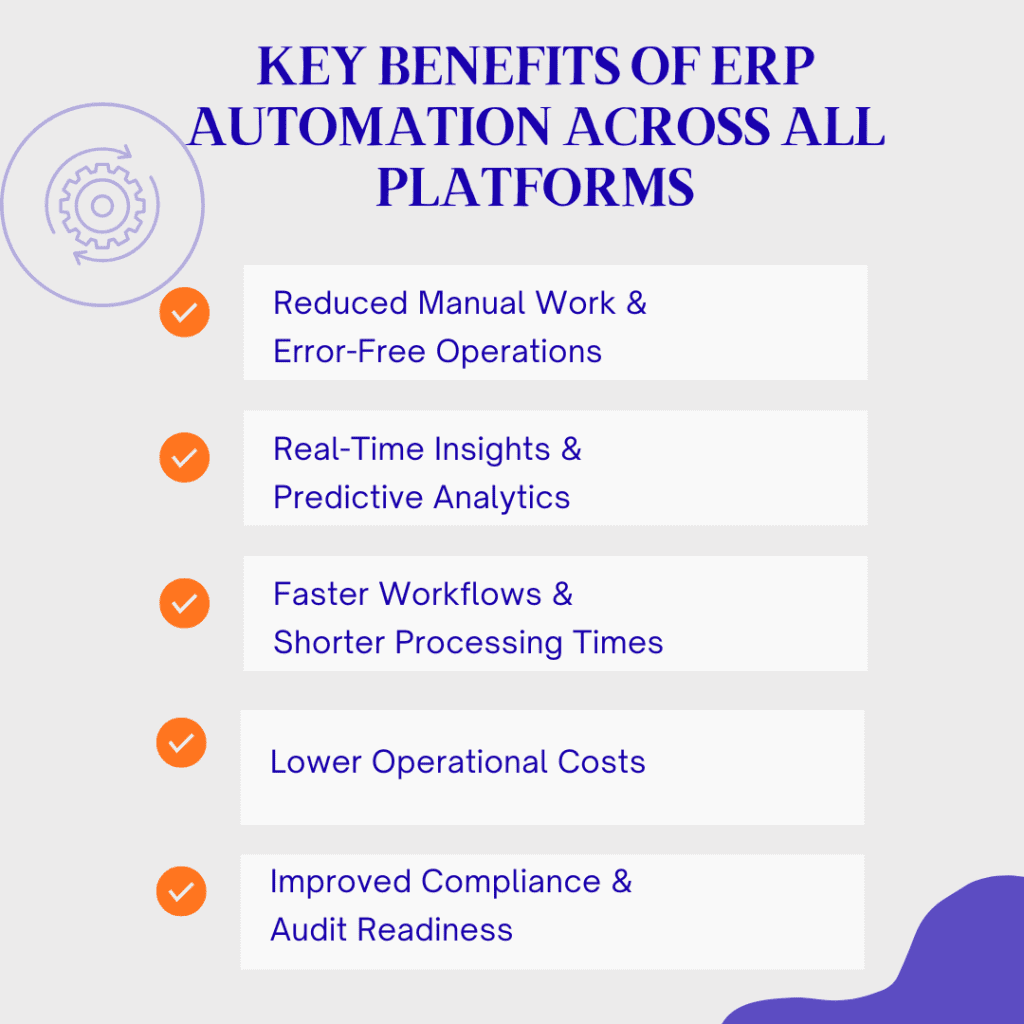
Automation reduces repetitive tasks such as data entry, reconciliations, approvals, and reporting.
Human errors—including incorrect entries, missing data, or delayed approvals—drop significantly.
Example:
A company using SAP can automate material posting, stock adjustments, or GR/IR clearance—saving hours of manual effort.
2.Real-Time Insights & Predictive Analytics
ERP systems powered by automation and AI help leadership make better decisions.
Decision-makers get live dashboards instead of waiting for monthly reports.
3.Faster Workflows & Shorter Processing Times
Automation accelerates:
This results in quicker service delivery, improved compliance, and higher customer satisfaction.
4.Lower Operational Costs
By reducing workload and minimizing errors:
RPA and workflow automation integrated with ERP systems help companies optimize staff distribution and reduce overtime expenses.
5.Improved Compliance & Audit Readiness
ERP automation ensures every approval, transaction, or change is logged automatically.
Compliance benefits include:
Industries such as banking, healthcare, and manufacturing rely heavily on automated compliance features of ERP platforms like Oracle and SAP.
ERP automation looks different across industries—but the impact is universal. Here are deeper insights into how each industry uses automation effectively:
Banking & Finance
Example:
A bank using Oracle ERP Cloud can automate risk scoring and generate compliance-ready reports without manual intervention.
Healthcare
Example:
Hospitals using Microsoft Dynamics connect patient records with billing systems to eliminate manual entries.
Manufacturing
SAP S/4HANA is widely used for end-to-end manufacturing automation—from procurement to delivery.
HR & Payroll
Platforms like Oracle HCM Cloud and Dynamics 365 HR help HR teams reduce administrative overhead.
Marketing & Sales
Dynamics 365 CRM and Salesforce integrations create faster sales cycles and higher conversion rates.
Every ERP platform automates workflows—but each offers unique strengths depending on business size, industry, and digital maturity.
SAP is known for deep industry-specific modules, especially in:
Automation Strengths:
Ideal for companies requiring complex, global, multi-entity automation.
Oracle excels in financial automation and compliance-heavy environments like:
Automation Strengths:
Oracle is preferred by CFOs seeking financial visibility and governance at scale.
Dynamics 365 offers strong flexibility and seamless integration with:
Automation Strengths:
Perfect for businesses wanting cost-effective automation with high scalability.
Sun Systems is widely used in:
Automation Strengths:
Ideal for organizations that handle complex financial structures without large IT overhead.
Consider these factors:
Business Size & Complexity
Integration Requirements
Budget & Customization
Future Scalability
Choose an ERP that supports AI, machine learning, and cloud-based automation.
ERP automation is rapidly moving into a new era driven by:
AI-Driven Workflows
Bots that learn from patterns and recommend actions.
Hyperautomation
A blend of:
This creates end-to-end autonomous processes.
Agentic Automation
ERP systems capable of:
Cloud-First Scalability
SAP S/4HANA Cloud, Oracle Fusion Cloud, and Dynamics 365 are shaping the next decade of automated enterprises.
ERP automation with SAP, Microsoft Dynamics, Sun Systems, and Oracle is no longer just a technology upgrade—it’s a strategic necessity. By automating core workflows in finance, HR, manufacturing, sales, and supply chain, organizations reduce costs, improve accuracy, and gain real-time visibility.
Automation ensures:
Businesses that embrace ERP automation today will stay competitive, scalable, and future-ready in an increasingly digital world.
1.What is ERP automation?
ERP automation refers to using tools like AI, RPA, and built-in workflows to automate repetitive tasks inside ERP systems such as SAP, Oracle, Sun Systems, or Dynamics 365.
2.Which ERP is best for large organizations?
SAP S/4HANA and Oracle ERP Cloud are preferred for large, complex, and global enterprises.
3.Can RPA work with ERP systems?
Yes. RPA integrates with SAP, Oracle, Dynamics, and Sun Systems to automate data entry, reconciliations, approvals, and more.
4.Is ERP automation expensive?
Costs vary, but automation reduces labor, errors, and delays—resulting in strong long-term ROI.
5.What is the future of ERP automation?
AI-driven ERP, hyperautomation, and autonomous process systems will dominate the next decade, making operations faster and more intelligent.
Subscribe to our newsletter and stay updated.