- Follow On:
- [email protected]
- +918655715397
- Thane west, Maharashtra - 400604

Business outsourcing is the practice of assigning specific business functions or processes to an external service provider instead of managing them entirely in-house. Businesses outsource functions such as finance and accounting, HR, payroll, IT, customer support and back-office operations to access specialized expertise, improve efficiency and scale operations.
Outsourcing is the practice of transferring specific business activities, processes or functions to an external service provider. Instead of performing every function with an internal team, businesses work with specialized providers to manage selected operational activities.
Depending on business requirements, outsourcing can support functions such as finance and accounting, HR, payroll, customer service, IT, data processing and other back-office operations.
Add this short process:
Determine which business function is consuming excessive time, resources or expertise.
Establish the scope, expected outcomes, service levels, security requirements and reporting needs.
Evaluate providers based on expertise, technology, security, compliance, scalability and industry experience.
Transfer relevant processes, documentation, systems and responsibilities to the outsourcing partner.
Track SLAs, KPIs, quality, turnaround times, compliance and business outcomes.
Review performance regularly and expand or adjust outsourced services as business needs change.
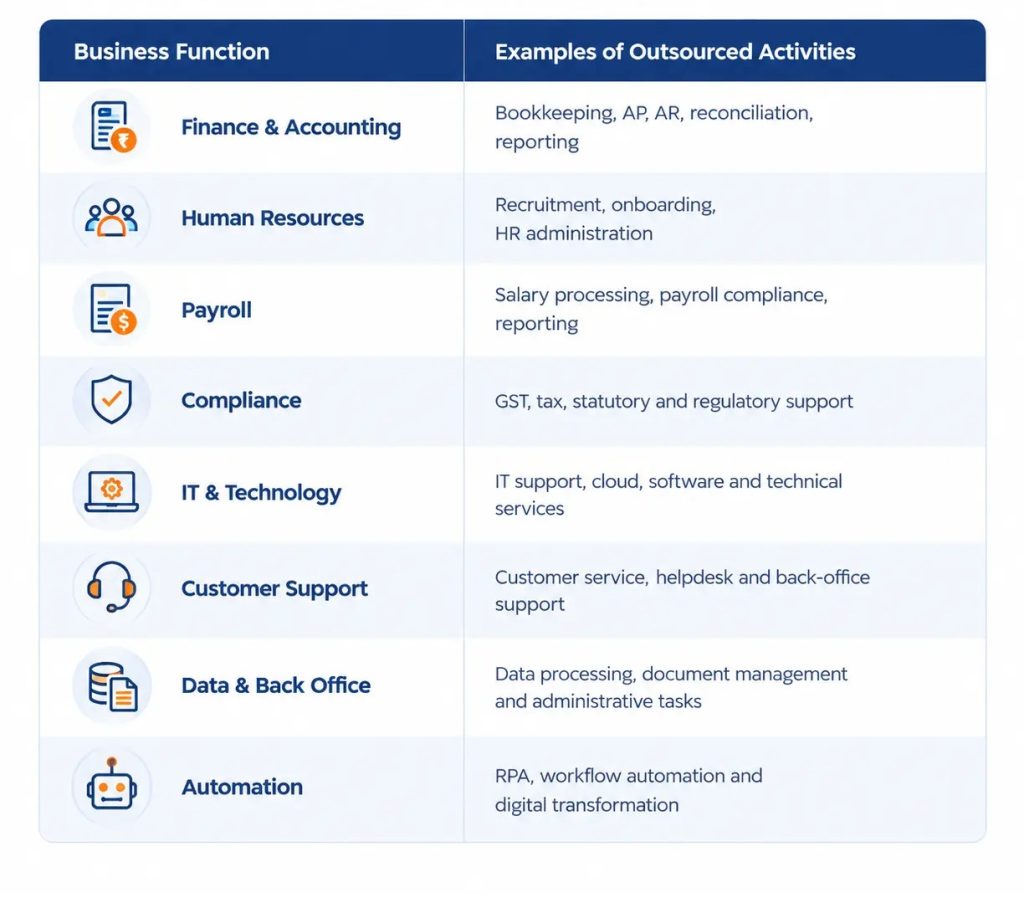
When businesses decide to outsource, they can choose from several types of outsourcing models, each suited to different needs and budgets.
These models give companies flexibility, scalability solutions, and cost-effective outsourcing opportunities.
The advantages of outsourcing are wide-ranging and directly impact a company’s growth and sustainability. Some key benefits include:
While outsourcing offers many benefits, it also has drawbacks that businesses must weigh carefully:
Understanding both advantages and disadvantages of outsourcing helps businesses make smarter decisions and select the right outsourcing model.
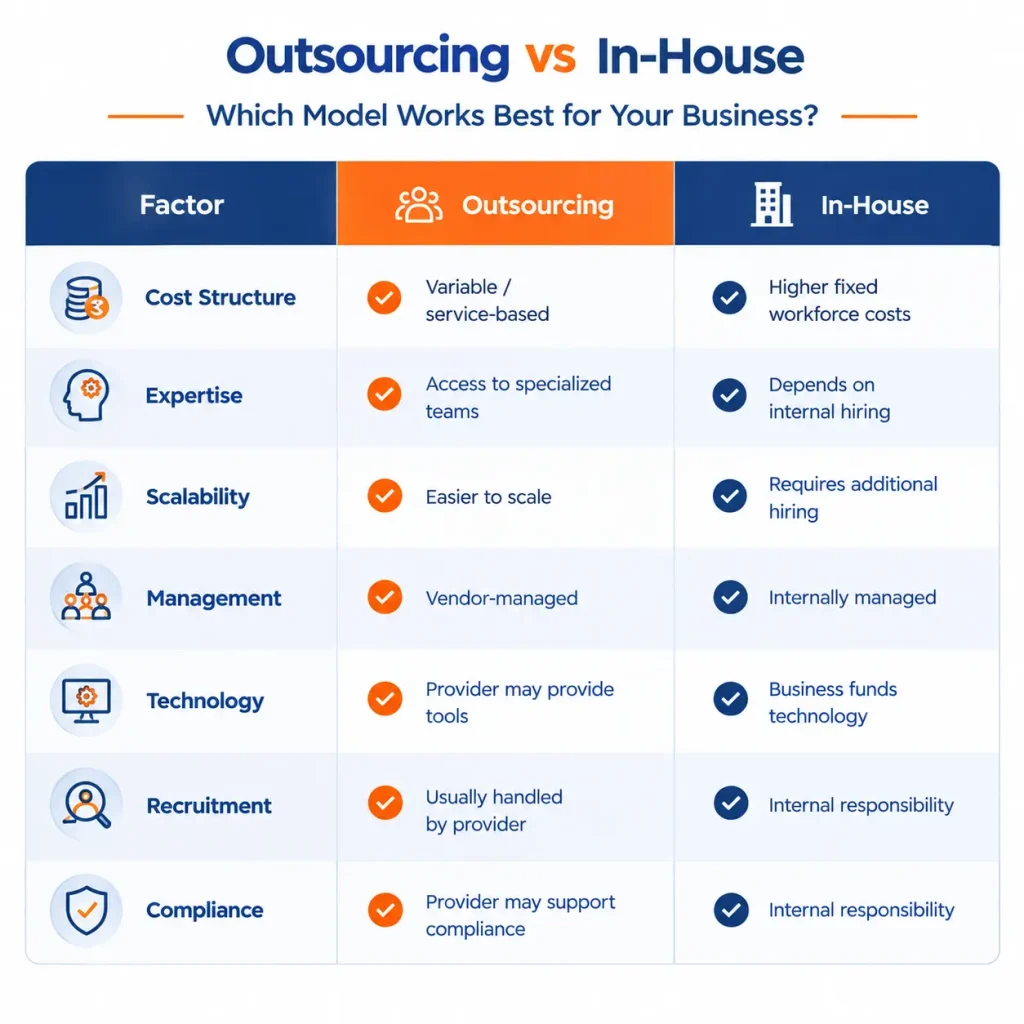
When it comes to managing critical business functions like HR, finance, Payroll, or customer support, companies often face a common dilemma: Should we manage everything in-house, or should we outsource to specialized service providers? Both approaches have their advantages and challenges, and the right choice depends on your company’s goals, resources, and long-term vision.
Outsourcing providers are increasingly combining human expertise with automation and AI-enabled workflows.
Businesses increasingly expect real-time reporting, dashboards and measurable KPIs from outsourcing partners.
Businesses are moving beyond simple task outsourcing toward partnerships focused on measurable business outcomes.
Companies are combining finance, HR, payroll, compliance and technology support instead of managing multiple disconnected providers.
As more sensitive financial, employee and operational data is handled externally, security and governance remain critical vendor-selection criteria.
Businesses can combine internal teams, outsourced specialists and global delivery models to create flexible operating structures.
These trends show how outsourcing has moved from being just a cost-cutting tool to becoming a strategic growth driver.
Not every task should be outsourced, but there are clear indicators that suggest when outsourcing makes sense:
For startups and established companies alike, understanding when to outsource business tasks is essential to staying competitive in today’s globalized economy.
For startups, resources are often limited, and every decision can impact growth. Outsourcing for startups is not just about saving money it’s about building a foundation for sustainable success.
Some key benefits include:
In short, outsourcing gives startups the flexibility to remain lean while focusing on innovation and customer acquisition.
Cost-effective outsourcing is one of the strongest reasons companies both startups and large enterprises embrace this strategy. Instead of hiring full-time employees for specialized roles, businesses can outsource tasks like payroll, HR, or IT services to reduce overhead.
Some cost-saving examples include:
By leveraging vendor management and managed services, organizations can reallocate savings toward research, marketing, or customer experience.
What functions should we outsource, and why?
Identify whether the tasks are core (directly impacting growth) or non-core (administrative, repetitive). Outsourcing works best for non-core but resource-heavy functions.
What are the cost implications compared to in-house management?
Beyond vendor pricing, consider hidden costs like transition, compliance, and technology integration.
How do we ensure data security and compliance?
Verify if the provider follows industry standards (ISO, GDPR, SOC 2, etc.) and offers transparent data handling practices.
What expertise and technology does the outsourcing partner bring?
Look for providers who can enhance efficiency through automation, cloud-based tools, and specialized talent.
How scalable are their services?
Check if they can handle sudden increases in workload or expand services as your business grows.
What level of control and reporting will we maintain?
Ensure clear SLAs (Service Level Agreements), reporting dashboards, and regular performance reviews.
How will outsourcing impact our company culture and employee experience?
Align outsourced services with your internal culture to avoid disconnect between teams.
What is the provider’s track record in our industry?
Industry-specific knowledge often makes outsourcing more efficient and reduces compliance risks.
What are the long-term strategic benefits?
Consider whether outsourcing only reduces costs or if it also contributes to innovation, growth, and competitiveness.
The BPO (Business Process Outsourcing) industry has been at the heart of the outsourcing revolution. From customer support to data entry, the BPO industry manages high-volume, repetitive tasks efficiently.
What is the BPO industry? It refers to companies that specialize in managing non-core processes for other organizations. These processes include:
The BPO business process outsourcing model offers scalability solutions, improves customer satisfaction, and ensures businesses focus on strategic initiatives rather than operational details.
With the growth of digital transformation, BPO companies now integrate advanced tools like AI chatbots, analytics, and digital asset management systems to deliver smarter solutions.
The outsourcing industry is evolving rapidly, and by 2025, businesses will not just be looking for cost savings; they will want innovation, flexibility, and process efficiency. Some global outsourcing trends include:
These trends in the outsourcing industry show how outsourcing has transformed from a tactical decision into a strategic advantage.
Effective vendor management is one of the most critical aspects of a successful outsourcing strategy. It ensures that service providers consistently deliver on quality, timelines, and performance standards through well-defined Service Level Agreements (SLAs) and KPIs. By maintaining structured oversight, businesses can avoid hidden costs, scope creep, and inefficiencies, making outsourcing truly cost-effective.
Strong vendor management also plays a vital role in compliance and risk mitigation, especially when partners handle sensitive employee or financial data. It helps organizations meet global regulations such as GDPR or ISO standards, reducing exposure to penalties and reputational damage. Moreover, effective vendor management fosters clear communication, collaboration, and faster problem resolution, ensuring alignment between outsourced teams and business objectives. Beyond immediate operational benefits, it also supports scalability and flexibility, enabling businesses to adjust services as they grow.
Most importantly, treating vendors as strategic partners rather than just service providers transforms outsourcing into a long-term growth enabler, driving innovation and sustainable business success.
Another rising trend is the use of managed services. Instead of outsourcing a single task, companies are outsourcing entire functions such as HR outsourcing, IT outsourcing, or payroll outsourcing.
Managed services outsourcing offers:
For businesses aiming at long-term growth, managed services are becoming a smarter alternative to traditional outsourcing.
One of the most debated questions is: Is outsourcing good or bad? The answer depends on how it is implemented.
Ultimately, outsourcing is neither fully good nor bad—it is a business strategy. Companies that choose the right outsourcing model, balance outsourcing vs in-house tasks, and manage vendors effectively will continue to thrive in 2025 and beyond.
Outsourcing has moved far beyond being just a cost-saving tactic. Today, it is about agility, innovation, and global collaboration. From business process outsourcing to outsourcing software development and digital transformation outsourcing, companies of all sizes from startups to enterprises are leveraging outsourcing to stay competitive.
As we look ahead, global outsourcing trends will be driven by technology, remote work, and the demand for specialized expertise. Businesses that embrace outsourcing as a strategic tool, supported by strong vendor management and scalability solutions, will shape the future of work.
So, if you are wondering whether outsourcing is right for your organization, the answer lies in your goals: reduce costs, access global talent, and achieve sustainable growth.
Business outsourcing is the practice of assigning selected business functions or processes to an external service provider instead of managing them entirely in-house.
Businesses can outsource finance and accounting, HR, payroll, recruitment, customer support, IT, data processing, compliance and other business processes.
The main benefits include access to specialized expertise, lower operating costs, improved efficiency, scalability and greater focus on core business activities.
It depends on the function, business requirements, cost structure, expertise needed and level of control required. Some businesses use outsourcing for selected functions while keeping strategic activities in-house.
A business may consider outsourcing when a function is consuming significant internal resources, requires specialized expertise, needs to scale quickly or is difficult to manage efficiently in-house.
Common risks include data-security concerns, vendor dependency, communication gaps, quality issues and inadequate oversight. Proper vendor selection, SLAs and regular performance monitoring can help reduce these risks.
Evaluate the provider’s expertise, service scope, technology, security practices, compliance capabilities, scalability, reporting and track record.
Explore tailored outsourcing solutions for finance, HR, payroll, compliance and business processes with Wisecor.
Subscribe to our newsletter and stay updated.