- Follow On:
- [email protected]
- +918655715397
- Thane west, Maharashtra - 400604
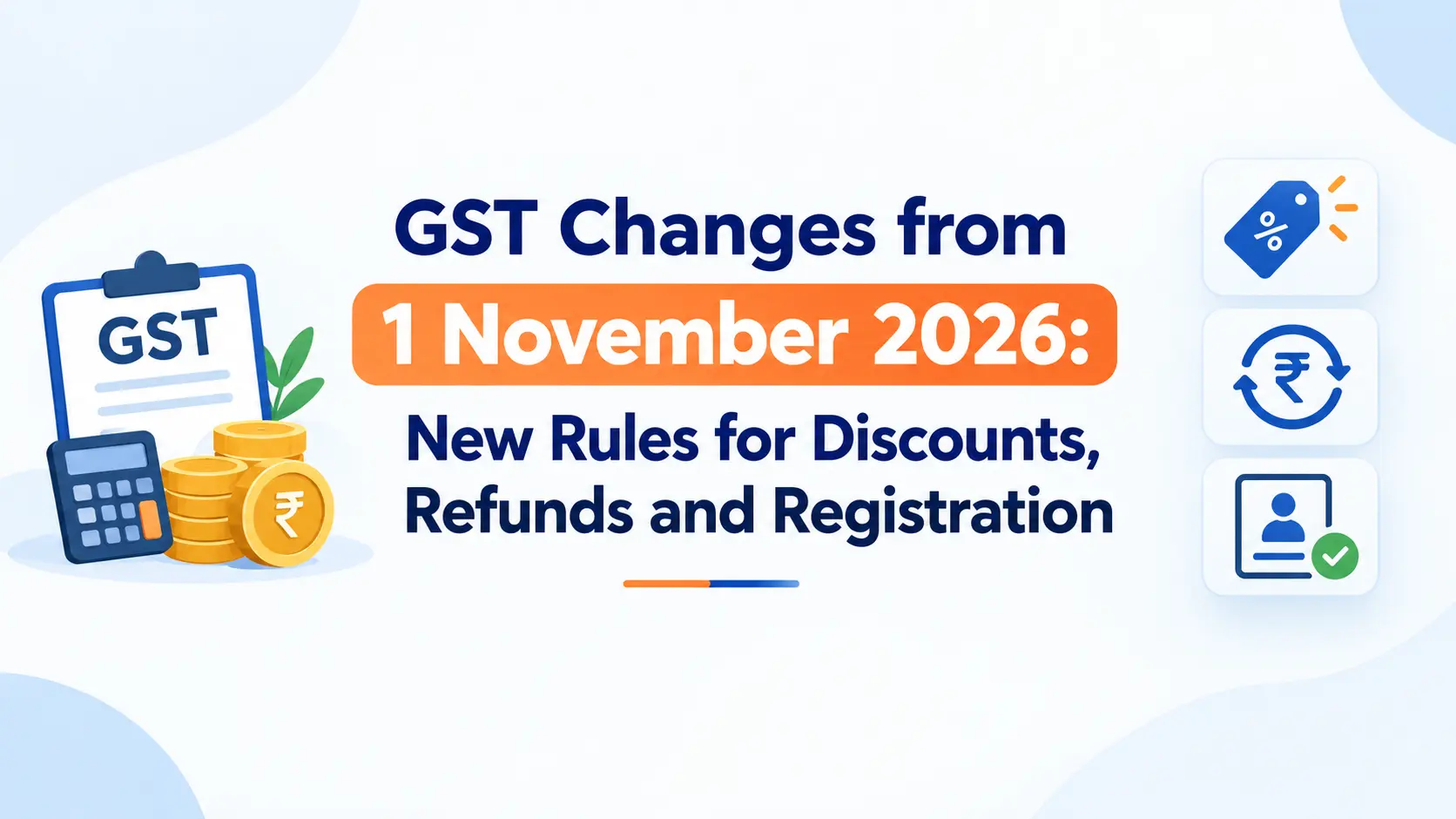
India is introducing important changes to its Goods and Services Tax (GST) framework from 1 November 2026, alongside wider reforms intended to simplify registration, improve refund processing and reduce compliance difficulties for businesses.
The latest amendments notified by the government cover post-sale discounts, provisional refunds for businesses facing an inverted duty structure and the minimum refund threshold for certain exports. Separately, the 57th GST Council meeting recommended reforms to GST registration, profile amendments, e-commerce seller registration, cancellation procedures and return filing.
These changes are relevant to manufacturers, pharmaceutical companies, retailers, distributors, exporters, startups, e-commerce sellers and finance teams managing GST compliance.
For businesses, the priority is to understand which changes take effect on 1 November, which are being introduced in phases and what adjustments may be needed in accounting, documentation and tax processes.
The government has notified 1 November 2026 as the commencement date for Sections 153 to 155 of the Finance Act, 2026, which amend provisions of the Central Goods and Services Tax (CGST) Act. The changes cover post-supply discounts, provisional refunds and certain export refund claims.
Businesses often offer discounts after a sale through annual rebates, volume incentives, dealer schemes, promotional arrangements or performance-based rewards. Under the earlier GST framework, the relevant post-supply discount generally had to be established through an agreement entered into before or at the time of supply and linked to the relevant invoices.
From 1 November 2026, the amended provisions remove the requirement for such a prior agreement for qualifying post-supply discounts.
However, the tax treatment is not automatic. To exclude an eligible discount from the value of supply, the supplier must issue a qualifying credit note and the recipient must reverse the corresponding input tax credit (ITC) attributable to the discount, as required under the amended provisions.
This change may be particularly relevant to FMCG, pharmaceutical, retail and consumer-goods businesses that frequently use post-sale commercial incentives.
An inverted duty structure occurs when the GST rate on inputs is higher than the GST rate on the corresponding outward supplies. This can result in accumulated, unutilised input tax credit and put pressure on a business’s working capital.
From 1 November 2026, the amended refund provisions extend the provisional refund framework to eligible refunds of unutilised ITC arising from an inverted duty structure.
Under the wider GST refund reforms, eligible claims may qualify for a provisional refund of up to 90% of the claimed amount, subject to the applicable process, risk assessment and other conditions.
This is intended to help eligible businesses access funds sooner while their refund claims undergo the prescribed verification process. It does not mean that every refund will automatically be sanctioned or that every accumulated ITC balance is refundable.
Businesses with substantial input-tax accumulation should review their refund processes and cash-flow forecasts to understand the potential impact.
The notified amendments also remove the ₹1,000 minimum refund threshold for the specified category of goods exported out of India with payment of tax.
This can help exporters with eligible lower-value refund claims that might otherwise fall below the minimum threshold.
The change is specific to the category covered by the amended law. It should not be interpreted as removing the minimum threshold for every GST refund category.
Alongside the notified tax amendments, the GST Council has recommended changes intended to make registration requirements clearer and more consistent.
A comprehensive set of registration documentation guidelines and FAQs is intended to help applicants understand the documents required for different registration situations. The GST registration application, FORM GST REG-01, is also being streamlined with clearer document-selection options and improved portal guidance.
These measures aim to reduce avoidable application errors and queries arising from incomplete documentation.
Standardisation does not remove the requirement to provide valid supporting documents or meet applicable GST conditions. Businesses should refer to the latest CBIC circulars and portal instructions when applying.
Startups and service businesses operating from shared offices may need to establish appropriate proof of their principal place of business.
The clarified documentation approach addresses co-working arrangements by recognising relevant membership documentation that identifies the allocated workspace. Depending on the arrangement, supporting documents relating to the premises or the co-working provider’s occupancy rights may also be required.
This can make the process more practical for eligible startups and service providers without a conventional standalone office.
Businesses may need to update GST registration details when changing certain business particulars or adding locations.
The reforms aim to reduce manual intervention for specified registration amendments. Under the applicable framework, changes to the principal place of business for taxpayers registered through Rule 14A are also covered by the automatic processing route, subject to the relevant conditions.
Other taxpayers must continue to follow the applicable approval process for principal-place-of-business amendments.
Eligible businesses may be able to update registration information more efficiently when making permitted changes. However, they should still submit the prescribed application, provide supporting documents and check that the updated information appears correctly on their registration certificate.
Automatic processing should not be confused with an exemption from documentation or compliance requirements.
A further reform supports eligible small suppliers selling goods through e-commerce operators.
Under the new mechanism in Rule 14B, qualifying sellers may declare an e-commerce operator’s warehouse in another state or Union Territory as their principal place of business for the relevant registration, subject to prescribed conditions.
The mechanism includes a monthly output-tax-liability condition of no more than ₹2.5 lakh for the specified supplies, along with requirements such as consent from the e-commerce operator and other applicable eligibility criteria.
The new route is scheduled to take effect from 1 November 2026.
The facility may help eligible online sellers expand into additional states without establishing a conventional physical office in every state where they seek registration.
However, this is not a blanket exemption from state-wise GST registration requirements. Sellers should confirm eligibility, the applicable tax-liability limit, warehouse arrangements and operator consent before applying.
The GST Council has also recommended changes intended to make registration cancellation more efficient for eligible taxpayers.
Under the phased framework, certain cancellation applications in FORM GST REG-16 can be automatically accepted once the prescribed requirements have been satisfied, including filing pending returns and clearing applicable dues.
The wider reform plan also includes integrating the relevant final-return information from FORM GSTR-10 into the cancellation process to reduce repetitive filing steps.
The automatic process is subject to the applicable eligibility conditions and implementation phase. Businesses should not assume that every cancellation application will be automatically approved from 1 November 2026.
Properly managing these steps can help businesses close their registrations with fewer avoidable compliance issues.
The wider GST reform programme also includes recommendations to improve return filing, invoice reconciliation and input tax credit reporting.
The proposed changes involve forms such as GSTR-1, GSTR-1A and the Invoice Furnishing Facility (IFF), along with improvements intended to help taxpayers reconcile outward supplies, tax liabilities and ITC information before filing GSTR-3B.
Better reconciliation with GSTR-2B and clearer correction processes are intended to reduce inconsistencies in reported data. However, these measures do not guarantee that mismatch notices will disappear or that every ITC claim will be accepted automatically.
Implementation note: Return-form changes and related system improvements may have separate rollout dates. Businesses should check official notifications and GST portal updates rather than assume all reforms take effect on 1 November 2026.
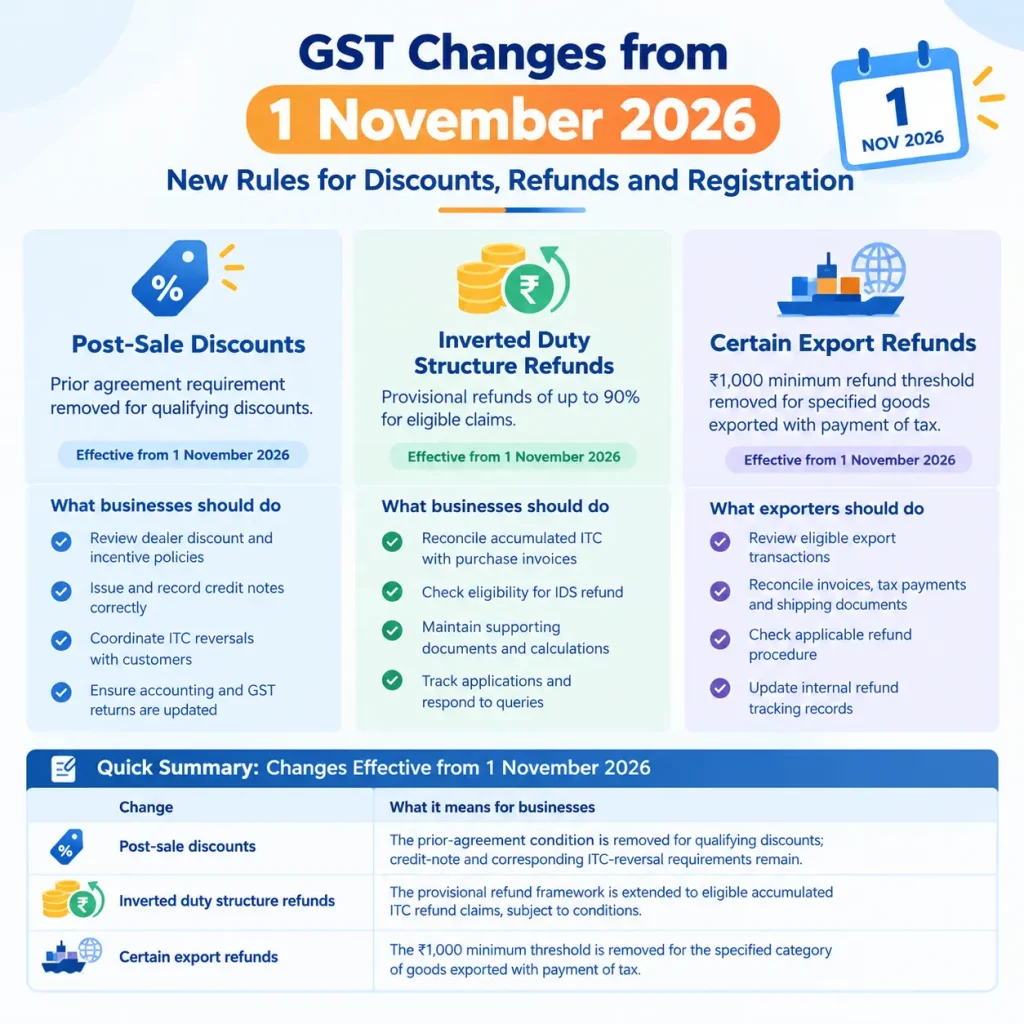
The combined reforms may affect different businesses in different ways.
Manufacturers and distributors: Review post-sale discount arrangements, credit notes and customer ITC-reversal processes.
Pharmaceutical and FMCG companies: Assess the impact of discount schemes and accumulated ITC on accounting procedures and working capital.
Exporters: Check eligibility for the specified refund relaxation and ensure that export documentation is complete.
Startups and SMEs: Review registration documentation, address proof and the requirements for using co-working spaces.
E-commerce sellers: Assess whether the new registration route is available for their business and warehouse arrangements.
Finance and accounting teams: Update reconciliation procedures, refund tracking and compliance calendars to reflect applicable changes.
Businesses should apply each reform only where its statutory conditions and effective date are satisfied.
GST amendments can affect tax calculations, credit-note processing, accounting records, refund claims and registration details. Businesses should review their procedures to ensure that changes are reflected accurately in their financial and compliance workflows.
Wisecor Global supports businesses with finance and accounting outsourcing, GST compliance and tax support, payroll and compliance services, and related business support solutions.
Businesses can benefit from a structured review of:
The appropriate support depends on the business’s transactions, registration status and compliance requirements.
The notified amendments cover qualifying post-sale discounts, provisional refunds for eligible inverted duty structure claims and removal of the ₹1,000 minimum refund threshold for the specified category of goods exported with payment of tax.
The amended provisions remove the requirement for a prior agreement for qualifying post-supply discounts. The supplier must still issue a qualifying credit note, and the recipient must reverse the corresponding ITC as required by law.
An inverted duty structure arises when the GST rate on inputs is higher than the rate on the corresponding outward supplies. This can lead to accumulated unutilised ITC and affect working capital. Refund eligibility remains subject to the applicable statutory conditions.
Eligible suppliers of goods may use the Rule 14B mechanism to declare a qualifying e-commerce operator’s warehouse as their principal place of business in another state or Union Territory. Prescribed tax-liability limits, operator consent and other conditions apply.
No. Automatic processing applies to specified amendments under the applicable framework. Other changes may still require officer approval and supporting documentation.
The cancellation process is being simplified in phases for eligible cases. Businesses must meet the applicable requirements for pending returns, dues and other prescribed conditions.
No. Businesses must continue to maintain accurate invoices, reconcile GST returns and verify ITC eligibility. System improvements do not replace the taxpayer’s compliance responsibilities.
The GST changes effective from 1 November 2026 introduce important adjustments to post-sale discounts, provisional refunds and certain export refund claims. Alongside these notified amendments, wider registration and compliance reforms aim to make the GST system more predictable and easier for eligible businesses to navigate.
Businesses should review their discount policies, refund eligibility, registration documentation and return-reconciliation procedures while tracking the implementation dates of the wider reforms.
Need support with GST compliance, accounting or financial processes? Explore Wisecor Global’s finance and accounting and GST compliance services to understand how structured support can help your business maintain accurate records and manage recurring compliance requirements.