- Follow On:
- [email protected]
- +918655715397
- Thane west, Maharashtra - 400604
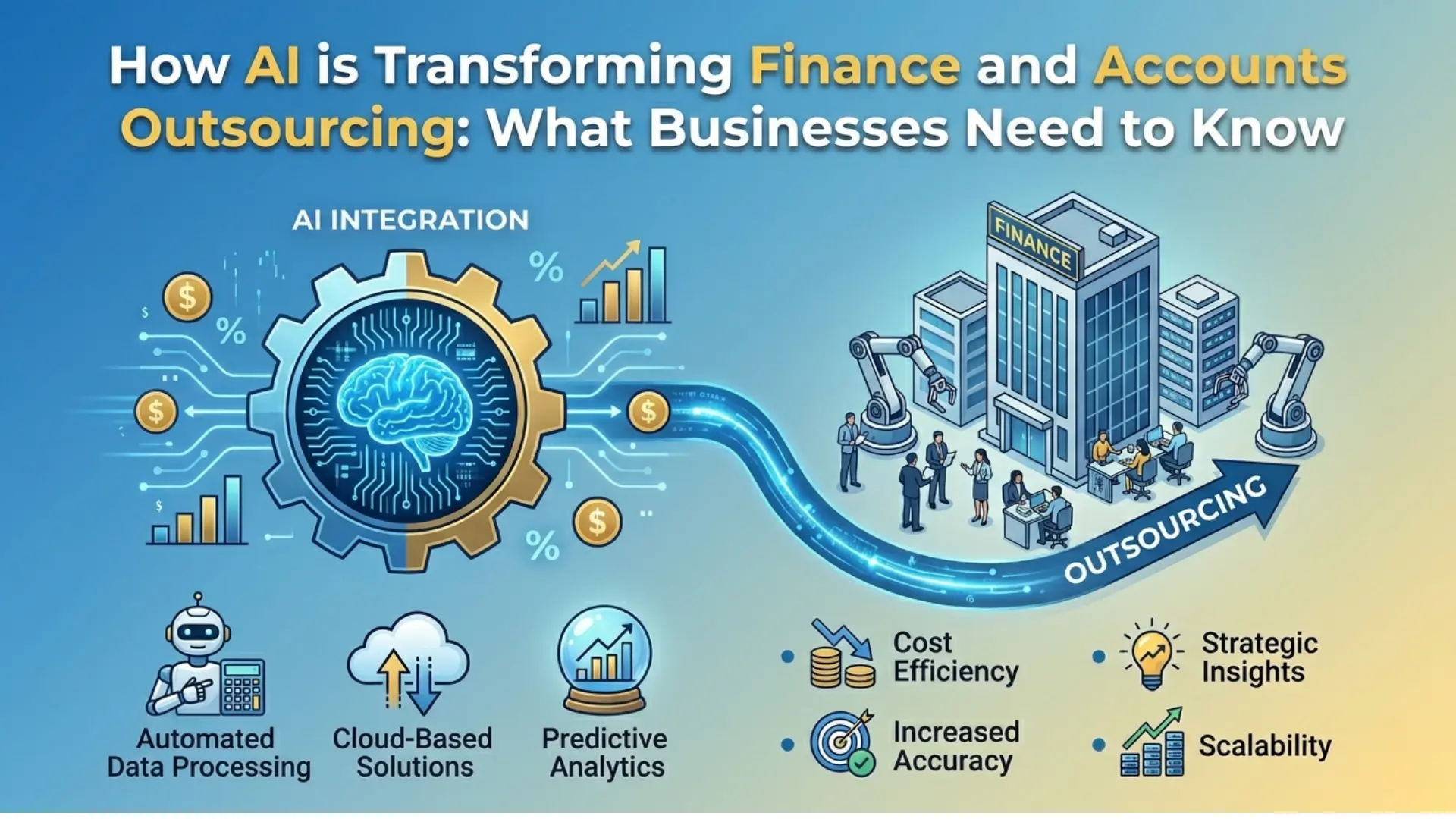
Finance and accounts outsourcing is evolving rapidly, and artificial intelligence is at the center of this transformation. What was once a process driven by manual data entry and routine bookkeeping is now becoming faster, more accurate, and more strategic. Businesses are no longer outsourcing only to reduce costs, but also to gain access to intelligent systems that improve decision making and financial visibility.
As companies deal with increasing data volumes and complex compliance requirements, AI in finance and accounting outsourcing is helping streamline operations. From automated invoice processing to predictive financial analysis, AI is reshaping how outsourced finance functions deliver value. Understanding this shift is essential for businesses looking to stay competitive and efficient.
Artificial intelligence plays a critical role in improving how outsourced finance functions operate. It helps automate repetitive tasks such as data entry, invoice matching, and reconciliation, which were traditionally time consuming and prone to human error.
In finance and accounting outsourcing, AI systems analyze large datasets quickly and provide insights that go beyond basic reporting. This enables outsourced teams to focus more on analysis and strategy rather than routine processing. As a result, businesses receive more accurate financial information and faster turnaround times.
Accuracy is one of the biggest challenges in accounting, especially when dealing with large volumes of transactions. AI reduces errors by automating data extraction and validation processes. It can identify inconsistencies, duplicate entries, and missing data in real time.
With AI driven accounting systems, businesses can ensure that financial records are consistent and reliable. This is particularly important for compliance and reporting, where even small mistakes can lead to penalties or audit risks. Improved accuracy also builds confidence in financial decision making.
Cost reduction has always been a key reason for outsourcing, but AI takes this benefit further. By automating routine accounting tasks, businesses can reduce the need for manual intervention and minimize operational expenses.
AI also helps optimize resource allocation. Instead of spending time on repetitive work, outsourced teams can focus on higher value activities such as financial planning and analysis. Over time, this leads to better productivity and cost efficiency without compromising quality.
Financial reporting is no longer limited to historical data. AI enables real time reporting and predictive analysis, giving businesses a forward looking view of their finances. This shift allows organizations to identify trends, forecast performance, and respond to changes quickly.
In outsourced accounting, AI tools generate dashboards and reports automatically, reducing delays in reporting cycles. Businesses can access insights whenever needed, which supports faster and more informed decision making. This makes financial reporting more dynamic and strategic.
Compliance is a critical aspect of finance and accounting outsourcing. AI helps ensure that financial processes follow regulatory requirements by continuously monitoring transactions and flagging potential issues.
It can detect unusual patterns that may indicate fraud or non compliance. This proactive approach reduces the risk of errors and strengthens internal controls. For businesses, this means better compliance management and lower exposure to financial risks.
AI is not just improving processes, it is enhancing decision making in finance. By analyzing historical data and identifying patterns, AI provides insights that help businesses plan more effectively. It supports forecasting, budgeting, and performance analysis with a higher level of accuracy.
In finance and accounts outsourcing, this means businesses receive more than just reports. They get actionable insights that guide strategic decisions. Whether it is managing cash flow or evaluating investments, AI driven insights help organizations make informed choices with confidence.
While AI brings many advantages, it also comes with certain challenges. One of the main concerns is the initial implementation and integration with existing systems. Businesses may need to invest time and resources to adopt AI driven solutions effectively.
Another challenge is the need for skilled professionals who can manage and interpret AI generated data. Without proper understanding, the benefits of AI may not be fully realized. Organizations must also ensure that their teams are trained to work alongside automated systems.
Data security is a major concern when outsourcing finance functions, and the use of AI adds another layer to this discussion. AI systems process large amounts of sensitive financial data, making it important to have strong security measures in place.
However, AI can also enhance security by detecting unusual activities and potential threats in real time. Advanced systems can identify suspicious transactions and alert businesses before issues escalate. When combined with proper controls, AI can strengthen overall data protection in outsourced accounting.
The future of finance and accounts outsourcing is closely linked with advancements in artificial intelligence. As technology continues to evolve, AI will become more integrated into financial operations, offering deeper insights and higher efficiency.
Businesses can expect more automation in areas such as tax compliance, financial reporting, and risk management. Predictive analytics will play a bigger role in planning and strategy. Over time, outsourcing will shift from being a cost saving solution to a value driven partnership supported by intelligent systems.
The impact of AI on finance and accounts outsourcing is both significant and ongoing. It is transforming traditional processes into more efficient, accurate, and insight driven operations. From improving financial reporting to strengthening compliance and supporting decision making, AI is redefining the role of outsourced finance functions.
For businesses, adopting AI enabled outsourcing is no longer just an option but a strategic move. It allows organizations to stay competitive, reduce risks, and make better financial decisions. As the technology continues to evolve, those who adapt early will benefit the most from its long term potential.
What is AI in finance and accounts outsourcing
AI in finance and accounts outsourcing refers to the use of intelligent systems to automate accounting tasks, improve accuracy, and provide data driven financial insights.
How does AI improve accounting accuracy
AI reduces manual errors by automating data entry, validating transactions, and identifying inconsistencies in financial records.
Is AI replacing human roles in accounting outsourcing
AI is not replacing human roles but changing them. It allows professionals to focus on analysis, strategy, and decision making instead of routine tasks.
What are the benefits of AI in outsourced finance services
Key benefits include improved efficiency, cost reduction, better compliance, enhanced reporting, and smarter financial decision making.
Is AI secure for handling financial data
AI systems can be secure when supported by strong data protection measures. They also help detect fraud and unusual activities in real time.
Subscribe to our newsletter and stay updated.