- Follow On:
- [email protected]
- +918655715397
- Thane west, Maharashtra - 400604
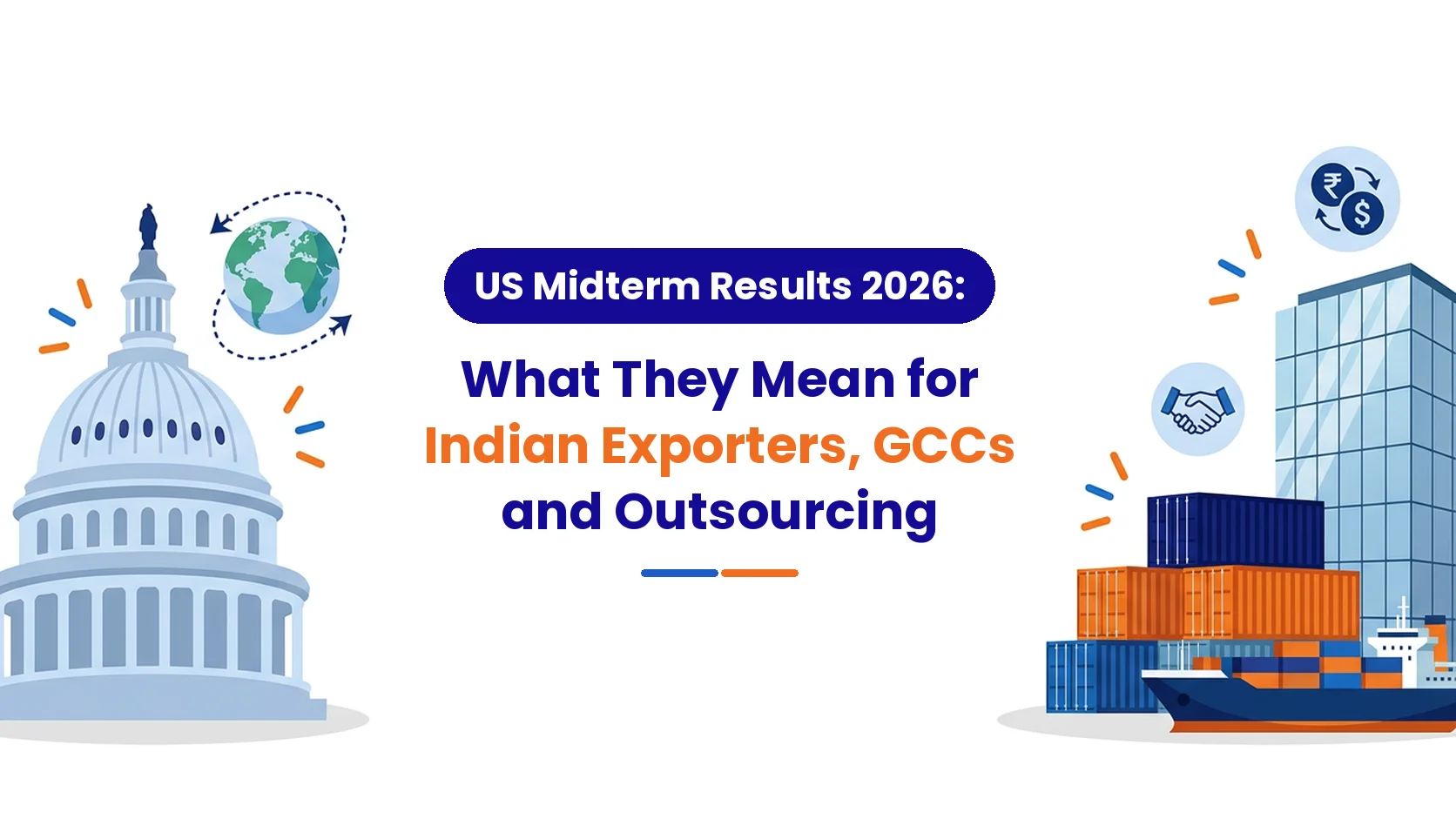
The results of the 2026 US midterm elections, declared on 4 November 2026, have changed the balance of power in Washington. The Democratic Party won majorities in both the Senate and the House of Representatives, so it will control the US Congress for the remaining two years of President Donald Trump’s term.
For Indian businesses, the result matters because US policy directly affects export tariffs, the proposed India-US trade agreement, outsourcing contracts with American clients and the movement of skilled professionals through the H-1B programme.
The outcome does not automatically reverse existing tariffs, visa rules or trade decisions. Many of these were introduced through executive action, and the President keeps significant authority over trade and immigration. What changes is the level of scrutiny, oversight and negotiation around these policies.
These developments are relevant to exporters, Global Capability Centres (GCCs), IT and business services companies, outsourcing providers, staffing firms and finance teams that manage US-linked revenue and costs.
All 435 seats in the House of Representatives and 35 of the 100 Senate seats were up for election on 3 November 2026. Before the vote, the Republican Party controlled both chambers.
According to results reported on 4 November 2026, Democrats hold at least 54 of the 100 Senate seats (including two independents who vote with them), with races in Alaska and Mississippi still uncalled. In the House, Democrats crossed the 218 seats needed for a majority, with trackers showing at least 240 seats as counting continues. Final counts may still change.
The new (120th) Congress will be sworn in in January 2027. Congressional committees, including those that handle trade and immigration legislation, will then be reconstituted with new chairs.
It is important to separate what Congress can influence from what remains with the President.
For businesses, the practical message is to plan for continued uncertainty rather than an immediate reversal of policies.
Indian exports to the US faced duties that at one point reached 50%. Under the India-US framework for an interim trade agreement announced in February 2026, the reciprocal tariff on most Indian goods was reduced to 18%.
Negotiations on a broader bilateral trade agreement are still under way. Market access for agricultural products and India’s purchases of Russian crude oil have been the main points of difference. A pending Section 301 investigation in the US also adds uncertainty to future tariff treatment.
A Democrat-controlled Congress may examine the effect of tariffs on American businesses, which could make trade policy more predictable over time. However, Democrats have their own concerns about market access, so the near-term direction is still unclear.
The Halting International Relocation of Employment (HIRE) Act was introduced in the US Senate in October 2025 by Senator Bernie Moreno of Ohio. It proposes a 25% excise tax on specified outsourcing payments made by US taxpayers to foreign persons for work that benefits consumers in the United States. It would also disallow income-tax deductions for those payments.
The HIRE Act is a proposal and has not become law. With control of Congress changing, its future is uncertain. Even so, it shows that outsourcing to India remains a topic of debate in US politics.
In September 2025, the US administration imposed a $100,000 fee on new H-1B visa applications through a presidential directive. A US federal court ruled in June 2026 that this fee was not clearly authorised, and enforcement has since been blocked. In August 2026, the Department of Homeland Security proposed a separate fee of $103,265 on each cap-subject H-1B petition through a formal rulemaking process.
India-born beneficiaries accounted for 69.9% of all approved H-1B petitions in the 2025 fiscal year, according to USCIS data.
A Democrat-controlled Congress may increase scrutiny of these measures. However, there is no immediate relief for applicants, and any reform of green card limits would require new legislation.
Restrictions on sending professionals to the US have encouraged many companies to build or expand teams in India, often through GCCs. Continued uncertainty around H-1B costs may keep this trend going, as businesses look for stable delivery models that rely less on on-site travel.
The election result may also affect the rupee, crude oil prices and Indian markets indirectly. Reports note that any easing of geopolitical tensions could lower oil prices, which matters for India as a major fuel importer. At the same time, a divided government in the US could lead to budget disputes and short-term market volatility.
For finance teams, this means keeping a closer watch on foreign exchange exposure, US dollar receivables and import costs.
The impact will differ by sector and business model.
Exporters: Review tariff exposure, contract terms with US buyers and working-capital requirements.
GCCs and captive centres: Track outsourcing tax proposals and maintain clear documentation of India-based work and transfer pricing.
IT and business services companies: Prepare for continued scrutiny of cross-border services and visa-dependent delivery models.
Foreign companies entering India: Factor US policy uncertainty into decisions on where to build delivery and support teams.
Finance and accounting teams: Monitor foreign exchange exposure, US receivables and tax implications of cross-border contracts.
Businesses should base decisions on official notifications and enacted law, not on proposals or political commentary.
Changes in US trade and immigration policy can affect pricing, contracts, cash flow, workforce planning and compliance for Indian businesses and foreign companies operating in India.
Wisecor Global supports businesses with India market entry, GCC setup and operations, finance and accounting outsourcing, payroll and compliance, international taxation and trade finance solutions.
Businesses can benefit from a structured review of:
The right support depends on each business’s markets, contracts and operating model.
According to results reported on 4 November 2026, the Democratic Party won majorities in both the Senate and the House of Representatives. President Donald Trump remains in office until January 2029.
Not automatically. Tariffs introduced through executive action remain in place unless the administration changes them or courts overturn them. Congress can increase scrutiny and oversight, which may influence future trade policy.
Under the India-US interim trade framework announced in February 2026, the reciprocal tariff on most Indian goods was reduced to 18%. Rates vary by product, so businesses should check the rate that applies to their goods.
The HIRE Act is a US Senate bill introduced in October 2025. It proposes a 25% excise tax on certain outsourcing payments made by US taxpayers to foreign persons. It has not become law.
Not immediately. Visa processing and many current measures are controlled by the US administration. Congress may increase scrutiny, but major changes such as reforms to green card limits would need new legislation.
Track US policy developments, review contracts with US clients for tax and change-in-law clauses, maintain clear documentation of India-based work and keep cash-flow and workforce plans flexible.
The 2026 US midterm results give the Democratic Party control of Congress, which is likely to bring more scrutiny of tariffs, trade negotiations, outsourcing proposals and immigration policy. For Indian exporters, GCCs and outsourcing providers, this may create more room for negotiation, but it does not remove uncertainty.
Businesses should review their tariff exposure, US contracts, foreign exchange risk and workforce plans, and track official developments rather than react to political headlines.
Planning to build or expand operations in India? Explore Wisecor Global’s India market entry and finance and accounting outsourcing services, or learn how export factoring can support working capital for US-linked exports.