- Follow On:
- [email protected]
- +918655715397
- Thane west, Maharashtra - 400604
Running a successful business requires more than generating sales—it requires strong Accounting Management and Financial Management to maintain profitability, manage cash flow, ensure compliance, and support strategic decision-making. Whether you’re a startup, SME, or growing enterprise, understanding the Finance and Accounting Process is essential for making informed business decisions and achieving sustainable growth.
Today’s businesses operate in a rapidly changing financial environment where digital transformation, automation, cloud accounting, and AI in Finance and Accounting are reshaping how finance teams work. Modern organizations rely on real-time reporting, Finance Analytics, Financial Dashboards, and AI Bookkeeping to improve accuracy, reduce manual work, and gain deeper insights into business performance.
This Complete Finance and Accounting Guide for Businesses explains the fundamentals of finance and accounting, their differences, key processes, best practices, and how businesses can build an efficient finance function. Whether you’re looking for a Finance and Accounting Guide for Startups or practical insights for growing businesses, this guide will help you understand how effective financial management drives long-term success.
Finance and accounting are two closely connected business functions that help organizations manage money, monitor performance, and plan for future growth. Although they work together, each serves a different purpose within an organization.
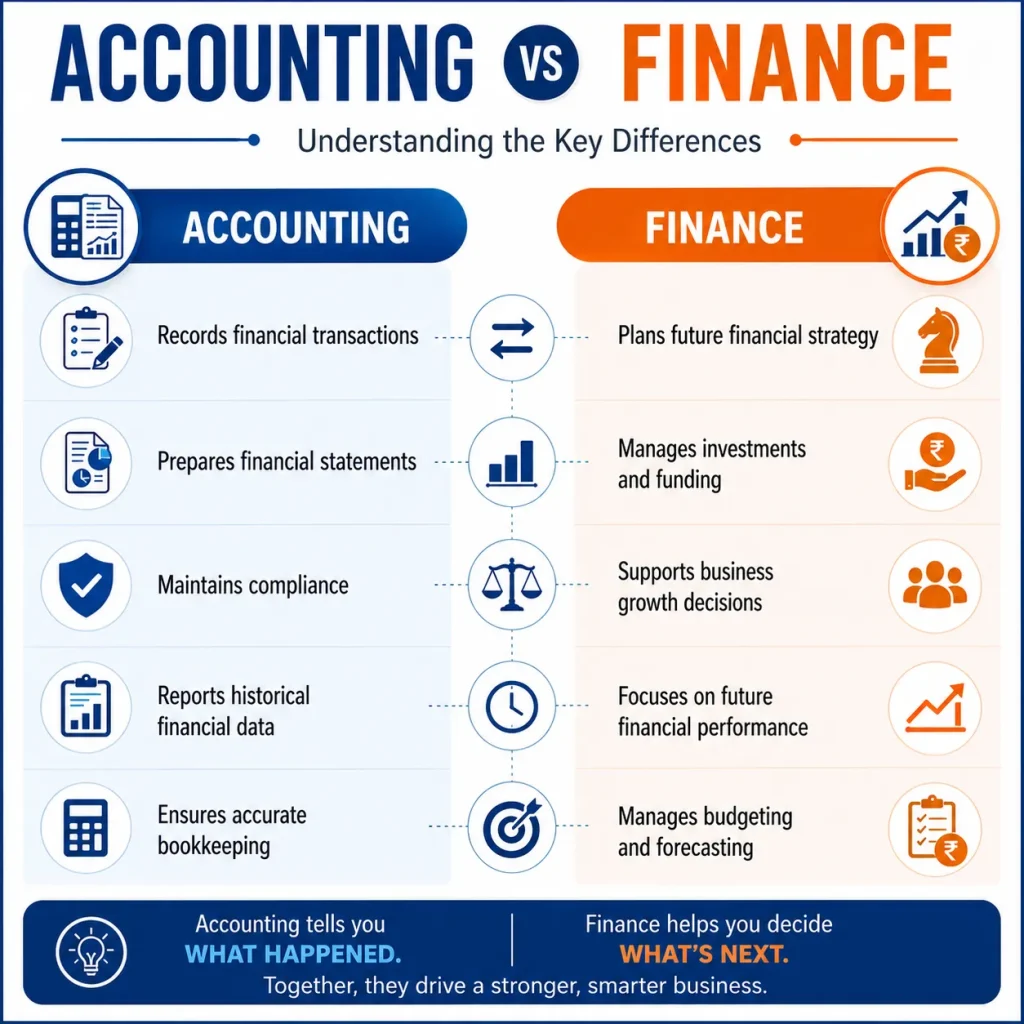
Accounting focuses on recording, organizing, and reporting financial transactions. It ensures that financial records are accurate, statutory requirements are met, and businesses can prepare reliable financial statements.
Finance, on the other hand, uses financial information to make strategic decisions. It involves budgeting, forecasting, investment planning, cash flow management, and business growth strategies.
Together, effective Finance and Accounting Management helps businesses:
A well-managed finance and accounting function creates a solid foundation for sustainable business growth.
Many business owners use the terms finance and accounting interchangeably, but they perform different roles.
Every business—regardless of its size or industry—depends on effective Financial Management to remain competitive. Without accurate financial data and structured accounting processes, organizations struggle to control costs, manage risks, or plan for future expansion.
Here are some key reasons why finance and accounting are essential:
Reliable financial information enables business owners and management teams to make informed decisions regarding investments, pricing, expansion, and resource allocation.
Monitoring receivables, payables, and expenses helps businesses maintain adequate cash flow and meet operational obligations.
Financial planning and forecasting allow companies to identify growth opportunities, secure funding, and prepare for future expansion.
Proper accounting practices help businesses comply with tax regulations, statutory reporting requirements, and financial reporting standards.
Financial statements and performance reports help businesses evaluate profitability, identify trends, and improve operational efficiency.
Modern Finance and Accounting Management covers much more than bookkeeping. Businesses require a combination of financial reporting, planning, compliance, analytics, and operational support.
Typical finance and accounting services include:
Many organizations now outsource these functions to specialized service providers, allowing internal teams to focus on core business operations while improving efficiency and reducing costs.
Effective Finance and Accounting Management is much more than maintaining books of accounts. It provides business leaders with the financial insights needed to make confident decisions, control costs, improve profitability, and plan for sustainable growth. Businesses that invest in strong financial processes are better positioned to respond to market changes, attract investors, and scale operations.
A structured finance function tracks incoming and outgoing cash, helping businesses maintain liquidity and meet operational expenses on time. Proper cash flow management also reduces the risk of financial shortages.
Accurate financial reports and Finance Analytics provide business owners with valuable insights into revenue trends, expenses, and profitability, enabling data-driven strategic decisions.
A well-defined budgeting process helps businesses allocate resources efficiently, control unnecessary expenses, and invest in growth opportunities with confidence.
Regular monitoring of financial performance helps organizations identify risks early, improve working capital management, and maintain long-term financial health.
Transparent financial reporting and well-maintained Financial Statements increase credibility with investors, lenders, and business partners, making it easier to secure funding when required.
Every successful business follows a structured Finance and Accounting Process that ensures financial transactions are accurately recorded, analyzed, and reported. While the exact workflow varies by industry, the overall process remains similar across organizations.
The process begins with recording daily business transactions, including sales, purchases, expenses, receipts, payroll, and banking activities. Accurate bookkeeping forms the foundation of reliable financial reporting.
Finance teams reconcile bank accounts, supplier statements, customer balances, and internal records to identify discrepancies and maintain data accuracy.
Businesses prepare key reports such as the Profit & Loss Statement, Balance Sheet, and Cash Flow Statement. These reports provide a clear picture of financial performance and business health.
Financial data is analyzed to prepare budgets, forecasts, and business plans that support operational and strategic decision-making.
Organizations track key financial metrics through Financial Dashboards and Finance Analytics to measure profitability, cash flow, operational efficiency, and business growth.
The final stage involves meeting statutory requirements, filing tax returns, maintaining compliance records, and ensuring adherence to accounting standards and government regulations.
A well-managed finance and accounting process improves operational efficiency, reduces errors, and supports better business performance.
Effective Accounting Management ensures that financial information remains accurate, organized, and compliant. It forms the backbone of every finance function and supports informed business decisions.
The major components include:
Recording all financial transactions systematically to maintain complete and accurate business records.
Managing supplier invoices, payments, and outstanding liabilities while maintaining healthy vendor relationships.
Tracking customer invoices, payment collections, and outstanding balances to improve cash flow and reduce overdue payments.
Comparing accounting records with bank statements to identify discrepancies and ensure financial accuracy.
Preparing Balance Sheets, Profit & Loss Statements, and Cash Flow Statements to evaluate financial performance and meet statutory reporting requirements.
Maintaining compliance with GST, income tax, payroll regulations, and other statutory obligations while reducing compliance risks.
Together, these components create a reliable accounting framework that supports operational efficiency and business growth.
Strong Financial Planning and effective budgeting enable businesses to prepare for future opportunities while managing financial risks. Instead of reacting to financial challenges, organizations can proactively plan investments, manage expenses, and achieve long-term objectives.
Modern businesses increasingly use financial planning software, cloud accounting platforms, and AI-powered forecasting tools to improve budgeting accuracy and financial visibility.
Financial statements are essential for measuring business performance and communicating financial information to management, investors, lenders, and regulatory authorities.
The three primary financial statements include:
Shows the company’s assets, liabilities, and shareholders’ equity at a specific point in time, providing insight into financial stability.
Summarizes income, expenses, and net profit over a reporting period, helping businesses evaluate operational performance and profitability.
Tracks the movement of cash from operating, investing, and financing activities, enabling businesses to maintain healthy liquidity.
When combined with Finance Analytics and Financial Dashboards, these reports provide real-time visibility into business performance, helping leaders make faster and more informed strategic decisions.
Technology is reshaping how finance teams operate, and AI in Finance and Accounting is becoming a key driver of business efficiency. Instead of spending hours on manual data entry and repetitive accounting tasks, businesses are adopting intelligent automation to improve speed, accuracy, and decision-making.
Modern AI Bookkeeping solutions automatically record transactions, categorize expenses, reconcile bank statements, and reduce manual errors. This enables finance teams to focus on strategic financial activities rather than routine administrative work.
Advanced Finance Analytics helps organizations identify revenue trends, monitor profitability, forecast cash flow, and evaluate business performance using real-time financial data.
Interactive Financial Dashboards provide business owners and finance managers with instant access to key performance indicators (KPIs), helping them make informed decisions faster.
AI-powered forecasting tools analyze historical data to predict future revenue, expenses, and cash flow, allowing businesses to prepare for opportunities and risks more effectively.
As businesses continue their digital transformation journey, combining automation with human expertise creates a more agile and efficient finance function.
Many startups and growing businesses reach a stage where managing finance internally becomes time-consuming and costly. Outsourcing allows companies to access experienced professionals, modern technology, and standardized processes without building a large in-house finance team.
You should consider outsourcing if your business:
Professional Finance and Accounting Management services help businesses improve efficiency, maintain compliance, and make better financial decisions.
A strong finance function is built on consistent processes and reliable financial information. Businesses should follow these best practices to improve performance:
Following these practices improves operational efficiency, reduces financial risks, and supports long-term success.
Finance and accounting are business functions that manage financial transactions, reporting, planning, budgeting, and decision-making to ensure financial stability and business growth.
Accounting records and reports historical financial transactions, while finance focuses on planning, forecasting, investments, and future financial decisions.
It helps businesses manage cash flow, maintain compliance, measure profitability, control costs, and make informed strategic decisions.
Services typically include bookkeeping, accounts payable, accounts receivable, payroll accounting, financial reporting, budgeting, forecasting, compliance, tax management, and financial analysis.
It provides accurate financial insights, improves budgeting, strengthens cash flow, supports investment decisions, and enables long-term strategic planning.
The primary financial statements are the Balance Sheet, Profit & Loss Statement, and Cash Flow Statement, which help evaluate business performance and financial health.
AI automates bookkeeping, reconciliations, reporting, forecasting, and analytics, reducing manual work while improving speed and accuracy.
Finance Analytics uses financial data to identify trends, monitor KPIs, forecast performance, and support business decision-making.
Businesses should consider outsourcing when they need expert financial management, better compliance, cost savings, and scalable finance operations.
Wisecor provides end-to-end Finance & Accounting Outsourcing Services, including bookkeeping, financial reporting, budgeting, payroll, tax compliance, virtual CFO support, and financial advisory to help businesses operate efficiently.
Effective Finance and Accounting Management is essential for every business, regardless of size or industry. From maintaining accurate financial records to supporting strategic planning, budgeting, compliance, and business growth, a well-managed finance function creates the foundation for long-term success.
As finance continues to evolve with AI Bookkeeping, Finance Analytics, and Financial Dashboards, businesses that embrace modern financial practices will be better equipped to improve efficiency, reduce costs, and make smarter decisions.
If your organization is looking to strengthen its finance operations, partnering with experienced professionals can help you streamline processes while focusing on your core business objectives.
Wisecor offers comprehensive Finance & Accounting Outsourcing Services, helping businesses manage bookkeeping, financial reporting, compliance, budgeting, forecasting, payroll, and strategic financial planning. Our experienced professionals and technology-driven approach enable businesses to improve financial performance and achieve sustainable growth.
Ready to optimize your finance function? Contact Wisecor today for a personalized consultation.
Subscribe to our newsletter and stay updated.