- Follow On:
- [email protected]
- +918655715397
- Thane west, Maharashtra - 400604
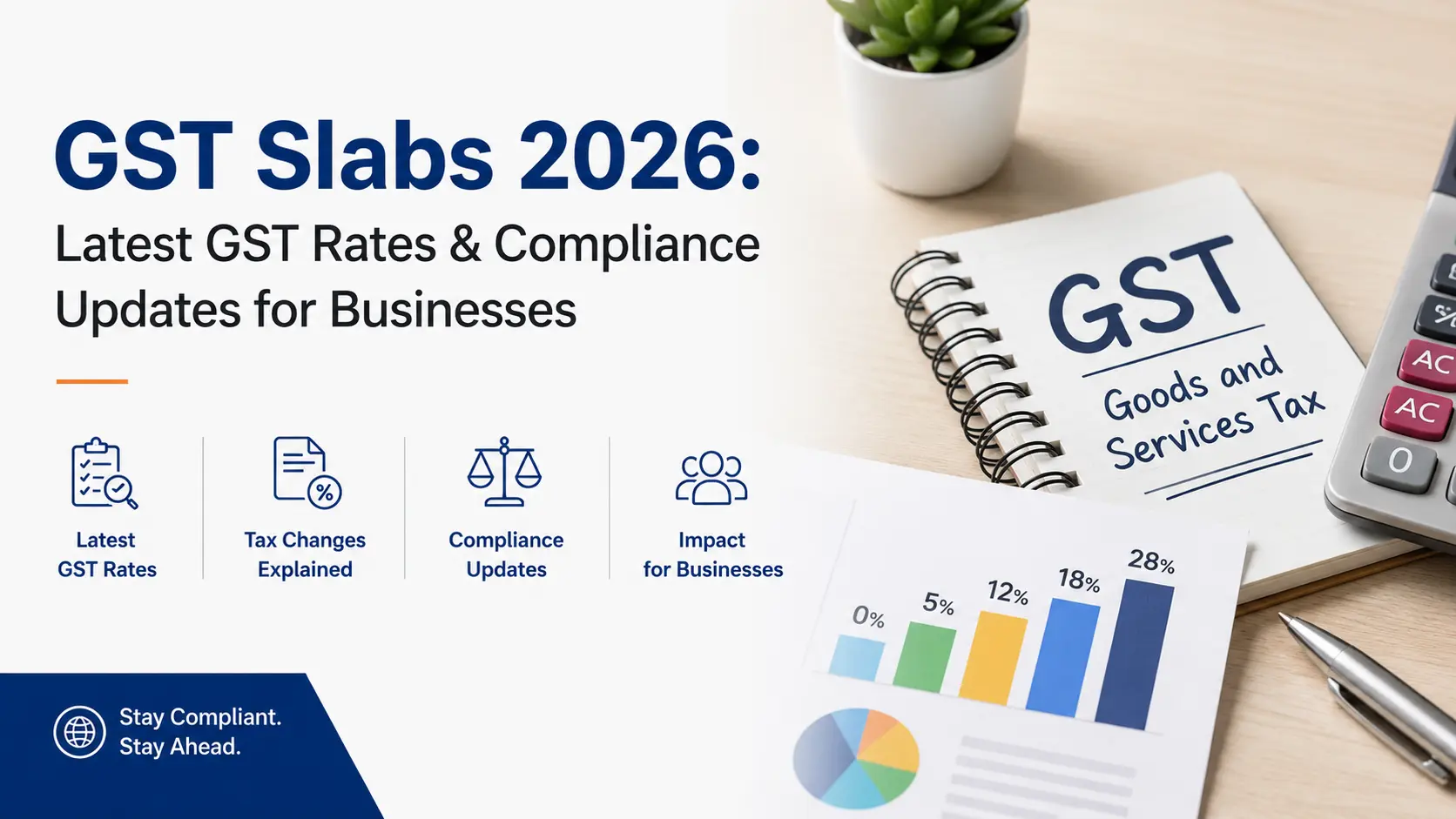
The Goods and Services Tax (GST) has transformed India’s indirect tax system by replacing multiple state and central taxes with a unified taxation framework. As businesses continue to adapt to changing regulations, staying updated with the latest GST Slabs 2026 is essential for maintaining compliance, optimizing tax planning, and avoiding penalties.
Every GST Council meeting introduces recommendations that may affect tax rates, exemptions, compliance procedures, and reporting requirements. Whether you are a manufacturer, retailer, service provider, e-commerce seller, exporter, or startup, understanding the latest GST changes helps you make informed financial and operational decisions.
In this guide, we’ll explain the latest GST slabs in 2026, recent GST rate changes, industry impact, compliance requirements, and practical steps businesses should take to remain compliant.
Goods and Services Tax (GST) is India’s comprehensive indirect tax system introduced to simplify taxation by replacing multiple taxes such as VAT, Service Tax, Excise Duty, and Entry Tax.
Instead of paying several indirect taxes, businesses now operate under a single tax framework that improves transparency, simplifies compliance, and creates a uniform national market.
Today, GST plays a crucial role in improving ease of doing business while helping organizations manage tax liabilities more efficiently.
GST is divided into multiple tax slabs based on the type of goods and services. Essential items attract lower tax rates, while luxury products and non-essential goods are taxed at higher rates.
The major GST tax slabs include:
These tax slabs are periodically reviewed by the GST Council based on economic conditions, industry feedback, and government policy objectives.
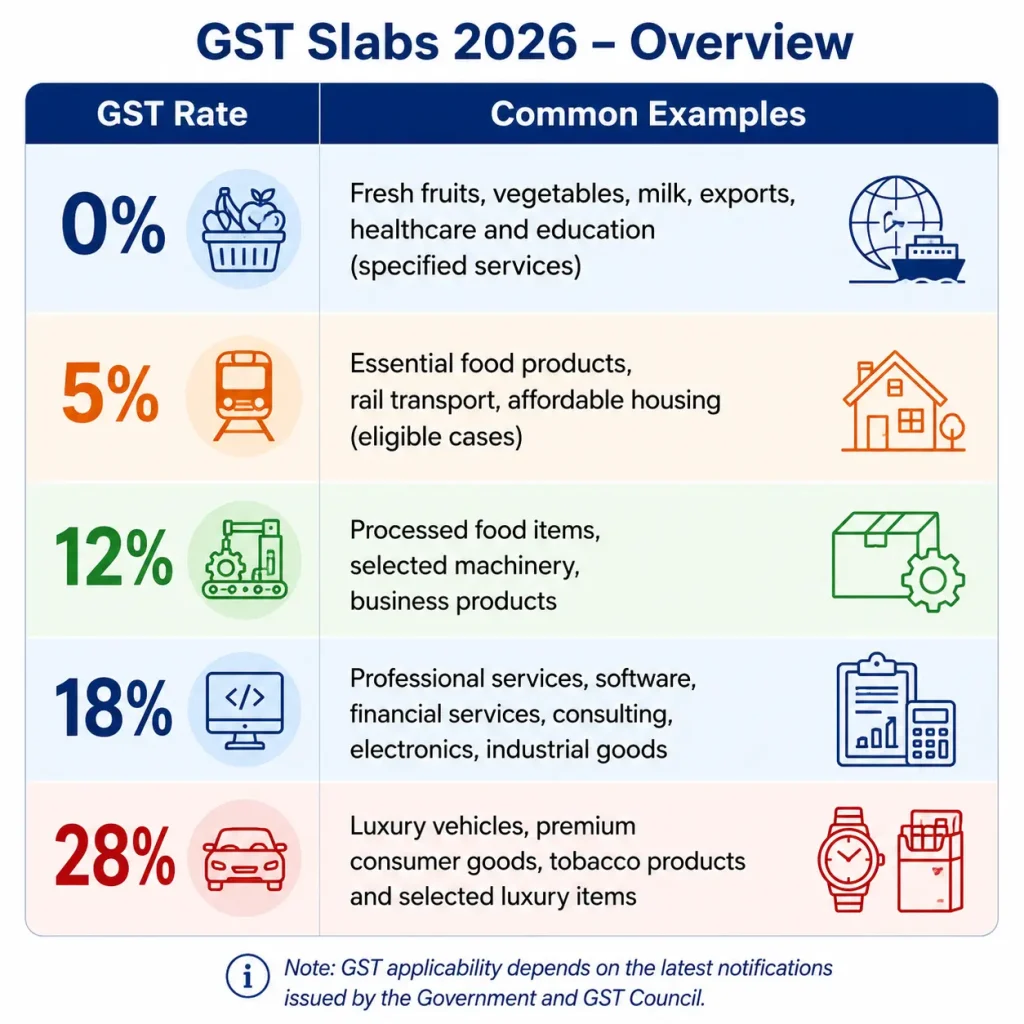
The GST framework continues to evolve to improve compliance, simplify tax administration, and reduce disputes. Businesses should stay informed about the latest developments that may impact pricing, invoicing, and tax reporting.
Some important focus areas in 2026 include:
The government continues to strengthen digital compliance by improving return filing systems, invoice validation, and reconciliation processes.
Businesses are expected to maintain accurate purchase records and vendor reconciliations to ensure eligible Input Tax Credit claims and reduce compliance risks.
GST compliance is becoming increasingly technology-driven with greater emphasis on e-invoicing, automated reporting, and real-time data matching.
The GST Council continues to introduce measures that improve transparency in tax administration, helping businesses reduce disputes and maintain better compliance records.
GST rates and exemptions may be reviewed periodically for sectors such as manufacturing, healthcare, renewable energy, hospitality, and digital services to support economic growth and simplify taxation.
Ignoring GST updates can result in incorrect tax calculations, delayed return filings, compliance notices, penalties, and blocked Input Tax Credit claims.
By keeping track of the latest GST changes, businesses can:
Whether you are a small business or a large enterprise, understanding the latest GST Slabs 2026 helps you remain compliant while making better financial decisions.
The GST Council periodically reviews tax rates to reduce the tax burden on essential goods and encourage economic growth. Lower GST rates can make products and services more affordable for consumers while helping businesses improve demand and competitiveness.
Some categories that may continue to benefit from lower GST rates or exemptions include:
Lower GST rates can reduce the overall cost to consumers while helping businesses increase sales volumes and improve market demand.
Luxury and non-essential products generally continue to attract higher GST rates. Businesses dealing in these categories should regularly review pricing strategies and ensure accurate tax classification.
Examples include:
Any revision in GST rates may directly affect pricing, profitability, and consumer purchasing decisions.
Manufacturers need to monitor GST rate revisions carefully as changes can affect raw material costs, production expenses, pricing, and Input Tax Credit (ITC). Proper tax planning and vendor reconciliation remain essential for maintaining compliance.
Retailers and online sellers must update product tax classifications, billing systems, and pricing whenever GST rates change. Accurate GST invoicing and timely return filing help businesses avoid compliance issues.
Healthcare organizations should regularly review GST applicability on medical equipment, pharmaceutical products, and taxable healthcare services while ensuring compliance with evolving regulations.
Logistics companies need accurate GST treatment for freight charges, interstate transportation, warehousing, and supply chain operations. Proper documentation supports smoother tax compliance and audit readiness.
Software companies, consultants, financial service providers, and professional firms generally fall under the standard GST rate. Businesses should maintain proper invoices, contracts, and tax records to ensure accurate GST reporting.
Hotels, restaurants, travel agencies, and tourism businesses should monitor GST revisions that may impact pricing, customer demand, and overall business profitability.
Small and medium enterprises (MSMEs) form a significant part of India’s economy. Staying compliant with GST regulations helps them avoid penalties and improve financial management.
Business owners should focus on:
Businesses eligible for the Composition Scheme should periodically review turnover limits and eligibility conditions.
GST revisions influence the final prices consumers pay for products and services. Lower tax rates can make essential goods more affordable, while higher rates on luxury products may increase retail prices.
Consumers may experience:
For businesses, understanding these consumer trends helps in making informed pricing and inventory decisions.
Keeping up with GST compliance is essential for avoiding notices, penalties, and disruptions. Every business should regularly review the following:
✔ Verify applicable GST rates on all products and services
✔ Update HSN/SAC codes where required
✔ File GST returns within due dates
✔ Reconcile GSTR-2B with purchase records
✔ Verify vendor GST compliance
✔ Ensure accurate Input Tax Credit (ITC) claims
✔ Maintain digital invoices and supporting documents
✔ Update accounting and ERP systems with the latest GST rates
✔ Conduct periodic internal GST reviews
✔ Stay informed about GST Council notifications and regulatory updates
Managing GST compliance can become complex as regulations evolve. Wisecor helps businesses simplify GST management through expert support for:
Explore our GST Compliance Services to streamline your GST processes, reduce compliance risks, and stay aligned with the latest GST regulations.
While the core GST structure continues to follow the 0%, 5%, 12%, 18%, and 28% tax slabs, businesses should stay updated with the latest GST Council recommendations, exemptions, and compliance changes. The focus in 2026 is not only on tax rates but also on improving digital compliance, invoice matching, and Input Tax Credit (ITC) accuracy.
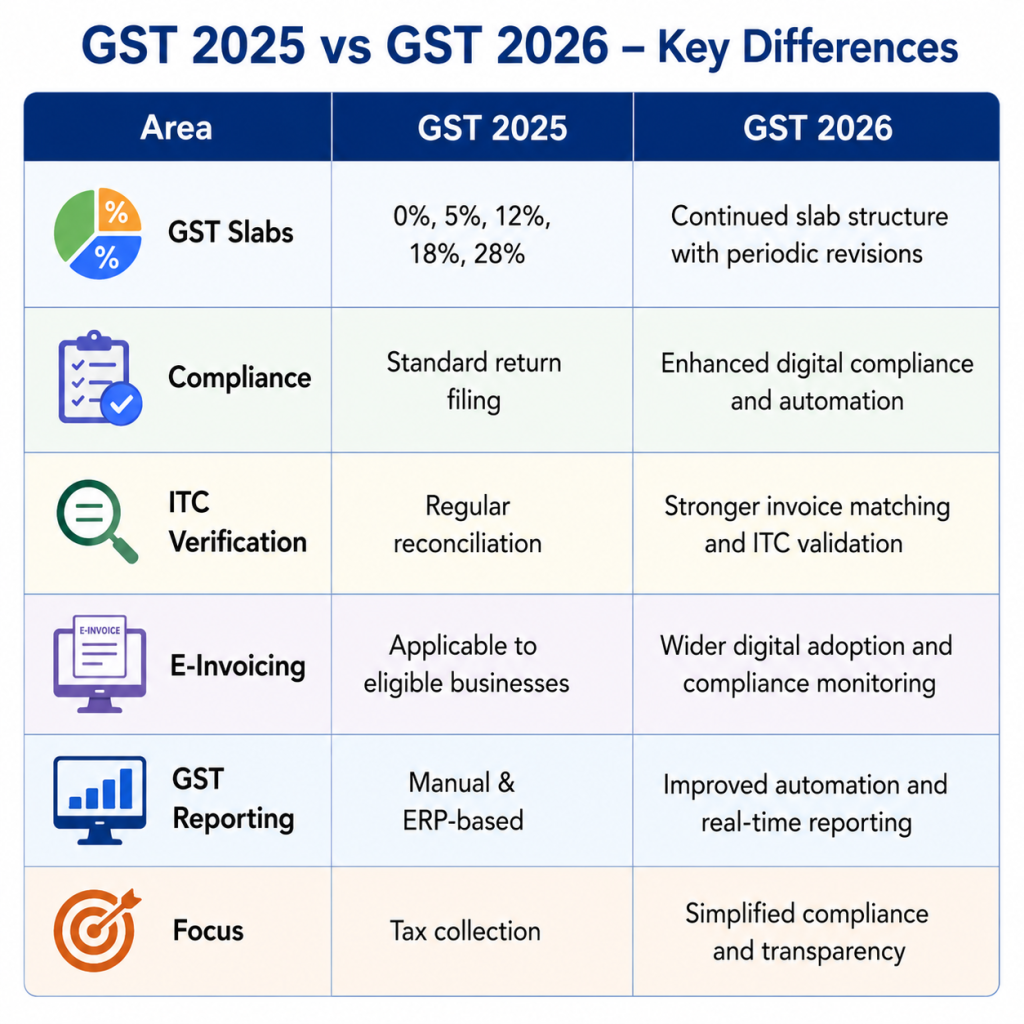
The GST structure continues with five primary tax slabs: 0%, 5%, 12%, 18%, and 28%, depending on the type of goods and services.
Yes. The GST Council regularly introduces updates related to tax rates, exemptions, compliance procedures, and digital reporting requirements.
Most professional, financial, IT, consulting, and business services generally fall under the 18% GST slab.
Input Tax Credit allows businesses to claim credit for GST paid on eligible business purchases, reducing their overall tax liability.
Businesses may need to update pricing, invoices, accounting systems, ERP software, and GST return filing processes to remain compliant.
Timely compliance helps businesses avoid penalties, maintain accurate tax records, claim eligible ITC, and improve audit readiness.
Businesses meeting the prescribed turnover limits or those engaged in interstate supplies, exports, e-commerce, or specified services should register under GST as applicable.
GST rates are revised only after recommendations and official notifications issued by the GST Council and the Government of India.
Regularly monitor GST Council announcements, review official notifications, update accounting systems, and seek professional GST advisory support.
Wisecor provides GST registration, return filing, ITC reconciliation, annual returns, GST advisory, compliance reviews, and GST litigation support to help businesses stay compliant.
The GST framework continues to evolve to support economic growth while making tax compliance more transparent and technology-driven. As businesses adapt to changing GST regulations, understanding the latest tax slabs, compliance requirements, and reporting obligations becomes essential for reducing risks and improving operational efficiency.
Whether you operate a startup, MSME, manufacturing company, retailer, exporter, or multinational enterprise, staying updated with the GST Slabs 2026 helps ensure accurate tax calculations, better financial planning, timely return filing, and improved Input Tax Credit management.
Rather than reacting to compliance issues after they arise, businesses should adopt a proactive approach by reviewing GST classifications, maintaining accurate records, reconciling ITC regularly, and monitoring the latest GST Council notifications.
Managing GST compliance can be time-consuming and complex without the right expertise. Wisecor offers end-to-end GST solutions designed to simplify compliance and help businesses operate with confidence.
Contact Wisecor today to streamline your GST compliance, reduce regulatory risks, and stay updated with the latest GST developments.
Subscribe to our newsletter and stay updated.