- Follow On:
- [email protected]
- +918655715397
- Thane west, Maharashtra - 400604
Human resources is no longer limited to hiring employees and maintaining personnel records. As businesses grow, HR teams have to manage recruitment, onboarding, payroll coordination, employee documentation, compliance, benefits, performance management, and several other administrative responsibilities.
This raises an important question: what HR functions can be outsourced?
The answer is broader than many business owners expect. Companies can outsource individual HR activities or use complete HR outsourcing services for businesses, depending on their size, workforce, internal capabilities, and operational requirements.
For startups and SMEs, outsourcing can be particularly useful because building a large in-house HR department can increase fixed costs before the business actually needs a large HR team.
With the right provider, HR outsourcing to save time and money can help businesses access specialized expertise while allowing internal teams to concentrate on strategic priorities.
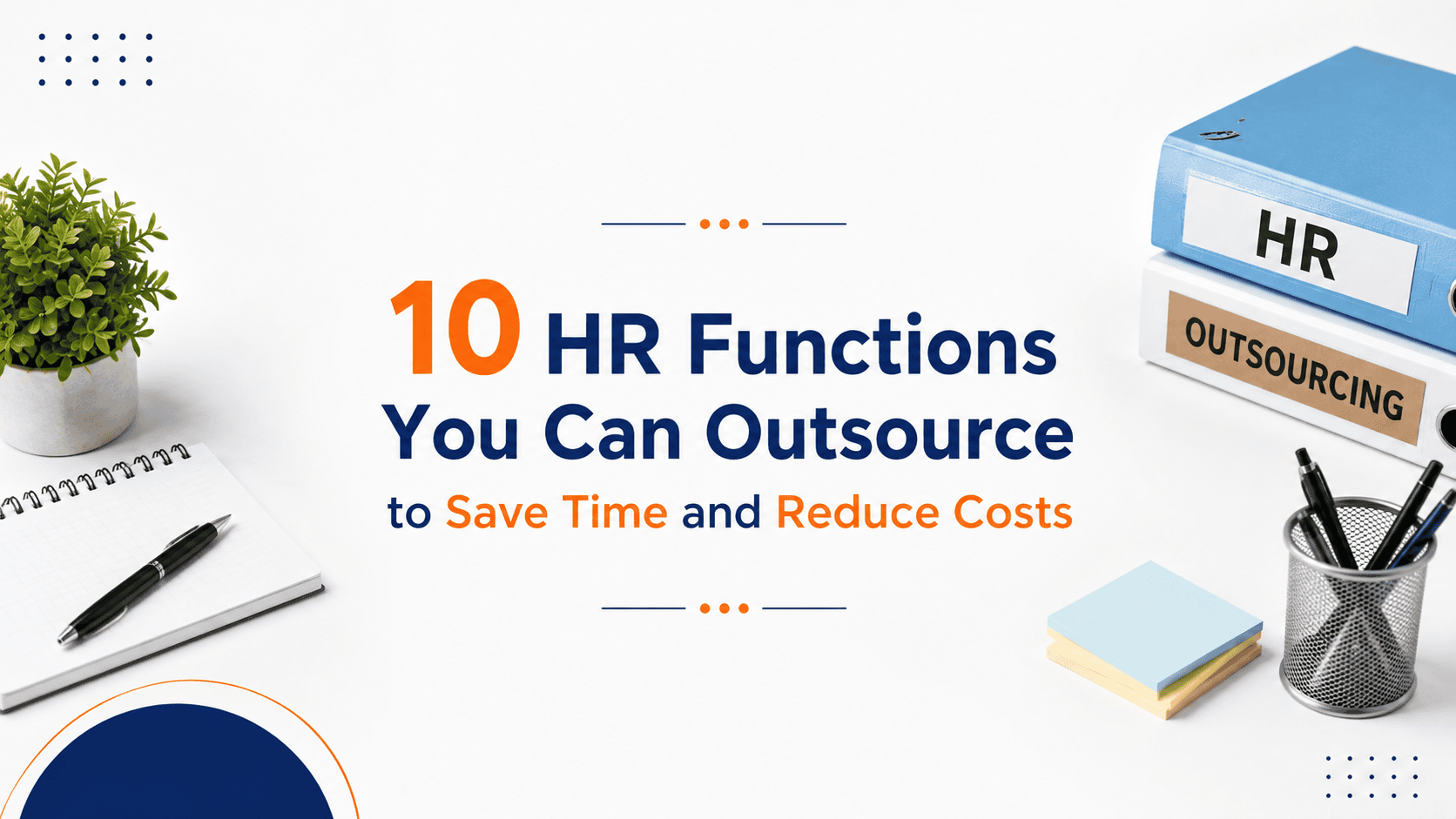
So, which HR functions can be outsourced? Here are 10 important areas businesses can consider.
Recruitment is one of the most time-consuming HR activities. Writing job descriptions, sourcing candidates, screening applications, coordinating interviews, conducting background checks, and managing candidate communication can consume significant internal resources.
Recruitment is therefore one of the best HR functions to outsource, particularly when a company is hiring frequently or needs specialized talent.
An external HR partner can support:
For growing companies, outsourcing recruitment can provide access to professional recruitment capabilities without maintaining a large talent acquisition team internally.
Payroll is another major area among HR tasks that can be outsourced. Although payroll is closely connected with finance and compliance, HR teams often spend considerable time coordinating employee information, attendance, leave data, salary changes, and payroll inputs.
Payroll outsourcing can help businesses streamline these activities while reducing manual work.
Typical outsourced payroll support may include:
For businesses with growing employee numbers, professional payroll support can reduce administrative pressure and improve consistency.
A new employee’s first few weeks can significantly influence their experience with an organization. Yet onboarding often involves multiple administrative activities that can become difficult to manage as hiring volumes increase.
Employee onboarding is one of the HR activities that can be outsourced to create a more structured joining process.
Outsourced onboarding support may include document collection, employee data management, joining formalities, policy communication, HR system updates, and coordination with relevant internal teams.
A standardized onboarding process can help businesses reduce paperwork while creating a smoother employee experience.
HR administration includes many repetitive activities that don’t necessarily require the constant attention of senior HR professionals. These include maintaining employee records, preparing HR documents, updating databases, managing letters, tracking employee information, and organizing HR files.
These are ideal HR administrative tasks to outsource when internal HR teams need more time for strategic work.
Businesses can outsource activities such as:
This can be especially valuable for SMEs that have limited HR resources.
Managing employee benefits can become complicated as an organization grows. HR teams may have to coordinate benefit enrollment, employee information, changes in eligibility, documentation, and employee queries.
Benefits administration is therefore another area among the HR functions businesses can outsource.
An external provider can help coordinate benefits-related administration while maintaining accurate employee information.
This can reduce repetitive work for internal HR teams and provide employees with a more organized support process.
Employment-related compliance is an area where businesses cannot afford to rely on inconsistent processes. Depending on the organization’s workforce and location, HR may need to coordinate various statutory requirements, records, policies, and documentation.
This makes HR compliance one of the important HR operations that can be outsourced.
External HR professionals can assist with compliance calendars, documentation, employee records, statutory processes, and compliance-related reporting.
For Indian businesses, this can be particularly useful because organizations may need to manage multiple employment and labour-related requirements.
However, outsourcing does not automatically transfer legal responsibility away from the business. Companies should clearly define responsibilities and review the scope of services provided by their HR partner.
Performance management involves more than conducting an annual appraisal. Businesses need structured processes for setting goals, monitoring performance, collecting feedback, conducting reviews, and documenting development plans.
Some of these processes can be supported externally.
Performance management outsourcing can help businesses establish consistent frameworks for:
The strategic decisions should generally remain with business leadership, while administrative and process-related activities can be supported by an external provider.
Employee information changes regularly. New employees join, existing employees change roles, compensation is updated, documents are renewed, and employees eventually leave the organization.
Managing these records manually can create unnecessary administrative work and increase the possibility of errors.
Employee records management is therefore one of the practical HR functions to outsource to reduce costs and administrative workload.
Outsourced support can include maintaining employee databases, organizing documentation, updating records, and ensuring information is properly managed according to the organization’s processes and applicable requirements.
Employee development is important for retaining talent and improving workforce capabilities. However, coordinating training schedules, registrations, attendance, training records, feedback, and learning documentation can become another administrative burden.
Businesses can outsource the administrative side of learning and development while keeping strategic decisions internally.
An HR provider may support:
This allows internal HR leaders to focus more on identifying skill gaps and developing the organization’s long-term talent strategy.
Employee separation involves more than collecting an ID card or processing a final salary. A structured exit process may include documentation, asset handover, access coordination, exit interviews, employee records, and communication with finance and other departments.
Employee offboarding can therefore become one of the HR functions to outsource for small businesses that do not have dedicated HR operations teams.
A structured outsourced process can help ensure that important steps are not missed when employees leave.
As businesses grow, the question is not simply whether they should outsource HR. The more important question is which HR functions can be outsourced without losing control over important people-related decisions?
The answer depends on the nature of the business. A startup may need recruitment and payroll support, while an established SME may benefit from outsourcing HR administration, compliance, employee lifecycle management, and other repetitive processes.
A practical approach is to separate HR activities into three categories: strategic, operational, and administrative. Strategic activities such as organizational culture, leadership decisions, and workforce strategy can often remain in-house. Operational and administrative activities are usually stronger candidates for outsourcing.
This approach helps businesses use HR outsourcing to save time and money while maintaining control over decisions that directly affect employees and company culture.
Not every HR activity should automatically be outsourced. The best HR functions to outsource are generally those that are repetitive, process-driven, time-consuming, require specialized knowledge, or need consistent execution.
For example, maintaining employee records may not require daily involvement from a senior HR manager. Similarly, recruitment coordination, payroll inputs, onboarding documentation, and HR reporting can often be handled through structured outsourced processes.
Before outsourcing, businesses should ask:
If the answer is yes to several of these questions, the function may be a good outsourcing candidate.
Businesses can outsource recruitment, payroll, onboarding, HR administration, employee records, compliance support, benefits administration, performance management, training coordination, and offboarding.
HR outsourcing can reduce costs by minimizing administrative workload, reducing the need for additional HR staff, improving process efficiency, and providing access to specialized expertise.
Yes. HR outsourcing for small businesses can provide professional HR support without the expense of maintaining a large in-house HR team.
Yes. Startups can outsource recruitment, payroll, onboarding, documentation, and other routine HR activities while focusing internal resources on business growth.
Businesses generally keep strategic HR activities such as workforce planning, organizational culture, leadership decisions, and sensitive employee relations in-house.
HR outsourcing costs depend on employee strength, services required, complexity, and the provider’s pricing model. Businesses should compare the overall value and scope rather than price alone.
Evaluate the provider’s experience, service offerings, technology, data security, compliance capabilities, scalability, reporting, and customer support before making a decision.
Consider outsourcing when HR administration is consuming too much time, employee numbers are increasing, compliance is becoming difficult, or the internal HR team lacks specialized expertise.
Subscribe to our newsletter and stay updated.