- Follow On:
- business@wisecor.in
- +918655715397
- Thane west, Maharashtra - 400604

Recruitment has quietly become one of the most complex business functions. Hiring is no longer just about filling vacancies. It involves sourcing the right talent, managing timelines, aligning with business goals, and maintaining candidate experience in a highly competitive market. As organizations grow, especially across geographies and skill demands, traditional hiring models often struggle to keep pace. This is where recruitment process outsourcing, commonly known as RPO, has emerged as a structured and scalable hiring approach.
Recruitment process outsourcing refers to transferring all or part of the recruitment function to an external specialist that manages hiring activities on behalf of the organization. Unlike temporary staffing or placement agencies, RPO focuses on building long term recruitment capability aligned with business needs. It is increasingly adopted by companies seeking faster hiring, better talent access, and improved recruitment efficiency without expanding internal teams.
Recruitment process outsourcing is a hiring model where an organization partners with an external provider to manage recruitment activities either fully or partially. These activities may include workforce planning, candidate sourcing, screening, interview coordination, offer management, and onboarding support. In many cases, RPO operates as an extension of the internal HR or talent acquisition team.
What distinguishes recruitment process outsourcing from traditional recruitment outsourcing is ownership. In an RPO model, the provider is accountable for outcomes such as hiring timelines, quality of hire, and process consistency. This approach supports end to end recruitment outsourcing while allowing businesses to maintain strategic oversight.
Recruitment lifecycle outsourcing is often part of this model, covering every stage from demand planning to onboarding. For organizations facing hiring volatility or rapid growth, RPO creates a predictable and repeatable recruitment structure.
The recruitment outsourcing process typically begins with a detailed understanding of the organization’s hiring goals, workforce requirements, and culture. Based on this, a recruitment process outsourcing model is designed. This model defines which recruitment activities will be outsourced and how the RPO team will integrate with internal stakeholders.
Once implemented, the RPO provider manages daily hiring operations using defined workflows and reporting mechanisms. Talent pipelines are built proactively, ensuring faster response to hiring demands. Offshore recruitment outsourcing services are often used to support sourcing, screening, and coordination, especially in high volume or multi location hiring scenarios.
In regions such as recruitment process outsourcing in India, organizations benefit from a strong talent ecosystem and process driven hiring support. The focus remains on efficiency, consistency, and scalability rather than transactional recruitment.
A well structured RPO model is built around clear roles, responsibilities, and performance metrics. While the structure may vary, most models include the following components:
This scalable recruitment outsourcing model allows organizations to adapt hiring capacity without overburdening internal HR teams. It is particularly useful for RPO services for SMEs and recruitment process outsourcing for startups where hiring needs fluctuate but quality cannot be compromised.
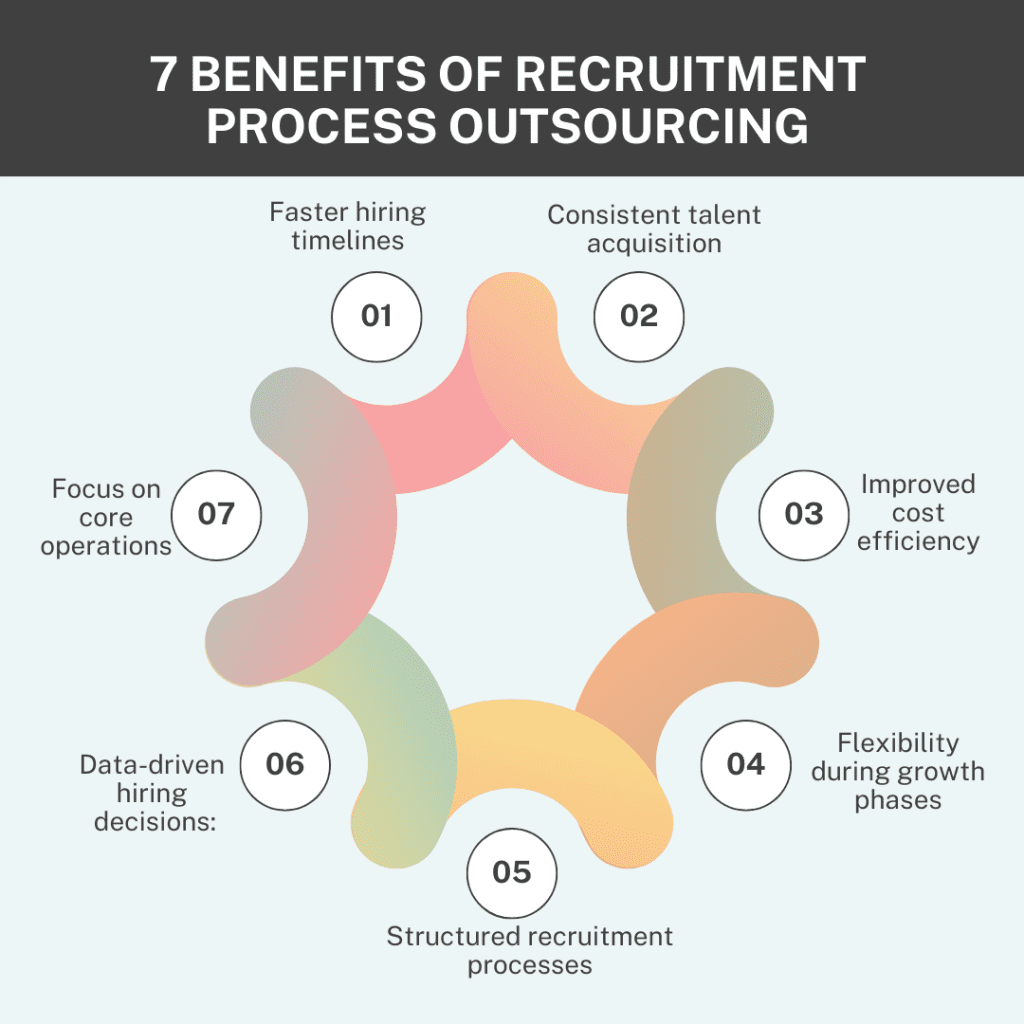
Faster hiring timelines:
Dedicated recruitment teams and established sourcing networks help businesses fill roles quickly without compromising candidate quality.
Consistent talent acquisition:
Talent acquisition outsourcing ensures uniform hiring standards across roles, departments, and locations.
Improved cost efficiency:
Businesses avoid the expense of maintaining large in-house recruitment teams and instead pay for hiring capacity and outcomes as needed.
Flexibility during growth phases:
RPO is especially effective during expansion, new market entry, or project-based hiring when recruitment needs fluctuate.
Structured recruitment processes:
Outsourced recruitment solutions introduce standardized workflows that bring discipline and predictability to hiring.
Data-driven hiring decisions:
Better visibility into recruitment metrics allows organizations to track performance, identify gaps, and improve hiring outcomes.
Focus on core operations:
By outsourcing recruitment execution, internal teams can concentrate on strategic priorities rather than day-to-day hiring activities.
Deciding when to use recruitment process outsourcing often depends on hiring complexity rather than company size. Organizations typically turn to RPO when internal hiring teams are stretched, hiring timelines are slipping, or talent quality is inconsistent. High growth phases, new market entry, and project based workforce expansion are common triggers.
Recruitment process outsourcing for startups is particularly effective when founders and small HR teams need structured hiring without building large internal recruitment functions. Similarly, RPO services for SMEs help maintain hiring momentum while controlling costs and improving process maturity.
Businesses also adopt recruitment outsourcing when hiring across multiple locations or managing niche skill requirements. In such cases, an RPO partner provides access to wider talent pools and standardized recruitment practices, reducing dependency on reactive hiring.
Talent acquisition outsourcing through RPO focuses on building long term hiring capability rather than filling roles one by one. Dedicated recruitment teams continuously engage talent markets, maintain candidate pipelines, and reduce time lost between hiring cycles.
Because recruitment lifecycle outsourcing covers sourcing, screening, coordination, and onboarding support, hiring managers experience smoother processes and better candidate alignment. Offshore recruitment outsourcing services often play a supporting role by managing research, resume screening, and interview logistics, allowing core recruitment teams to focus on decision making.
Another advantage of RPO for businesses is hiring predictability. With defined workflows and performance tracking, organizations gain clarity on timelines and outcomes. This structured approach enables faster hiring decisions without compromising candidate experience.
Recruitment process outsourcing is often adopted to resolve recurring hiring challenges that internal teams struggle to manage consistently. These challenges include:
Outsourced recruitment solutions address these issues by introducing standardized hiring frameworks, dedicated recruitment resources, and data driven insights. A scalable recruitment outsourcing model allows organizations to respond quickly to changing workforce demands without rebuilding processes each time.
In markets such as recruitment process outsourcing in India, businesses also benefit from mature recruitment ecosystems and experienced talent acquisition professionals who understand global hiring expectations.
Recruitment process outsourcing is increasingly viewed as a strategic workforce enabler rather than a temporary hiring fix. As organizations evolve, hiring needs become more dynamic, requiring flexible recruitment capacity and consistent quality standards.
End to end recruitment outsourcing supports long term workforce planning by aligning hiring activity with business objectives. Recruitment outsourcing process data helps organizations identify hiring trends, skill gaps, and future workforce requirements.
For growing companies, RPO creates stability in hiring operations while allowing leadership teams to focus on expansion, innovation, and performance. Whether used fully or partially, recruitment process outsourcing becomes a foundational part of sustainable talent management.
Recruitment process outsourcing has reshaped how businesses approach hiring in an increasingly competitive talent landscape. By moving beyond transactional recruitment, RPO offers a structured, scalable, and outcome driven approach to talent acquisition. It enables faster hiring, better workforce alignment, and improved recruitment consistency without overextending internal resources.
From startups navigating early growth to established organizations managing complex hiring needs, recruitment process outsourcing provides clarity and control across the recruitment lifecycle. When applied thoughtfully, RPO becomes not just a hiring solution, but a long term strategy for building resilient and future ready teams.
Subscribe to our newsletter and stay updated.