- Follow On:
- business@wisecor.in
- +918655715397
- Thane west, Maharashtra - 400604
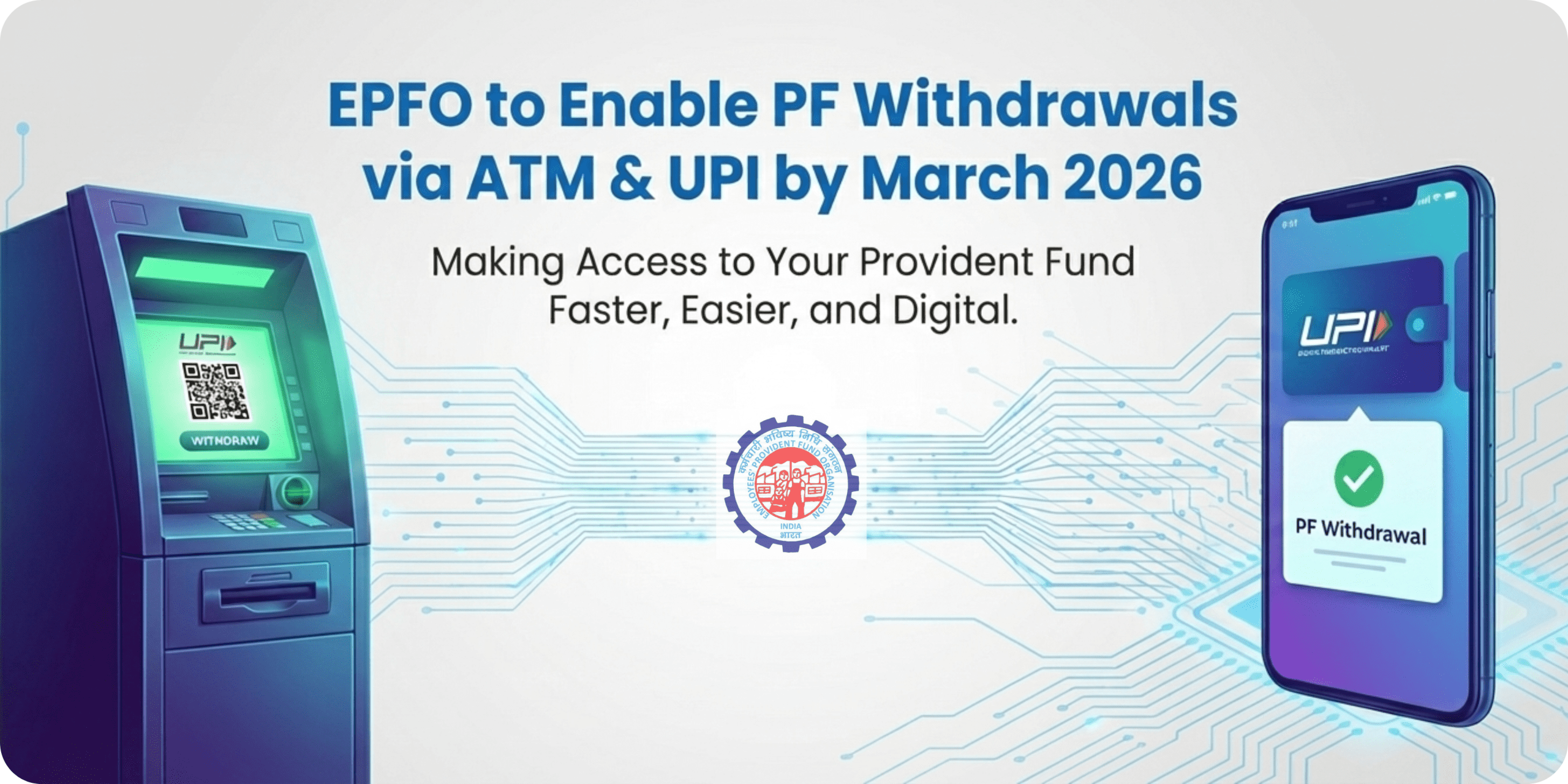
The Employees’ Provident Fund Organisation (EPFO) is set to roll out one of its most employee-centric reforms yet. As announced by the Union Labour Minister, EPFO members will soon be able to withdraw Provident Fund (PF) money directly through ATMs and UPI platforms by March 2026.
This landmark move aims to simplify PF access, reduce dependency on lengthy claim processes, and align India’s social security systems with the country’s rapidly evolving digital payments ecosystem.
Under the upcoming reform, EPFO plans to integrate PF accounts with UPI and ATM-based withdrawal systems, making fund access faster and more convenient for millions of salaried employees.
PF Withdrawal via ATM
Members may use dedicated EPFO-linked ATM cards to withdraw eligible PF amounts instantly, similar to bank withdrawals.
UPI-Based PF Access
PF balances and partial withdrawals could be enabled via UPI apps, reducing the need for manual claims and paperwork.
Faster Claim Settlement
The current waiting period of days or weeks may reduce significantly, improving liquidity for employees during emergencies.
Fully Digital Process
Aadhaar-linked authentication and backend digitisation will support secure, paperless withdrawals.
Enhanced Transparency
Real-time balance visibility and transaction tracking will improve trust and clarity for EPFO members.
India’s workforce is increasingly mobile, digital-first, and dependent on instant access to funds. The existing PF withdrawal process, while improved in recent years, still involves approvals, validations, and processing delays.
This reform supports the government’s broader objectives of:
Strengthening Digital India
Improving ease of living for employees
Modernising social security infrastructure
Reducing administrative bottlenecks at EPFO offices
For employees across sectors, this reform brings tangible benefits:
Immediate access to emergency funds
Less dependency on employers for claim processing
Reduced paperwork and follow-ups
Improved confidence in long-term PF savings
This is particularly beneficial for contract workers, gig workers, and employees in high-attrition industries.
While the reform simplifies employee access, it also places greater importance on accurate compliance and data management.
Correct UAN–Aadhaar–bank account linking
Timely and accurate monthly PF filings
Clean employee master data
Consistent wage and contribution reporting
Any mismatch in records could directly affect an employee’s ability to withdraw funds instantly.
With real-time withdrawals becoming possible, businesses will need stronger controls over:
Payroll accuracy
PF contribution calculations
Exit settlements
Digital compliance documentation
Errors that were earlier noticed only during claims may now surface immediately, increasing compliance sensitivity.
At Wisecor, we already support organisations with digitally driven payroll, PF compliance, and statutory reporting, which becomes even more critical under this new EPFO framework.
Our aligned capabilities include:
End-to-end PF & payroll management
Aadhaar and UAN-linked compliance checks
Digital documentation and audit-ready records
Employee lifecycle compliance support
Ongoing regulatory updates and advisory
This ensures businesses remain compliant while employees enjoy seamless PF access.
EPFO is expected to conduct pilot implementations, system integrations, and regulatory notifications ahead of the March 2026 rollout. Detailed operational guidelines will follow.
Organisations that strengthen payroll accuracy and compliance readiness now will be best positioned to adapt smoothly.
The move to enable PF withdrawals via ATM and UPI marks a significant leap in India’s labour and social security reforms. It reflects a shift toward employee empowerment, speed, and digital-first governance.
For businesses, this is a reminder that strong payroll compliance is no longer optional — it directly impacts employee experience.
Wisecor continues to help organisations stay future-ready as India’s compliance landscape evolves.
Subscribe to our newsletter and stay updated.