- Follow On:
- business@wisecor.in
- +918655715397
- Thane west, Maharashtra - 400604
In today’s fast-moving digital economy, businesses can no longer rely on spreadsheets or manual logs to manage valuable assets. Whether it’s IT assets, physical assets, vehicles, or inventory, visibility and control are critical. This is where an asset tracking solution becomes a strategic necessity rather than a luxury.
From GPS tracking and RFID tracking to asset tracking software powered by data analytics and IoT (Internet of Things), modern asset tracking systems help organizations reduce losses, improve efficiency, and make smarter decisions in real time.
But what exactly is asset tracking, and why are so many companies investing in it?
An asset tracking solution is a combination of hardware, software, and location services used to monitor, manage, and optimize assets throughout their lifecycle. These assets may include:
Using tools such as QR codes, barcode scanners, GPS trackers, and RFID tracking, businesses can track the real-time location, usage, condition, and status of their assets through a centralized asset tracking system.
The modern business environment demands speed, accuracy, and accountability. Without proper asset management, organizations face issues such as misplaced equipment, compliance risks, operational delays, and rising costs.
An effective asset tracking software helps businesses:
For enterprises managing multiple locations or large fleets, location tracking and GPS tracking ensure visibility across operations—anytime, anywhere.
An asset tracking system typically works in three layers:
Assets are tagged using QR codes, RFID tracking, or GPS-enabled devices such as a vehicle GPS tracker, car tracker, or location tracker.
Data is captured through barcode scanners, GPS devices, or IoT sensors and transmitted to the cloud using cloud solutions.
The collected data is processed by asset tracking software, enabling reporting, alerts, lifecycle tracking, and integration with enterprise asset management systems.
This end-to-end visibility allows businesses to track assets from acquisition to disposal—also known as asset lifecycle management.
Understanding user intent is key to ranking on Google. People searching for asset tracking solutions usually fall into these categories:
Their core intent is problem-solving—they want clarity, control, and cost efficiency.
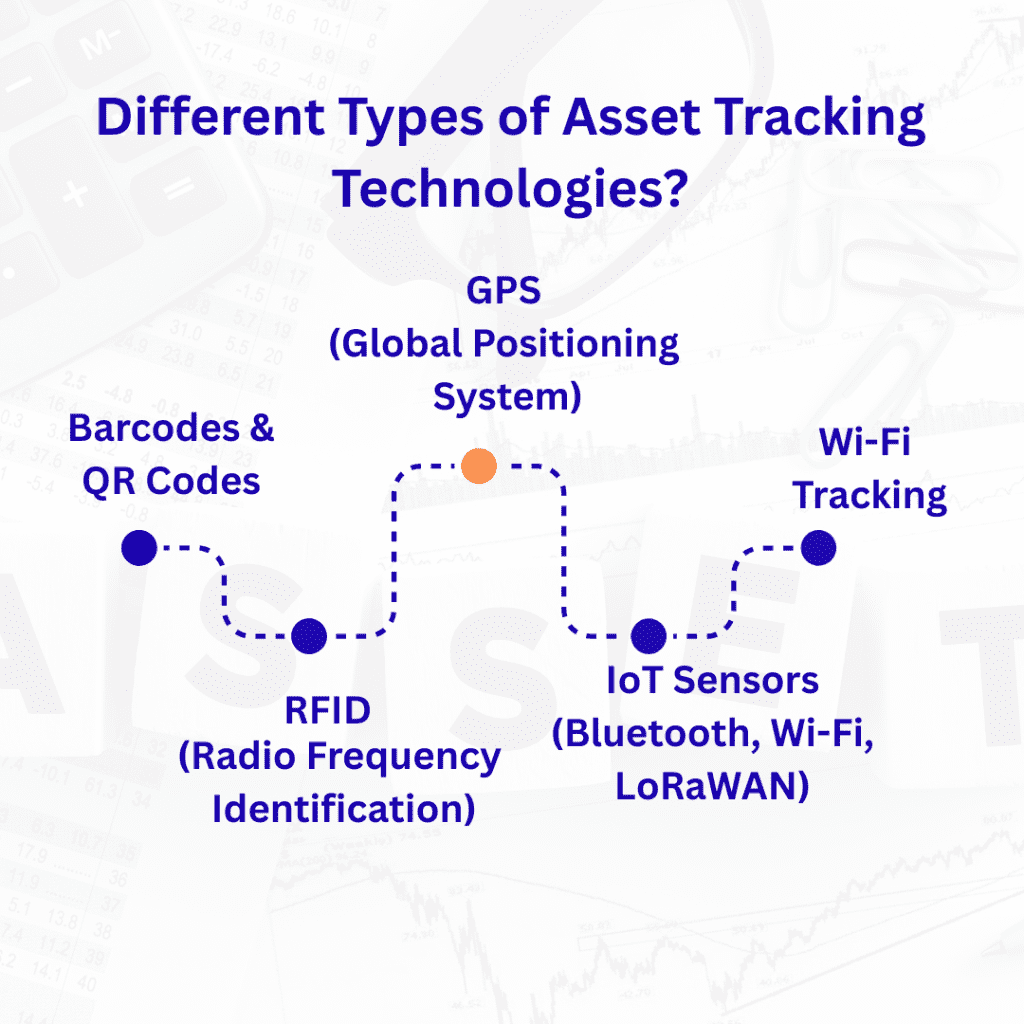
Choosing the right asset tracking solution starts with understanding the technologies behind it. Different businesses require different tracking methods depending on asset value, mobility, and operational complexity. Below are the most widely used asset tracking technologies today.
How It Works:
A unique barcode or QR code is printed on an asset label. The code is scanned manually using a barcode scanner or smartphone to update the asset’s location, status, or usage within an asset tracking system.
Best For:
Low-cost asset tracking
Quick inventory checks
Managing fixed assets and IT assets
Small or static items within offices, hospitals, and warehouses
How It Works:
RFID tracking uses tags embedded with microchips and antennas that communicate wirelessly with RFID readers.
Passive RFID tags activate when they receive radio waves from a reader
Active RFID tags use internal batteries for longer-range tracking
Best For:
Automated inventory control
High-volume asset environments
Tracking assets through checkpoints without line-of-sight
Manufacturing, warehousing, and logistics operations
How It Works:
GPS tracking devices use satellite signals to determine the precise location of assets. Location data is transmitted via cellular or internet networks and displayed in real time through asset tracking software.
Best For:
Fleet tracking and fleet management
Vehicles, heavy machinery, and shipping containers
Long-distance and outdoor asset tracking
Use cases like vehicle GPS tracker, car tracker, and mobile asset monitoring
How It Works:
IoT (Internet of Things) sensors and beacons collect and transmit asset data in real time.
Bluetooth Low Energy (BLE) beacons work over short ranges
Wi-Fi-based sensors use network connectivity
LoRaWAN supports long-range, low-power tracking
These sensors can also monitor conditions like temperature, humidity, or movement.
Best For:
Real-time asset visibility
Condition and maintenance management
Asset lifecycle management
Short- to long-range tracking across indoor and outdoor environments
How It Works:
Wi-Fi tracking uses existing wireless access points to triangulate an asset’s location based on signal strength. Assets are identified using Wi-Fi-enabled tags or devices connected to the network.
Best For:
Indoor asset tracking
Enterprises with existing Wi-Fi infrastructure
Hospitals, offices, campuses, and retail environments
Cost-effective enterprise asset management
At the core of every tracking system is asset tracking software. This centralized platform integrates data from GPS, RFID, QR codes, and IoT devices to deliver actionable insights.
Key features include:
With advanced data analytics, organizations can identify inefficiencies, optimize asset usage, and plan future investments more effectively.
Investing in a modern asset tracking solution delivers measurable benefits across operations, finance, and compliance. Businesses that adopt advanced asset tracking systems gain greater control, transparency, and efficiency throughout the organization.
One of the primary reasons companies adopt asset management technology is cost optimization. Without proper tracking, assets are often underutilized, misplaced, or duplicated.
With asset tracking software, businesses can:
For organizations using fleet tracking or GPS tracking, real-time visibility helps reduce fuel expenses, prevent misuse, and improve route planning.
Poor inventory control leads to stock shortages, overstocking, and revenue loss. An integrated asset tracking system paired with inventory management software provides accurate, real-time asset and inventory data.
Key improvements include:
This is especially valuable for warehouses, manufacturing units, and retail businesses managing high-volume physical assets.
Unplanned downtime can be costly. Maintenance management becomes more proactive when supported by asset tracking technology.
By monitoring asset usage and performance, businesses can:
IoT-enabled asset tracking solutions provide alerts when assets require servicing, ensuring minimal disruption and better productivity.
Regulatory compliance and asset security are critical, especially for enterprises managing sensitive or high-value assets.
An effective enterprise asset management system ensures:
With real-time monitoring and automated reporting, businesses can maintain strong security and compliance standards without increasing administrative workload.
Asset lifecycle management allows organizations to track assets from procurement to disposal. This lifecycle visibility helps businesses plan capital expenditure more effectively.
Benefits include:
Using cloud solutions, asset data remains accessible across departments and locations, enabling smarter enterprise-level decisions.
Asset tracking solutions are ideal for:
Regardless of industry, businesses gain increased efficiency, reduced risk, and improved accountability.
How to Choose the Right Asset Tracking Solution for Your Business?
Selecting the right asset tracking solution depends on your industry, asset type, and operational goals. Not every business needs the same tracking technology, so aligning the system with your real-world requirements is essential.
Before choosing an asset tracking system, consider:
For example, logistics companies benefit most from GPS tracking and fleet tracking, while warehouses and manufacturers often prefer RFID tracking or inventory management software.
A reliable asset tracking software should offer more than just location visibility. It should act as a central intelligence platform for asset decision-making.
Key features to look for include:
For enterprises, a robust enterprise asset management platform ensures centralized control across multiple locations and departments.
How Is Asset Tracking Evolving with IoT and Cloud Technology?
The future of asset tracking is being shaped by IoT (Internet of Things) and cloud-based platforms. Smart sensors now collect continuous data on asset performance, environment, and usage.
Future-ready asset tracking solutions will:
Cloud-powered systems also make it easier to scale operations without investing heavily in infrastructure.
While asset tracking delivers significant benefits, businesses may face challenges during implementation, such as:
These challenges can be minimized by choosing a scalable solution, training employees, and partnering with an experienced asset management provider.
Organizations that should prioritize asset tracking include:
Whether you manage a vehicle GPS tracker, a warehouse full of inventory, or enterprise-level digital infrastructure, asset tracking provides measurable ROI.
An asset tracking solution is a system that helps businesses monitor, manage, and optimize assets using technologies such as GPS tracking, RFID tracking, QR codes, and asset tracking software. It provides real-time visibility into asset location, usage, and lifecycle.
Asset tracking software collects data from tracking devices like GPS trackers, RFID tags, or barcode scanners and displays it on a centralized dashboard. Using cloud solutions and data analytics, the software helps businesses track assets, automate workflows, and generate reports.
GPS tracking is ideal for mobile assets such as vehicles and fleets, offering real-time location updates. RFID tracking works best for indoor or high-volume environments like warehouses, enabling fast scanning and accurate inventory control without line-of-sight requirements.
Asset tracking systems are beneficial for:
Yes. An effective asset management system reduces asset loss, prevents duplicate purchases, improves asset utilization, and optimizes maintenance schedules—resulting in significant cost savings over time.
By integrating RFID tracking, barcode scanners, and inventory management software, businesses gain real-time stock visibility, reduce manual errors, improve forecasting, and maintain accurate inventory records.
IoT (Internet of Things) enables smart sensors to collect real-time data on asset location, condition, and usage. When combined with asset lifecycle management and cloud-based platforms, IoT enhances predictive maintenance and decision-making
Yes. Modern enterprise asset management systems are designed with strong security and compliance features, including access control, audit trails, and encrypted cloud storage to meet regulatory standards.
Implementation timelines vary depending on asset volume and technology used. Basic QR or barcode-based systems can be deployed quickly, while GPS and IoT-based asset tracking solutions may take a few weeks for full integration.
Choose a solution based on asset type, tracking needs, scalability, integration capabilities, and reporting requirements. Businesses with mobile assets benefit from GPS tracking, while warehouses and enterprises often prefer RFID tracking or cloud-based asset tracking software.
An asset tracking solution is no longer just an operational tool it is a strategic business investment. By combining GPS tracking, RFID tracking, asset tracking software, and data analytics, businesses gain complete visibility and control over their assets.
From improved productivity and reduced costs to stronger compliance and smarter planning, asset tracking empowers organizations to operate with confidence in a competitive environment.
As businesses continue to digitize operations, investing in a scalable, cloud-enabled asset tracking system is the key to long-term success.
Subscribe to our newsletter and stay updated.