- Follow On:
- [email protected]
- +918655715397
- Thane west, Maharashtra - 400604
Filing an Income Tax Return (ITR) is no longer just a legal obligation it is an essential part of responsible financial planning. Whether you’re a salaried employee, freelancer, business owner, or investor, submitting your ITR on time helps you stay compliant with tax laws, claim refunds, and maintain a strong financial record.
For the Assessment Year (AY) 2026–27, taxpayers filing returns for Financial Year (FY) 2025–26 should be aware of the latest ITR forms, due dates, document requirements, and recent changes introduced by the Income Tax Department. Filing your return accurately and before the deadline can help you avoid penalties, interest charges, and unnecessary scrutiny.
In this complete guide, you’ll learn how to file Income Tax Return in 2026, who should file an ITR, the documents required, the correct ITR forms, and a step-by-step filing process.
An Income Tax Return (ITR) is an official form submitted to the Income Tax Department that reports your income, taxes paid, deductions claimed, and tax liability for a financial year.
When you file your ITR, you declare income earned from various sources, including:
Apart from paying taxes, filing an ITR also helps taxpayers claim refunds, carry forward eligible losses, and maintain financial transparency.
Many people believe only high-income earners need to file tax returns. In reality, several categories of taxpayers should file an ITR even if their taxable income is below the exemption limit.
Generally, an ITR should be filed by:
Filing your return also creates financial proof that is often required while applying for visas, home loans, education loans, and business financing.
Collecting the necessary documents beforehand makes the filing process much easier and reduces the chances of mistakes.
Commonly required documents include:
Before submitting your return, always reconcile your income with AIS and Form 26AS to avoid mismatches that could trigger notices.
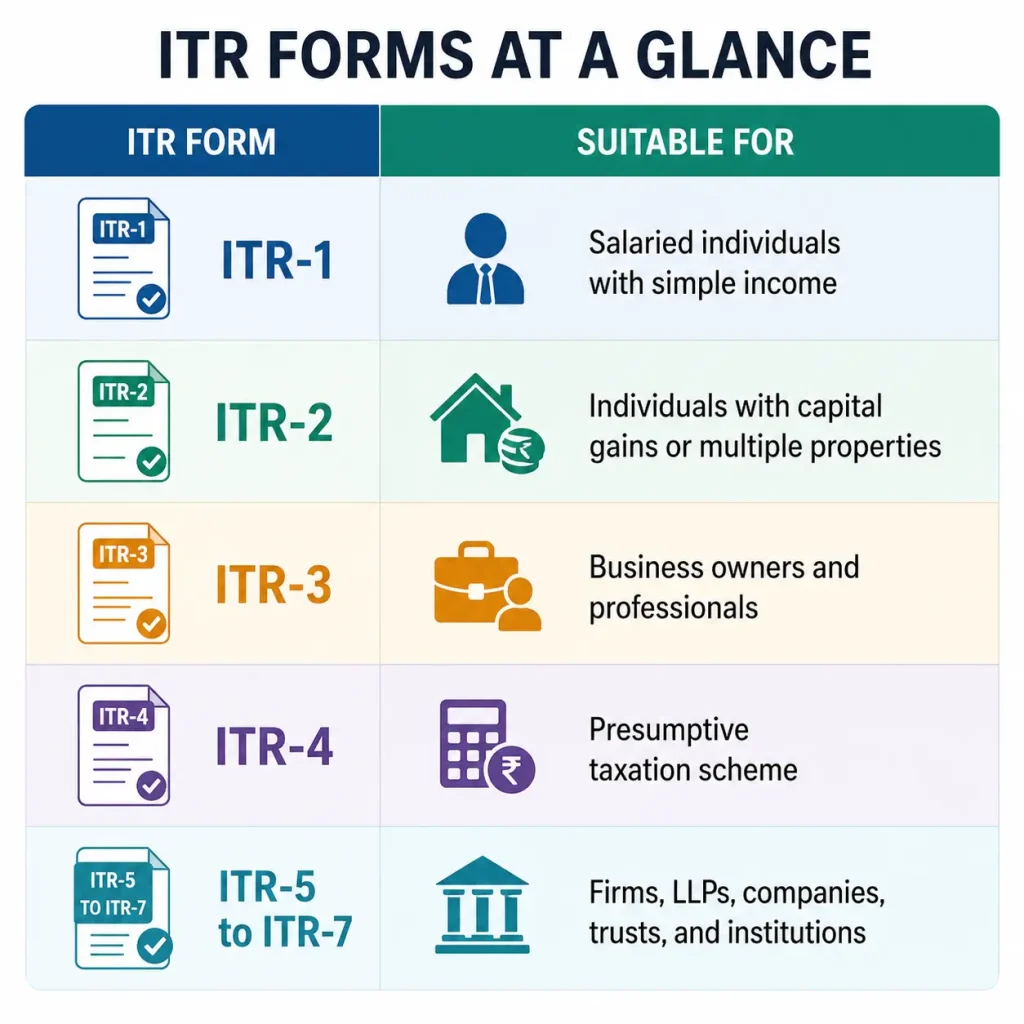
Choosing the correct ITR form is one of the most important steps in the filing process. Filing under the wrong form can lead to delays or defects in your return.
Always verify your eligibility before selecting an ITR form.
 How to File Income Tax Return Online in 2026?
The Income Tax Department has made online filing much simpler through its e-filing portal.
Visit the Income Tax e-Filing portal and log in using your PAN (User ID) and password.
Choose AY 2026–27, which corresponds to income earned during FY 2025–26.
Select the ITR form applicable to your income sources and taxpayer category.
Review the pre-filled information carefully before proceeding.
Check and confirm:
Also verify TDS deducted and taxes already paid.
Enter deductions under applicable sections such as:
Correct deduction claims help reduce your overall tax liability.
The portal automatically calculates:
Review all figures before submitting the return.
After filing, complete e-verification using one of the available methods such as Aadhaar OTP, net banking, or other approved verification options.
Your return is considered complete only after successful verification.
Every financial year, the Income Tax Department introduces updates to simplify tax filing and improve compliance. Before filing your return for AY 2026–27, it’s important to review the latest notifications, updated ITR forms, and revised reporting requirements.
Some of the key changes taxpayers should check include:
Reviewing these updates before filing helps reduce errors and ensures your return is processed smoothly.
One of the most common questions taxpayers ask is whether they can file an Income Tax Return after the due date.
The answer is yes, but there may be consequences.
Missing the filing deadline can lead to:
Filing your return before the due date is always the safest option. It helps avoid unnecessary penalties and ensures faster processing of refunds.
Example:
If an individual has excess TDS deducted from their salary but files the return late, the refund process may take longer than expected.
Many taxpayers make small mistakes while filing their Income Tax Return. Even minor errors can delay processing or lead to notices from the Income Tax Department.
Here are some common mistakes to avoid.
Using an incorrect ITR form may result in your return being treated as defective. Always select the form that matches your income sources and taxpayer category.
Some taxpayers report only salary income and forget to include:
Always disclose every applicable income source to ensure accurate tax filing.
Before submitting your return, compare your income details with:
Any mismatch between these records and your ITR may lead to additional verification or notices.
Only claim deductions that are supported by valid documents.
Incorrect deduction claims can increase scrutiny and delay the processing of your return.
Many taxpayers believe filing the return is the final step.
However, an ITR is considered complete only after successful e-verification within the prescribed timeline.
If you are eligible for a refund, accurate filing can significantly improve processing speed.
Here are a few best practices:
These simple steps help reduce processing delays and improve refund timelines.
Rahul works for a private company and receives Form 16 from his employer. Before filing his return, he verifies his salary details with AIS and Form 26AS, claims eligible deductions under Sections 80C and 80D, and completes e-verification using Aadhaar OTP. His refund is processed without any issues.
Priya earns income from freelance consulting and receives payments from multiple clients. She maintains records of her invoices, bank statements, and expenses throughout the year. By accurately reporting her professional income and claiming eligible deductions, she files her ITR smoothly and remains tax compliant.
A manufacturing business owner files an ITR after reconciling financial statements, GST records, and tax payments. Proper documentation helps avoid reporting errors and supports timely return processing.
Individuals, businesses, professionals, freelancers, companies, and taxpayers meeting the prescribed conditions should file an ITR for AY 2026–27.
Common documents include PAN, Aadhaar, Form 16, AIS, Form 26AS, salary slips, bank statements, investment proofs, and income records.
Yes, delayed filing may be allowed under applicable rules, but it can attract late fees, interest, and other consequences.
The correct form depends on your income sources, taxpayer category, and eligibility. Always choose the form applicable to your financial profile.
Yes. Your Income Tax Return is considered complete only after successful e-verification within the prescribed time limit.
Refund timelines vary depending on successful verification, accuracy of the return, and processing by the Income Tax Department.
Choosing the wrong ITR form, reporting incomplete income, claiming incorrect deductions, ignoring AIS reconciliation, and forgetting e-verification are among the most common mistakes.
Filing an ITR helps maintain financial records, claim tax refunds, carry forward eligible losses, and support applications for loans, visas, and other financial services.
Filing an Income Tax Return (ITR) in 2026 is an important step toward maintaining tax compliance and financial transparency. Whether you are a salaried employee, freelancer, entrepreneur, or business owner, understanding the correct filing process helps you avoid penalties, claim eligible deductions, and receive refunds without unnecessary delays.
Before submitting your return, ensure you choose the correct ITR form, verify your income with AIS and Form 26AS, claim only eligible deductions, and complete e-verification promptly. Taking these steps can make the filing process smoother and reduce the likelihood of errors or notices.
By filing your ITR accurately and on time, you not only meet your legal obligations but also strengthen your financial profile for future opportunities such as loans, investments, and international travel.
Subscribe to our newsletter and stay updated.