- Follow On:
- [email protected]
- +918655715397
- Thane west, Maharashtra - 400604

Financial decisions shape the direction of every growing company. While revenue and operations may expand, growth becomes unpredictable without structured financial planning and analysis. Long term sustainability depends on clear financial visibility, disciplined budgeting and forecasting, and consistent performance tracking.
Financial planning and analysis goes beyond reviewing past numbers. It connects financial data with future strategy, helping businesses manage costs, allocate resources effectively, and evaluate results against goals. When organizations neglect business financial forecasting or delay financial performance planning, they often react to challenges instead of preparing for them. Strong financial planning and analysis builds the discipline needed for stable and sustainable growth.
Financial planning and analysis refers to a structured approach to managing an organization’s financial direction through budgeting and forecasting, financial modeling, and performance evaluation. It helps leadership translate business goals into measurable financial targets.
At its core, financial planning and analysis involves collecting financial data, analyzing trends, and creating forward looking projections. These projections are not guesses. They are built using financial modeling techniques that combine historical performance, market assumptions, and strategic objectives. The outcome is business financial forecasting that supports informed decision making.
For growing companies, financial planning and analysis for growing businesses becomes even more critical. As revenue streams diversify and operating costs increase, financial complexity rises. Structured analysis ensures that expansion is supported by realistic projections rather than optimistic assumptions.
Variance analysis is another key element. By comparing actual performance against budgets and forecasts, companies identify gaps early. This allows management to correct course before small issues turn into major financial setbacks. In this way, financial planning and analysis becomes an active management tool rather than a reporting exercise.
The importance of financial forecasting in business lies in reducing uncertainty. Markets shift, costs change, and competition evolves, making intuition alone unreliable for decision making.
Business financial forecasting provides clear projections of revenue, expenses, and cash flow through structured budgeting and forecasting. This visibility supports better capital allocation, hiring, and operational planning. It also strengthens accountability by enabling variance analysis against defined financial performance planning targets.
For expanding businesses, forecasting is essential to evaluate growth investments and ensure expansion plans remain financially sustainable.
Financial planning and analysis follows a structured process designed to connect financial data with strategic decision making. While the depth may vary across organizations, the core FP&A process typically includes the following steps:
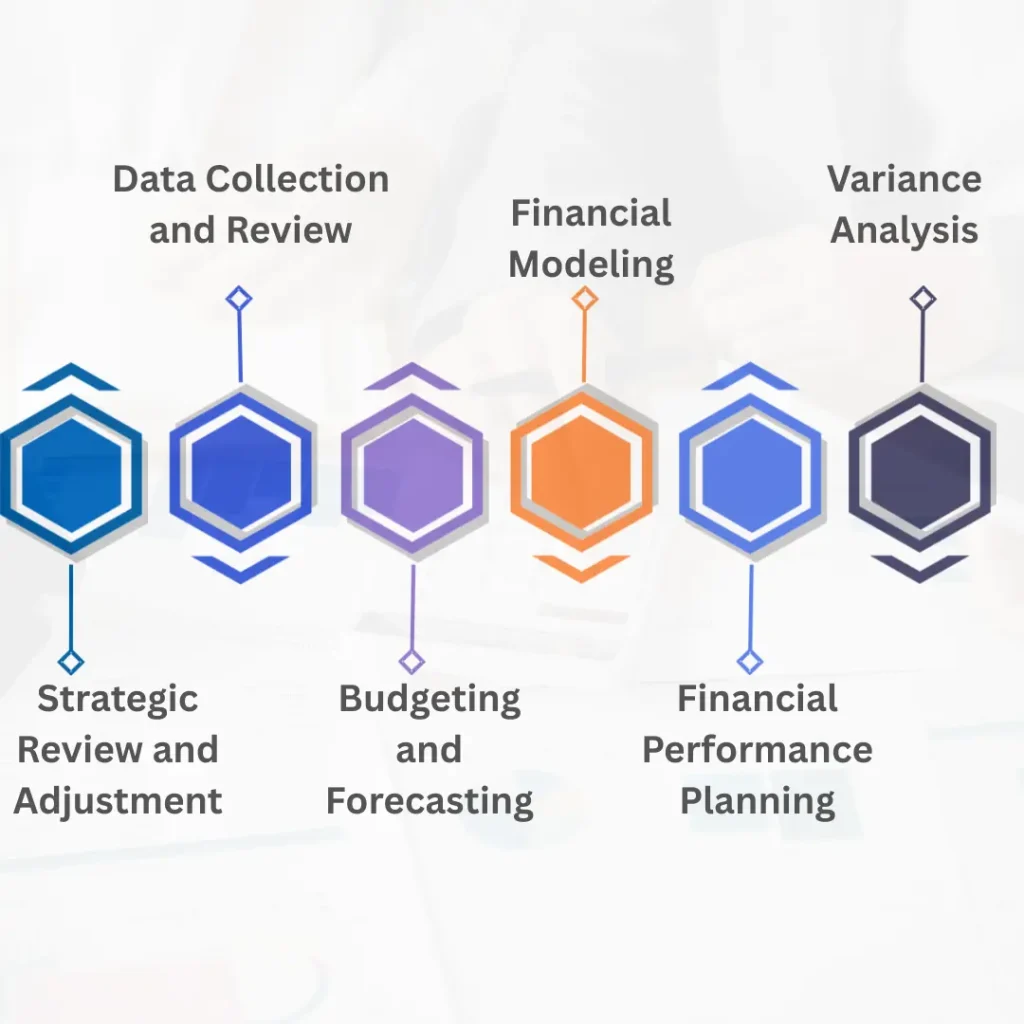
These steps ensure that financial planning and analysis remains a continuous cycle rather than a one time exercise, helping organizations stay aligned with their long term strategic financial planning objectives.
How FP&A supports business growth becomes clear when financial planning moves beyond cost control and becomes part of strategy. Growth requires investment in talent, infrastructure, technology, and marketing. Without clear financial planning and analysis, these investments may lack coordination.
FP&A services in many organizations function as a bridge between finance and operations. They provide data driven insights that help leadership evaluate expansion plans, pricing strategies, and cost structures. By integrating budgeting and forecasting with operational goals, businesses align financial capacity with strategic ambition.
Financial modeling allows companies to simulate different growth scenarios. Leadership can assess the financial impact of entering new markets, launching new services, or adjusting pricing models. This structured analysis reduces uncertainty and improves confidence in decision making.
For financial planning and analysis for growing businesses, the real value lies in proactive management. Instead of reacting to financial pressure, companies anticipate needs and prepare for them. Strategic financial planning becomes a continuous process rather than an annual event.
No financial plan is perfect. Market conditions change, customer behavior shifts, and internal costs fluctuate. This is why variance analysis plays a critical role within financial planning and analysis.
Variance analysis compares actual results with the figures established during budgeting and forecasting. The goal is not just to identify differences, but to understand why those differences occurred. For example, if revenue falls short of projections, the cause may be pricing strategy, demand shifts, or operational inefficiencies. Similarly, higher than expected costs may signal supply chain issues or internal overspending.
Effective variance analysis helps organizations:
For growing businesses, this process prevents minor deviations from becoming serious financial risks. Instead of waiting until year end to evaluate results, management can respond quickly and maintain financial stability.
As organizations expand, financial complexity increases. New departments, product lines, and markets introduce additional variables that must be managed carefully. Financial planning and analysis for growing businesses provides a framework for handling this complexity.
Growth often brings challenges such as uneven cash flow, unpredictable expenses, and pressure on margins. Without disciplined budgeting and forecasting, companies may struggle to balance growth with profitability.
Key priorities for growing businesses include:
When financial planning and analysis is integrated into leadership discussions, growth decisions become more sustainable. Companies gain visibility into resource allocation and can prioritize initiatives that deliver measurable value.
Financial planning and analysis provides structure in an environment where uncertainty is constant. Through disciplined budgeting and forecasting, detailed financial modeling, consistent variance analysis, and clear financial performance planning, organizations gain control over their financial direction.
The importance of financial forecasting in business becomes evident as companies grow. Expansion without planning increases risk. Growth supported by structured financial planning and analysis increases sustainability.
For growing businesses, the question is not whether financial planning and analysis is necessary, but how effectively it is integrated into decision making. When strategic financial planning is supported by accurate data and forward looking analysis, businesses are better equipped to manage risk, allocate resources wisely, and pursue long term growth with confidence.
What is financial planning and analysis?
Financial planning and analysis is a structured process that includes budgeting and forecasting, financial modeling, and variance analysis to support strategic decision making.
Why is financial forecasting important in business?
It reduces uncertainty by projecting revenue, expenses, and cash flow, helping businesses plan growth and manage risk effectively.
How does FP&A support business growth?
FP&A supports business growth by aligning financial performance planning with strategy, improving resource allocation, and guiding expansion decisions through data driven insights.
What is included in the FP&A process?
The FP&A process typically includes data analysis, budgeting and forecasting, financial modeling, variance analysis, and ongoing strategic financial planning.
Subscribe to our newsletter and stay updated.