- Follow On:
- [email protected]
- +918655715397
- Thane west, Maharashtra - 400604
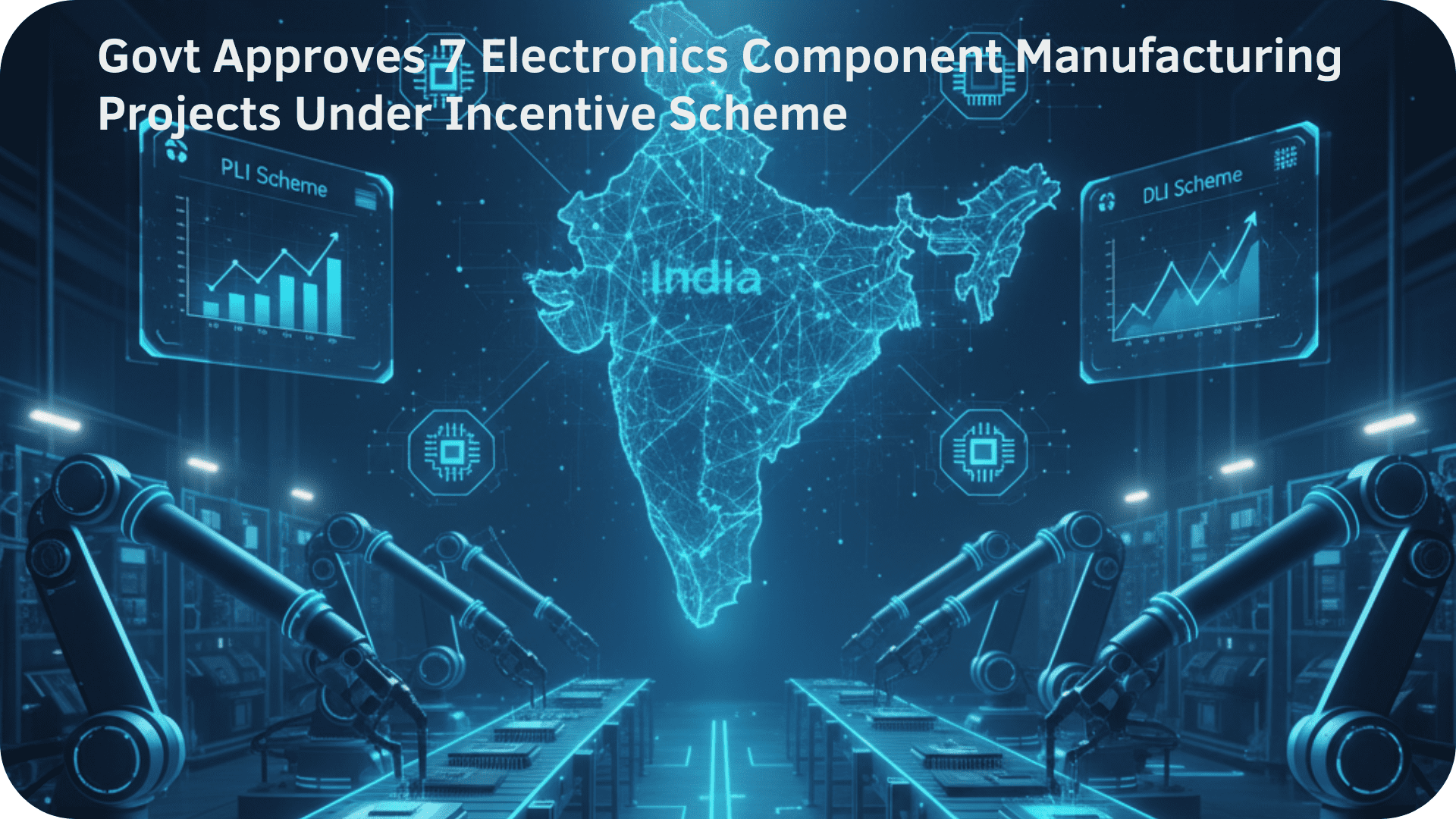
The Government of India has approved seven new electronics component manufacturing projects under the Production Linked Incentive (PLI) and Design Linked Incentive (DLI) schemes. This strategic move reinforces India’s commitment to becoming a global electronics manufacturing hub and reducing dependence on imported components critical to the country’s technology and industrial ecosystem.
These projects form part of India’s broader vision of “Atmanirbhar Bharat” (self-reliant India) and Digital India, aiming to strengthen the domestic supply chain for core electronic components such as semiconductors, sensors, resistors, capacitors, and chip packaging units.
The seven approved projects will be set up across key industrial regions in Tamil Nadu, Karnataka, Maharashtra, and Gujarat, bringing together domestic enterprises and global technology leaders.
The projects will focus on:
Semiconductors and chip packaging units: To enhance India’s position in global semiconductor manufacturing and ensure stable supply for electronics, EVs, and telecom sectors.
Passive components: Including resistors, capacitors, and inductors, essential for consumer electronics, automotive, and energy devices.
Sensors and precision modules: Targeted toward advanced applications in automotive electronics, 5G telecom infrastructure, and smart devices.
Together, these initiatives represent an investment exceeding ₹4,000 crore and are expected to create over 25,000 direct and indirect jobs. The projects also emphasize sustainable manufacturing through clean energy integration and waste recycling.
The Indian government’s objective is clear to build a resilient and globally competitive electronics ecosystem. By supporting domestic manufacturing of key components, India aims to reduce its import dependency, especially on countries like China and Taiwan, and enhance its export competitiveness.
These projects are expected to:
Boost local value addition and import substitution, ensuring greater self-reliance.
Enhance component availability for India’s booming smartphone, EV, and IoT industries.
Attract global partnerships in high-end manufacturing and technology transfer.
Strengthen the MSME ecosystem, enabling smaller manufacturers to become part of global value chains.
Promote R&D and design-led innovation, a key focus under the DLI scheme.
Industry experts project that these initiatives will play a significant role in achieving India’s $120 billion electronics export target by FY2026.
By developing a strong base for electronic components, India will not only reduce its trade deficit but also stabilize supply chains critical to sectors like automotive, healthcare, and telecommunications.
Moreover, the combination of PLI and DLI incentives encourages technology innovation, skills development, and sustainable manufacturing practices paving the way for a more inclusive and future-ready industrial economy.
The approval of these seven electronics component manufacturing projects marks another milestone in India’s “Make in India” journey.
By merging global expertise with indigenous innovation, the government is fostering a new wave of industrial growth, employment opportunities, and technological advancement.
This move not only strengthens India’s electronics backbone but also propels the nation toward becoming a self-reliant, innovation-driven electronics powerhouse ready to lead in the digital and manufacturing revolution.
Subscribe to our newsletter and stay updated.